
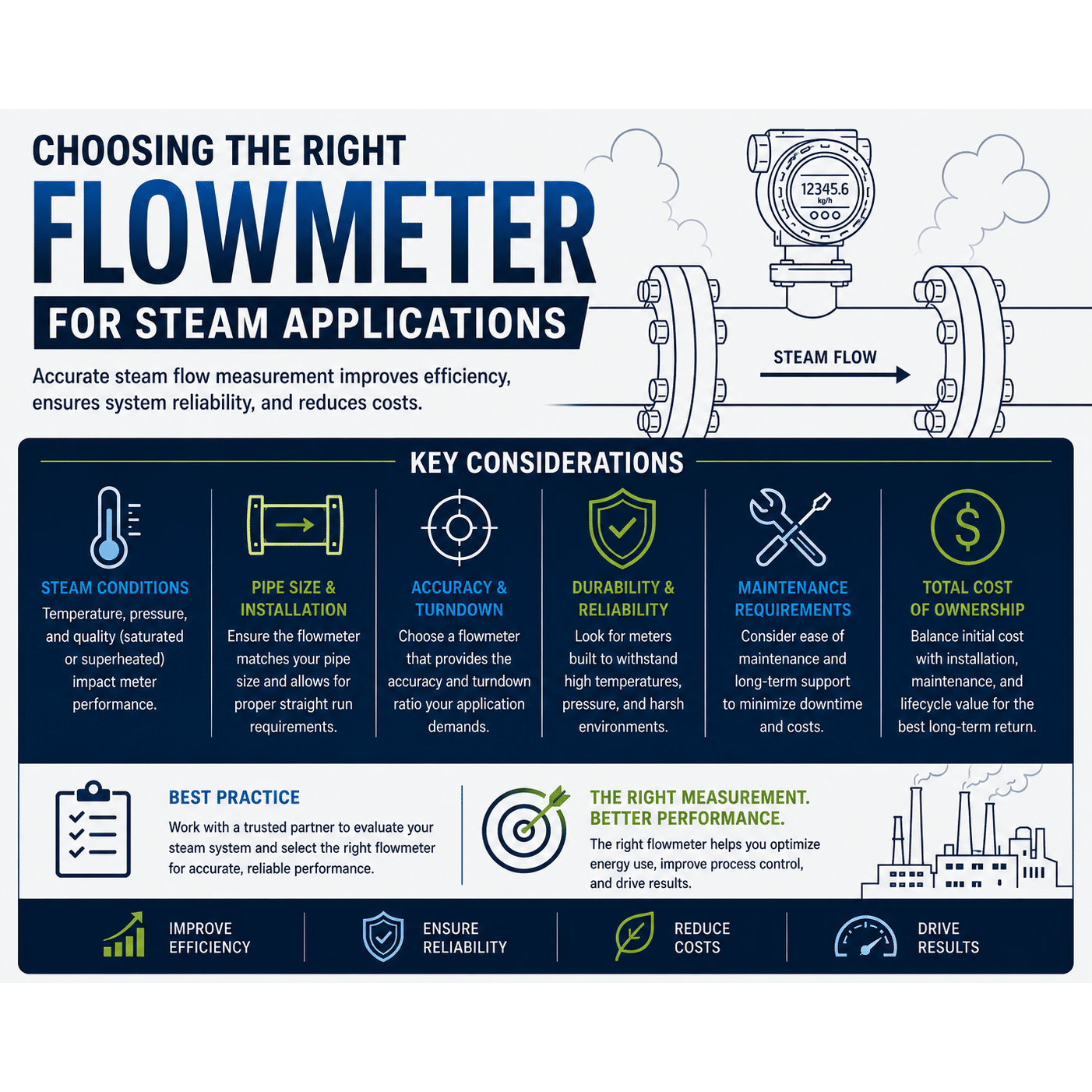
Accurately measuring steam flow is essential for improving energy efficiency, optimizing process performance, and controlling operating costs in industrial facilities. Whether steam is used for heating, sterilization, power generation, or manufacturing processes, selecting the right flowmeter can significantly impact measurement accuracy and system reliability.
However, steam presents unique challenges that make flow measurement more complex than measuring liquids or gases. High temperatures, pressure variations, condensate formation, and changing flow rates all influence meter performance.
This guide explores the key considerations when selecting a flowmeter for steam applications and compares the most common technologies used in today’s industrial facilities.
Why Steam Flow Measurement Matters
Steam is one of the most widely used utilities in industry, but it is also one of the most expensive forms of energy to generate and distribute.
Accurate steam measurement helps facilities:
- Monitor energy consumption
- Allocate utility costs between departments
- Verify boiler performance
- Detect leaks and system inefficiencies
- Optimize process control
- Support sustainability and energy management initiatives
- Verify energy savings projects
Without reliable flow data, facilities often struggle to understand where steam is being used and where opportunities for improvement exist.
Understanding the Challenges of Measuring Steam
Steam differs significantly from water or compressed air.
Several factors make flow measurement more demanding:
High Temperatures
Steam systems routinely operate at temperatures exceeding 250°F (120°C), while some processes operate well above 500°F (260°C).
Flowmeters must be designed to withstand these conditions without affecting measurement accuracy.
Pressure Variations
Changes in steam pressure alter density, which can affect certain measurement technologies.
Condensate Formation
Wet steam or condensate can influence flowmeter performance and may cause measurement errors if not properly addressed.
Wide Flow Ranges
Many steam systems operate under varying loads throughout the day, requiring flowmeters with a broad turndown ratio.
Installation Constraints
Older facilities often have limited straight pipe runs, making meter selection and placement more challenging.
Types of Steam Used in Industrial Applications
Before selecting a flowmeter, it is important to understand the type of steam being measured.
Saturated Steam
Saturated steam exists at the temperature corresponding to its pressure.
It is commonly used for:
- Space heating
- Process heating
- Sterilization
- Food processing
Superheated Steam
Superheated steam is heated beyond its saturation point.
Applications include:
- Turbines
- Power generation
- High-temperature industrial processes
Some flowmeter technologies perform differently depending on whether the steam is saturated or superheated.
Common Flowmeter Technologies for Steam
Several technologies are commonly used for steam flow measurement.
Each offers distinct advantages and limitations.
Vortex Flowmeters
Vortex flowmeters are among the most popular choices for steam applications.
How They Work
A bluff body placed in the flow stream creates alternating vortices. The frequency of these vortices is proportional to flow velocity.
Advantages
- Specifically suited for steam measurement
- Handles high temperatures and pressures
- No moving parts
- Low maintenance requirements
- Suitable for saturated and superheated steam
Limitations
- Requires adequate straight pipe runs
- Performance can decline at very low flow rates
- Sensitive to excessive vibration
Ideal Applications
- General industrial steam distribution
- Boiler monitoring
- Process steam measurement
- Energy management systems
For many facilities, vortex technology provides an excellent balance of performance, durability, and cost.
Differential Pressure (DP) Flowmeters
Differential pressure flow measurement has been used in steam systems for decades.
How They Work
A restriction device creates a pressure drop that can be correlated to flow rate.
Common primary elements include:
- Orifice plates
- Venturi tubes
- Flow nozzles
Advantages
- Proven technology
- Widely accepted in industrial applications
- Suitable for high temperatures and pressures
- Extensive industry experience
Limitations
- Permanent pressure loss
- Requires impulse lines and transmitters
- More complex installation
- Lower turndown ratios than some modern technologies
Ideal Applications
- Utility metering
- Power plants
- Legacy steam systems
- High-pressure steam networks
While reliable, DP systems often involve higher installation and maintenance requirements than newer technologies.
Coriolis Flowmeters
Coriolis meters directly measure mass flow and are considered among the most accurate flow technologies available.
How They Work
The meter measures the Coriolis effect produced as fluid moves through vibrating flow tubes.
Advantages
- Direct mass flow measurement
- Extremely high accuracy
- Minimal dependence on pressure and temperature compensation
- Suitable for custody transfer and critical measurements
Limitations
- Higher initial cost
- Larger sizes can become expensive
- Weight may require additional support
Ideal Applications
- High-value process applications
- Energy accounting
- Pharmaceutical manufacturing
- Chemical processing
Where maximum accuracy is required, Coriolis technology is often the preferred solution.
Multivariable Flowmeters
Multivariable meters combine flow, pressure, and temperature measurements within a single device.
Advantages
- Simplified installation
- Automatic steam density compensation
- Improved mass flow calculations
- Reduced instrumentation requirements
Limitations
- Higher cost than standard vortex meters
- More sophisticated configuration requirements
Ideal Applications
- Energy monitoring
- Boiler performance measurement
- Facilities seeking accurate mass flow data
Thermal Mass Flowmeters
Thermal mass flowmeters are widely used for gases but are less common for steam applications.
Advantages
- Direct mass flow measurement
- Excellent low-flow sensitivity
Limitations
- Not generally preferred for high-temperature steam systems
- Performance can be affected by changing steam conditions
Ideal Applications
Typically better suited for compressed air and industrial gas measurement than steam service.
Key Selection Factors
When choosing a steam flowmeter, several factors should be evaluated.
Accuracy Requirements
Consider how the flow data will be used.
Applications involving:
- Billing
- Energy accounting
- Process control
often require higher accuracy than general monitoring applications.
Steam Quality
Determine whether the system operates with:
- Dry saturated steam
- Wet steam
- Superheated steam
Some technologies are more tolerant of changing steam quality than others.
Flow Range
Review both minimum and maximum expected flow rates.
A flowmeter should maintain accuracy across the entire operating range.
Meters with larger turndown ratios provide greater flexibility.
Temperature and Pressure
Verify that the selected meter is rated for the maximum operating conditions.
Always include a safety margin for future system changes.
Pipe Size
Available technologies may vary based on line size.
For example:
- Small process lines may favor Coriolis meters.
- Larger utility mains often utilize vortex or DP technologies.
Maintenance Requirements
Some facilities prioritize low-maintenance solutions.
Technologies with no moving parts generally offer:
- Longer service life
- Reduced maintenance costs
- Improved reliability
Installation Constraints
Proper installation is critical for measurement accuracy.
Consider:
- Straight pipe run requirements
- Vibration levels
- Accessibility
- Available mounting locations
In retrofit applications, installation limitations may strongly influence meter selection.
Common Installation Mistakes
Even the best flowmeter can produce inaccurate results if installed improperly.
Common issues include:
Insufficient Straight Pipe
Disturbed flow profiles can reduce measurement accuracy.
Poor Condensate Management
Condensate accumulation can affect steam measurement performance.
Improper Sensor Orientation
Manufacturers provide specific installation guidelines that should always be followed.
Ignoring Pressure and Temperature Compensation
For certain technologies, compensation is essential for accurate mass flow calculations.
Which Flowmeter Is Best for Steam?
There is no single flowmeter that is ideal for every application.
As a general guideline:
|
Application |
Recommended Technology |
|
General steam monitoring |
Vortex |
|
Boiler efficiency measurement |
Multivariable Vortex |
|
Utility metering |
Differential Pressure |
|
High-accuracy mass flow |
Coriolis |
|
Energy management programs |
Vortex or Multivariable |
For most industrial steam systems, vortex flowmeters remain the most commonly selected solution due to their reliability, durability, and ability to handle a wide range of steam conditions.
Final Thoughts
Accurate steam flow measurement plays a critical role in improving energy efficiency, reducing operating costs, and optimizing industrial processes. Choosing the right flowmeter requires careful consideration of steam quality, pressure, temperature, flow range, installation conditions, and accuracy requirements.
While vortex flowmeters are often the preferred choice for general steam applications, technologies such as differential pressure, Coriolis, and multivariable flowmeters each offer advantages for specific operating environments.
By evaluating application requirements and selecting the appropriate technology, facilities can achieve reliable steam measurement, gain greater visibility into energy usage, and support long-term operational and sustainability goals.