
Uninterruptible Power Supply (UPS) systems play a critical role in protecting data centers, industrial facilities, healthcare environments, telecommunications networks, and commercial buildings from power interruptions. While much attention is given to UPS capacity, runtime, and maintenance, one of the most significant factors affecting UPS reliability is often overlooked: temperature.
Battery performance and lifespan are highly sensitive to temperature. Even modest deviations from recommended operating conditions can dramatically reduce battery life, decrease runtime, and increase the risk of unexpected failures during a power outage.
Understanding how temperature affects UPS batteries can help facility managers, IT professionals, and maintenance teams maximize system reliability while reducing replacement costs.
Why UPS Batteries Are Sensitive to Temperature
Most UPS systems use Valve-Regulated Lead-Acid (VRLA) batteries, although lithium-ion batteries are becoming increasingly common in modern installations. Regardless of chemistry, batteries rely on chemical reactions to store and deliver energy.
Temperature directly affects these reactions by influencing:
- Charge acceptance
- Discharge performance
- Internal resistance
- Capacity
- Aging rate
- Overall battery health
While batteries can operate across a wide range of temperatures, they perform best within a relatively narrow temperature window.
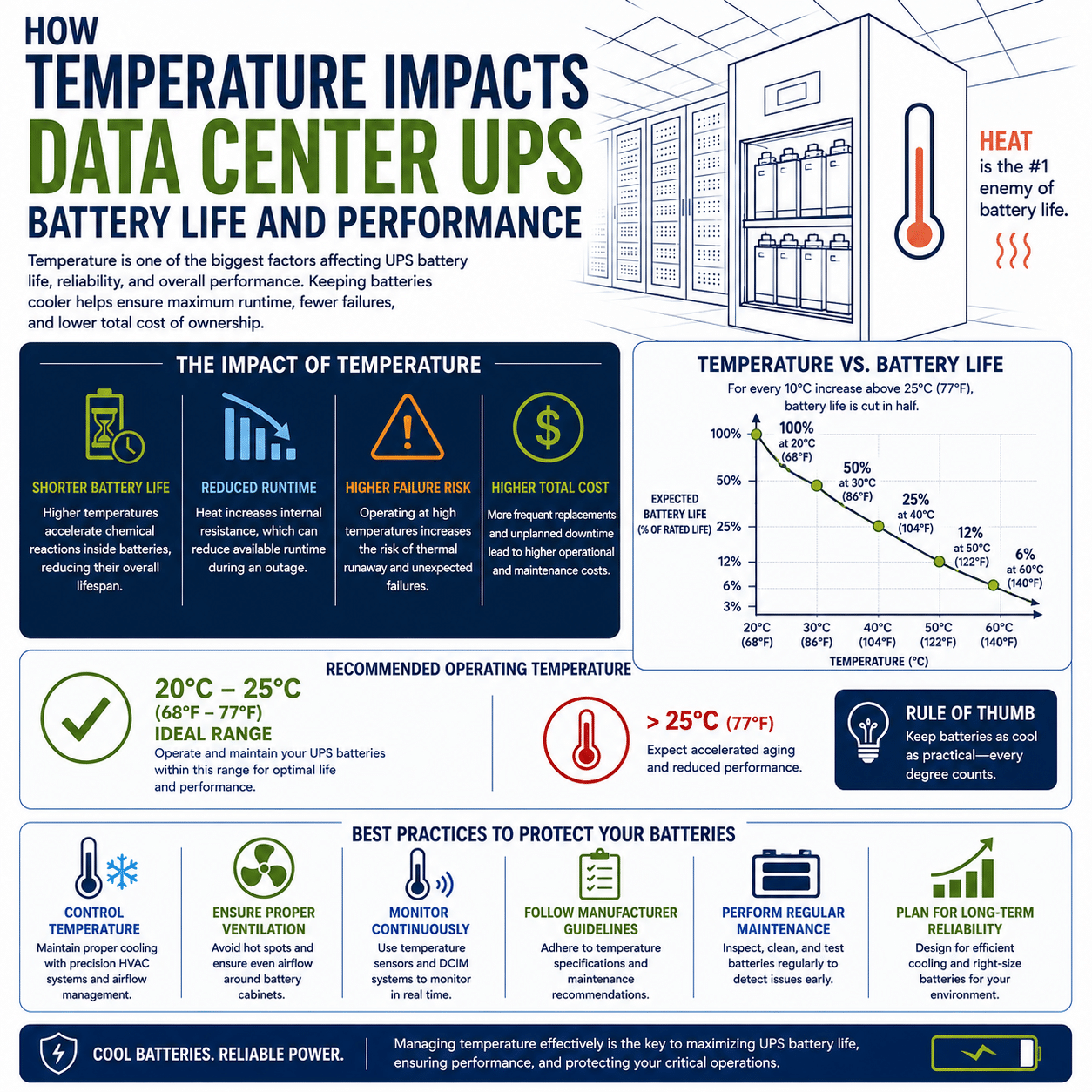
The Ideal Temperature for UPS Batteries
Most UPS battery manufacturers recommend maintaining an ambient temperature of approximately:
68°F to 77°F (20°C to 25°C)
This range is generally considered optimal for balancing:
- Battery lifespan
- Capacity
- Charging performance
- System reliability
Many battery life expectancy ratings are based on continuous operation at 77°F (25°C).
When temperatures consistently exceed this level, battery aging accelerates significantly.
The Impact of High Temperatures
Heat is often considered the single greatest threat to UPS battery longevity.
While elevated temperatures can temporarily improve battery capacity, they also accelerate chemical degradation.
Reduced Battery Life
One of the most widely cited industry guidelines states:
For every 15°F (8°C) to 18°F (10°C) increase above 77°F (25°C), battery life may be reduced by approximately 50%.
For example:
|
Average Temperature |
Expected Battery Life* |
|
77°F (25°C) |
100% |
|
86°F (30°C) |
~75% |
|
95°F (35°C) |
~50% |
|
104°F (40°C) |
~25% |
*Actual results vary by battery type and manufacturer.
A battery designed for a 10-year service life may last only 5 years—or less—if continuously exposed to elevated temperatures.
Increased Internal Corrosion
High temperatures accelerate corrosion of internal battery components, particularly:
- Positive plates
- Grid structures
- Internal connectors
Corrosion reduces battery capacity and increases the likelihood of premature failure.
Thermal Runaway Risk
In extreme cases, elevated temperatures can contribute to thermal runaway.
Thermal runaway occurs when:
- Temperature increases
- Internal current increases
- Additional heat is generated
- Temperature rises further
This cycle can rapidly escalate and potentially damage batteries or surrounding equipment.
Although modern UPS systems include protective measures, thermal runaway remains a concern in poorly controlled environments.
Reduced Reliability During Outages
A battery that has experienced prolonged exposure to heat may appear to function normally during routine operation but fail to deliver expected runtime during a power outage.
This hidden degradation often goes unnoticed until backup power is needed most.
The Impact of Low Temperatures
While heat shortens battery life, cold temperatures primarily affect battery performance.
Reduced Capacity
As temperatures decrease, chemical reactions inside the battery slow down.
This results in:
- Lower available capacity
- Reduced runtime
- Increased internal resistance
For example:
|
Temperature |
Approximate Available Capacity |
|
77°F (25°C) |
100% |
|
50°F (10°C) |
~80–90% |
|
32°F (0°C) |
~60–80% |
The battery may still be healthy, but it will deliver less usable energy.
Slower Recharge Rates
Cold batteries accept charge more slowly.
Following a discharge event, a UPS may require additional time to restore full backup capability.
Increased Voltage Drop
Low temperatures increase internal resistance, which can result in:
- Greater voltage sag under load
- Reduced runtime
- Lower system performance during discharge events
How Temperature Affects Different Battery Types
Not all UPS batteries respond to temperature in the same way.
VRLA Batteries
Valve-Regulated Lead-Acid batteries remain the most common UPS battery technology.
Characteristics include:
- Highly temperature-sensitive lifespan
- Moderate temperature operating range
- Relatively low upfront cost
- Widely available replacement options
Most temperature-related battery life concerns involve VRLA batteries.
Lithium-Ion Batteries
Lithium-ion UPS batteries generally offer:
- Longer service life
- Better high-temperature performance
- Improved cycle life
- Faster recharge rates
However, they are not immune to temperature effects.
Extreme temperatures can still impact:
- Capacity
- Charging performance
- Long-term reliability
Proper thermal management remains important.
Environmental Factors That Increase Battery Temperature
Even facilities with climate-controlled rooms may experience localized heating.
Common contributors include:
Poor Ventilation
Restricted airflow can trap heat around battery cabinets and UPS equipment.
Overcrowded Equipment Rooms
High equipment density can raise ambient temperatures significantly.
Direct Sunlight
Batteries installed near windows or exposed to solar gain may experience elevated temperatures.
HVAC Failures
Unexpected cooling system outages can rapidly create damaging conditions.
Hot Electrical Equipment
Transformers, drives, servers, and power distribution equipment can contribute to local heat buildup.
Monitoring Temperature Is Essential
Many UPS failures can be traced back to environmental issues that were not identified early.
Temperature monitoring provides valuable insight into battery health and operating conditions.
Recommended practices include:
- Continuous room temperature monitoring
- Battery cabinet temperature sensors
- Automated alarms for high-temperature conditions
- Trending historical temperature data
- Routine thermal inspections
Early detection allows corrective action before battery damage occurs.
Best Practices for Maximizing UPS Battery Life
Maintain Recommended Room Temperatures
Aim to keep battery environments between:
68°F and 77°F (20°C to 25°C)
whenever possible.
Ensure Adequate Airflow
Provide sufficient clearance around:
- UPS cabinets
- Battery racks
- Ventilation openings
Avoid blocking airflow paths.
Perform Regular Battery Testing
Routine inspections should include:
- Capacity testing
- Internal resistance measurements
- Visual inspections
- Temperature verification
Testing helps identify degradation before failures occur.
Monitor HVAC Performance
Backup power systems depend heavily on reliable cooling.
Ensure HVAC systems serving UPS rooms are:
- Properly maintained
- Adequately sized
- Monitored for failures
Consider Lithium-Ion Technology
For facilities with challenging environmental conditions or high reliability requirements, lithium-ion battery systems may offer longer service life and reduced maintenance demands.
Signs Temperature May Be Affecting Your UPS Batteries
Watch for warning signs such as:
- Unexpected battery replacements
- Reduced runtime
- Swollen battery cases
- Frequent battery alarms
- Uneven battery temperatures
- Increased maintenance findings
- Premature battery failures
These symptoms often indicate environmental conditions that should be investigated.
Final Thoughts
Temperature is one of the most influential factors affecting UPS battery performance, reliability, and lifespan. While batteries may continue to operate across a broad range of conditions, both excessive heat and extreme cold can significantly impact their ability to deliver backup power when needed.
High temperatures accelerate aging and reduce battery life, while low temperatures reduce available capacity and runtime. By maintaining proper environmental conditions, monitoring temperatures continuously, and following recommended maintenance practices, organizations can extend battery life, reduce replacement costs, and improve the overall reliability of their UPS systems.
When it comes to backup power, battery health is everything—and temperature management is one of the most effective ways to protect that investment.