
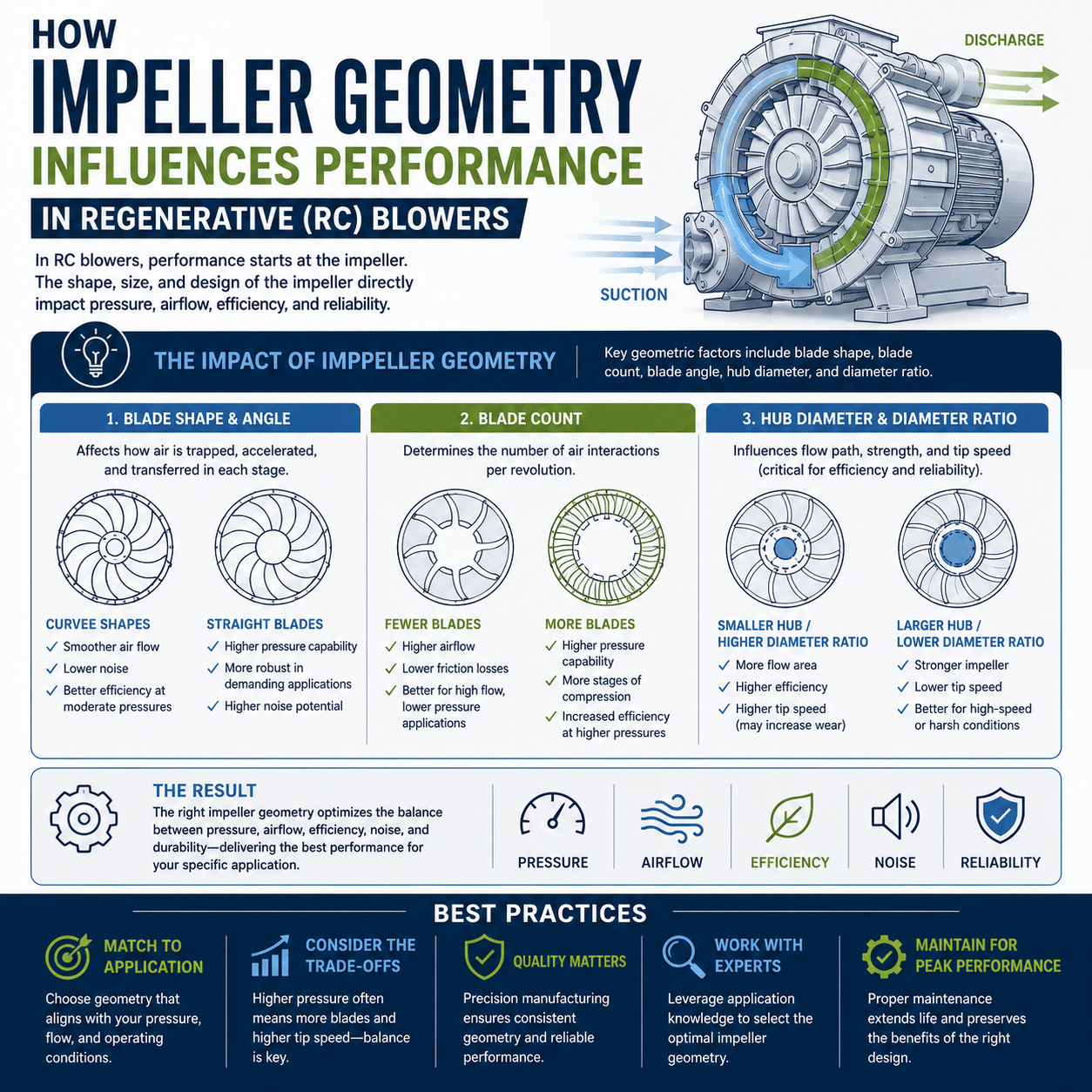
Regenerative blowers, often referred to as ring compressors (RC blowers), are widely used in industrial applications that require clean, oil-free air movement at relatively high pressures and vacuum levels. From pneumatic conveying and wastewater aeration to packaging equipment and medical systems, these blowers offer reliable performance with minimal maintenance.
At the heart of every regenerative blower is the impeller. While the motor provides the rotational energy, the impeller’s geometry largely determines how efficiently that energy is converted into airflow and pressure.
Understanding how impeller design affects blower performance can help engineers, OEMs, and facility managers select the right blower for their application and optimize system efficiency.
What Is a Regenerative Blower?
Unlike positive displacement blowers or centrifugal fans, regenerative blowers operate using a unique principle called regenerative acceleration.
As the impeller rotates, air is repeatedly accelerated by specially designed blades and circulated through a side channel within the blower housing. With each pass through the channel, the air gains additional energy before exiting the blower.
This repeated energy transfer allows regenerative blowers to generate higher pressure and vacuum levels than conventional centrifugal fans while maintaining oil-free operation.
The effectiveness of this process depends heavily on the geometry of the impeller.
Why Impeller Geometry Matters
The impeller is responsible for:
- Accelerating air
- Creating pressure differentials
- Determining airflow characteristics
- Influencing efficiency
- Affecting noise levels
- Impacting power consumption
Even small changes in blade shape, blade count, channel design, or impeller diameter can significantly alter blower performance.
Manufacturers invest considerable engineering effort into optimizing impeller geometry to achieve specific performance objectives.
Key Impeller Geometry Factors
Several design elements influence how a regenerative blower performs.
Impeller Diameter
One of the most fundamental design parameters is impeller diameter.
Larger impellers generally:
- Move more air
- Generate higher pressure potential
- Operate at lower rotational speeds for a given airflow
Smaller impellers typically:
- Respond more quickly
- Require higher rotational speeds
- Fit into more compact equipment designs
The relationship between impeller diameter and performance follows well-established fan laws, making diameter a critical factor in blower selection.
Impact on Performance
Increasing impeller diameter often results in:
- Higher pressure capability
- Increased airflow capacity
- Greater power requirements
However, larger diameters may also increase overall equipment size and weight.
Blade Shape
The shape of the impeller blades directly influences how efficiently energy is transferred to the air.
Common blade characteristics include:
- Curvature
- Angle
- Thickness
- Leading-edge profile
- Trailing-edge profile
Forward-Curved Designs
Forward-curved blades can provide strong airflow characteristics but may sacrifice some efficiency at higher operating pressures.
Optimized Aerodynamic Profiles
Modern regenerative blowers often utilize advanced blade geometries designed using computational fluid dynamics (CFD).
These profiles help:
- Reduce turbulence
- Improve airflow uniformity
- Increase efficiency
- Lower operating noise
Well-designed blade profiles maximize energy transfer while minimizing losses.
Number of Blades
The number of impeller blades significantly affects airflow behavior.
More Blades
A higher blade count generally:
- Creates smoother airflow
- Improves pressure generation
- Reduces pulsation
- Enhances pressure stability
However, excessive blade counts can increase friction losses and manufacturing complexity.
Fewer Blades
A lower blade count may:
- Reduce aerodynamic drag
- Increase airflow capacity
- Lower manufacturing costs
The optimal number depends on the intended operating range and application requirements.
Blade Height and Depth
Blade dimensions influence the volume of air captured and accelerated during each revolution.
Deeper Blades
Deeper blade channels can:
- Move greater air volumes
- Increase flow capacity
- Support higher throughput applications
Shallower Blades
Shallower blade designs may:
- Improve pressure generation
- Reduce internal recirculation
- Enhance efficiency in certain operating conditions
Manufacturers carefully balance blade depth with pressure and flow objectives.
Impeller Channel Design
The interaction between the impeller and the blower housing side channel is critical to regenerative blower performance.
The channel acts as the pathway where air repeatedly gains energy.
Optimized channel geometry can:
- Improve pressure generation
- Reduce turbulence
- Increase efficiency
- Lower operating temperatures
Poor channel design can result in significant energy losses regardless of impeller quality.
Blade Spacing
Blade spacing affects how air moves through the impeller.
Proper spacing helps:
- Minimize flow separation
- Reduce turbulence
- Improve pressure consistency
- Increase overall efficiency
Advanced blower designs often use carefully calculated blade spacing to optimize performance across a wide operating range.
How Impeller Geometry Affects Key Performance Metrics
Airflow Capacity
Airflow is largely influenced by:
- Impeller diameter
- Blade depth
- Rotational speed
- Blade count
Designs optimized for maximum airflow prioritize efficient air movement through the blower rather than maximum pressure generation.
Applications include:
- Aeration systems
- Air knife systems
- Pneumatic conveying
- Vacuum hold-down tables
Pressure and Vacuum Performance
Pressure capability depends heavily on:
- Blade geometry
- Side-channel design
- Number of regenerative stages
- Impeller speed
Impellers designed for higher pressure applications focus on maximizing energy transfer during each circulation cycle.
Efficiency
Efficiency is one of the most important design objectives.
Optimized impeller geometry can:
- Reduce energy consumption
- Lower operating costs
- Decrease heat generation
- Improve equipment life
Even modest efficiency improvements can generate significant energy savings over the life of a blower.
Noise Levels
Noise is often influenced by:
- Blade design
- Blade spacing
- Air turbulence
- Pressure pulsations
Modern impeller designs frequently incorporate noise-reduction features that improve workplace comfort and help facilities meet environmental requirements.
Temperature Rise
All regenerative blowers generate heat during operation.
Impeller geometry affects:
- Internal airflow patterns
- Energy transfer efficiency
- Friction losses
More efficient designs typically produce less heat and support longer operating life.
Single-Stage vs. Dual-Stage Impellers
Many regenerative blowers are available in single-stage and dual-stage configurations.
Single-Stage Designs
Single-stage blowers generally provide:
- Higher airflow
- Lower pressure capability
- Lower energy consumption
Dual-Stage Designs
Dual-stage blowers use multiple regenerative acceleration cycles to achieve:
- Higher pressure
- Higher vacuum levels
- Greater compression capability
The choice depends on system requirements rather than simply selecting the highest pressure option.
The Role of Computational Fluid Dynamics (CFD)
Modern blower manufacturers increasingly use CFD software to refine impeller geometry.
CFD allows engineers to:
- Visualize airflow patterns
- Identify turbulence zones
- Optimize blade angles
- Improve efficiency
- Reduce noise
These simulations help manufacturers achieve performance improvements that would be difficult to identify through traditional prototyping alone.
Selecting the Right Blower for Your Application
When evaluating regenerative blowers, it is important to look beyond horsepower ratings and airflow specifications.
Consider:
- Required airflow
- Operating pressure or vacuum
- Duty cycle
- Energy efficiency goals
- Noise requirements
- Installation constraints
Different impeller designs are optimized for different operating conditions.
A blower that performs exceptionally well in one application may not be the best choice for another.
Final Thoughts
The impeller is the core component that determines how effectively a regenerative blower converts motor power into useful airflow and pressure. Factors such as impeller diameter, blade shape, blade count, channel design, and spacing all play critical roles in defining performance characteristics.
Well-engineered impeller geometry can improve efficiency, increase pressure capability, reduce noise, lower operating temperatures, and extend equipment life. As regenerative blower technology continues to evolve, advanced design tools and aerodynamic optimization are enabling manufacturers to deliver increasingly efficient and reliable solutions.
By understanding the relationship between impeller geometry and blower performance, engineers and facility operators can make more informed equipment selections and achieve better long-term results from their air handling systems.