
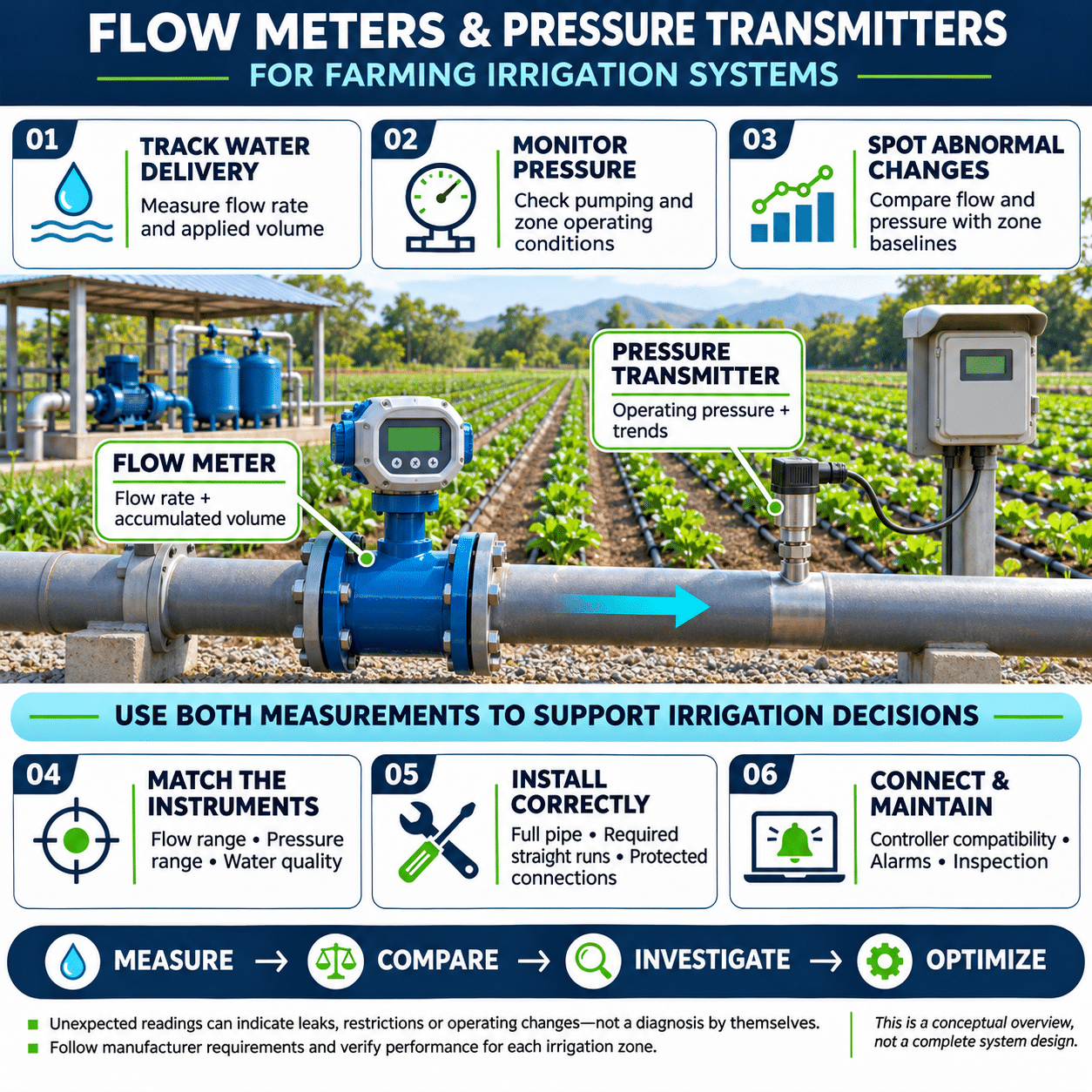
Modern irrigation systems must deliver the right amount of water to the right location at the right time. Too little water can reduce crop yield and quality, while excessive irrigation wastes water, consumes unnecessary pumping energy, leaches nutrients below the root zone, and may contribute to soil erosion or plant disease.
Flow meters and pressure transmitters give growers and irrigation managers the information needed to control water distribution more precisely. These instruments can help verify pump performance, identify leaks, detect clogged filters, confirm irrigation-zone operation, and measure the water applied to individual fields.
Selecting the right instruments requires more than matching a device to the pipe diameter. Water quality, operating pressure, flow range, pipe layout, installation environment, communication requirements, and maintenance capabilities must all be considered.
Why Measure Both Flow and Pressure?
Flow and pressure describe different aspects of irrigation-system performance.
A flow meter measures the volume of water passing through a pipe over time. It can provide:
- Instantaneous flow rate
- Total water consumption
- Flow direction
- Zone-by-zone water delivery
- Pump or well production
- Fertigation and chemical-injection verification
A pressure transmitter measures the force exerted by the water within the system. It can be used to monitor:
- Pump discharge pressure
- Mainline and lateral pressure
- Pressure at remote sections of a field
- Filter differential pressure
- Well drawdown or tank level
- Sprinkler and drip-system operating conditions
Using the two measurements together provides a more complete picture. A reduction in flow alone could indicate a closed valve, clogged filter, declining well output, or pump problem. Pressure data helps distinguish between these possibilities.
For example, low flow combined with high pressure upstream of a filter may indicate filter blockage. Low flow and low pump-discharge pressure may instead suggest pump wear, insufficient water supply, air entrainment, or an incorrect pump speed.
Start With the Irrigation Application
Before selecting an instrument, define exactly what the measurement must accomplish. Common measurement points include:
Well and Pump Discharge
A flow meter at the pump discharge can track well production, verify pump capacity, and document total water withdrawal. A pressure transmitter at the same location can indicate changes in pump performance or system resistance.
If flow and pressure gradually decline while pump speed remains constant, the well level may be falling or the pump may be deteriorating. If pressure rises while flow falls, a restriction may be developing downstream.
Main Irrigation Lines
Mainline flow measurement supports water-use reporting, irrigation scheduling, and leak detection. The meter must accommodate the full operating range, including periods when only one zone is active and periods when several zones operate simultaneously.
Individual Irrigation Zones
Zone-level meters allow operators to compare actual water delivery with the irrigation plan. Unexpected differences between similar zones may indicate damaged emitters, partially closed valves, clogged piping, or incorrect controller settings.
Drip Irrigation Systems
Drip systems require relatively stable pressure to maintain uniform emitter output. Flow measurement can identify broken laterals or excessive leakage, while pressure measurement can reveal clogged filters, failed regulators, or inadequate pressure at distant sections.
Sprinkler and Center-Pivot Systems
Sprinkler performance depends heavily on pressure. Excessive pressure can create small droplets, misting, and wind drift. Insufficient pressure can reduce the wetted radius and produce uneven coverage.
Flow measurement verifies total application rate, while pressure transmitters can monitor pump discharge, pivot inlet pressure, and pressure at critical points along the distribution system.
Filtration Equipment
Filters gradually accumulate sand, organic matter, algae, and other solids. Differential pressure measurement indicates how much resistance the filter creates.
A differential pressure transmitter measures the pressure before and after the filter:
[
\Delta P = P_{\text{upstream}} – P_{\text{downstream}}
]
As the filter becomes clogged, differential pressure increases. The measurement can initiate an alarm or automatically trigger a backwash cycle.
Fertigation Systems
Flow measurement helps maintain the correct relationship between irrigation water and injected fertilizer. Pressure monitoring can confirm that injection equipment operates against the expected line pressure and can help detect plugged injection points.
Materials must be evaluated carefully because concentrated fertilizers and treatment chemicals may be corrosive.
How to Select a Flow Meter
1. Identify the Water Characteristics
The first consideration is the liquid being measured. Irrigation water may contain:
- Sand and silt
- Organic material
- Air bubbles
- Dissolved minerals
- Fertilizers or treatment chemicals
- Algae and biological growth
Clean groundwater behaves differently from surface water containing suspended solids. A flow technology that performs well on a clean, full pipe may become unreliable if the water contains excessive air or if deposits accumulate on the pipe wall.
For ultrasonic measurement, the liquid must transmit an ultrasonic signal effectively. Transit-time ultrasonic meters are generally best suited to relatively homogeneous liquids. Heavy concentrations of suspended solids or entrained air can weaken or disrupt the signal.
2. Establish the Minimum and Maximum Flow Rates
A meter should be selected for the actual operating flow range, not simply for the nominal pipe size.
Determine:
- Minimum expected flow
- Normal operating flow
- Maximum expected flow
- Frequency of low-flow operation
- Whether reverse flow must be detected
- Required totalization accuracy
Oversizing a meter can reduce measurement quality at low flow. Undersizing it can create excessive velocity, pressure loss, or equipment stress.
The ratio between maximum and minimum measurable flow is often called turndown or rangeability. Systems that operate with different combinations of irrigation zones may require a wide measurement range.
3. Check Pipe Size, Material, and Condition
The pipe’s outside diameter, wall thickness, lining, and material influence meter selection. Agricultural systems commonly use:
- PVC
- Polyethylene
- Steel
- Ductile iron
- Aluminum
- Stainless steel
For clamp-on ultrasonic meters, accurate pipe dimensions are essential because the instrument uses those values to calculate the ultrasonic path and fluid velocity. Aging pipe, internal scaling, mortar lining, corrosion, or uncertain wall thickness can introduce error.
The pipe should also remain completely full at the measurement location. A partially filled pipe can produce unstable or misleading results.
4. Consider Installation Requirements
Flow profiles become distorted by elbows, pumps, partially open valves, reducers, and other fittings. A meter installed too close to these disturbances may report an inaccurate flow rate.
Provide the manufacturer’s recommended lengths of straight pipe upstream and downstream. When sufficient straight pipe is unavailable, consider:
- Relocating the meter
- Using a flow conditioner
- Selecting a multipath meter
- Reviewing the installation with the instrument manufacturer
- Performing a field flow-profile survey
The meter should not be installed at a high point where air can collect. For outdoor installations, the electronics and connections must be protected against rain, irrigation spray, condensation, dust, insects, ultraviolet exposure, and temperature extremes.
5. Evaluate Pressure Loss
Every additional pressure drop increases the pumping energy required to deliver water. This is especially important in large irrigation networks and systems that already operate near the pump’s capacity.
Clamp-on ultrasonic flow meters attach to the outside of the pipe and introduce no obstruction into the water stream. As a result, they do not create additional pressure loss and do not require the pipe to be cut.
Inline meters may provide a controlled measurement section and high repeatability, but installation normally requires piping modifications and a shutdown.
6. Match Accuracy to the Purpose
Not every measurement point requires the same accuracy.
Higher accuracy may be justified for:
- Water-allocation accounting
- Regulatory reporting
- Pump-performance testing
- Fertigation ratio control
- Water supplied to multiple users
- Irrigation-efficiency studies
Moderate accuracy may be sufficient for:
- Leak detection
- Zone confirmation
- General trending
- Pump on-or-off verification
- Maintenance diagnostics
Accuracy specifications should be reviewed carefully. Some are expressed as a percentage of the measured rate, while others include a fixed velocity or full-scale component. Low-flow performance can therefore differ significantly between instruments with apparently similar accuracy ratings.
7. Select the Appropriate Meter Configuration
A portable clamp-on ultrasonic flow meter is useful for temporary surveys, commissioning, pump testing, troubleshooting, and comparing multiple irrigation zones. It can be moved between pipes without interrupting service.
A permanently installed clamp-on meter is suitable when continuous measurement is needed but cutting the irrigation line is undesirable. It can reduce installation labor and eliminate additional pressure loss.
An inline ultrasonic meter may be appropriate when a permanent, high-performance measurement point is required and piping modification is acceptable. With no moving components in the flow stream, ultrasonic designs can also reduce routine mechanical maintenance.
Fuji Electric ultrasonic flow meters can support applications involving irrigation water and other homogeneous liquids. Available configurations include portable instruments for field surveys, clamp-on systems for permanent monitoring, and inline multipath meters for applications requiring higher accuracy.
How to Select a Pressure Transmitter
1. Choose the Correct Pressure Measurement
Most irrigation-system measurements fall into one of three categories.
Gauge pressure is measured relative to atmospheric pressure. It is commonly used for pump discharge, pipelines, sprinklers, and drip-irrigation headers.
Differential pressure is the difference between two pressure points. It is commonly used across filters, screens, strainers, and other equipment that can become restricted.
Hydrostatic pressure can be used to estimate water level in a tank, reservoir, or well when liquid density is known.
Selecting the correct measurement type is essential. Two separate gauge transmitters can be used to estimate filter pressure drop, but a dedicated differential pressure transmitter normally provides a direct and more coordinated measurement.
2. Define the Pressure Range
The transmitter should cover the normal operating range while retaining enough margin for expected pressure fluctuations. However, selecting an unnecessarily broad range reduces useful measurement resolution.
Consider:
- Normal system pressure
- Minimum operating pressure
- Pump shutoff pressure
- Pressure during filter backwashing
- Elevation-related pressure changes
- Water hammer and valve-closing surges
- Maximum allowable system pressure
The transmitter’s measurement range, overpressure rating, and burst-pressure rating are different specifications. All three should be evaluated.
3. Account for Elevation
Elevation changes can have a major effect on irrigation pressure. For water, an elevation change of approximately 2.31 feet corresponds to about 1 psi of static pressure.
A transmitter located downhill from the pump may therefore read significantly higher pressure than a transmitter located at the same horizontal distance uphill. Instrument readings should be interpreted using both pipeline resistance and site elevation.
Pressure measurement at the pump alone may not indicate whether the last sprinkler or emitter receives adequate pressure. Remote transmitters can be placed at hydraulically critical locations to confirm distribution performance.
4. Evaluate Water Hammer and Pulsation
Rapid valve closure, pump startup, pump shutdown, and sudden zone changes can create pressure surges. These transients may exceed normal system pressure and damage piping, seals, gauges, and transmitters.
Where severe surges are possible, consider:
- A transmitter with adequate overpressure capability
- A pressure snubber or pulsation dampener
- Proper valve-closing times
- Variable-speed pump control
- Surge tanks or air chambers
- High-speed data collection when transient analysis is required
Excessive damping in the transmitter can hide short pressure events. The response time should match the monitoring objective.
5. Select Compatible Wetted Materials
All parts that contact the water must be compatible with the irrigation water and any injected chemicals. Stainless steel may be suitable for many water applications, but salinity, fertilizer concentration, acids, chlorine compounds, and other treatments can require different materials or protective diaphragms.
Water containing sand or abrasive solids can also damage exposed sensing surfaces. A flush diaphragm or remote seal may be preferable where small pressure passages could plug.
Fuji Electric pressure transmitters are available in gauge, differential, and hydrostatic configurations, with different wetted materials and diaphragm options for demanding fluid conditions.
6. Consider Outdoor Protection
Agricultural instruments frequently operate in exposed locations. The installation should account for:
- Rain and irrigation spray
- Dust and soil
- Condensation
- Freezing conditions
- Direct sunlight
- Lightning and electrical surges
- Rodents and insects
- Agricultural chemicals
- Accidental impact from equipment
The enclosure rating, cable entries, conduit seals, grounding, and surge protection should suit the site. A sun shield may improve readability and reduce temperature-related stress on exposed electronics.
Communications and System Integration
Instrumentation becomes more valuable when measurements are connected to the irrigation-control system.
Common outputs include:
- 4 to 20 mA analog signals
- Pulse outputs for flow totalization
- Alarm contacts
- Digital communications
- Local displays
- Data logging
A 4 to 20 mA signal is widely used because it can travel over relatively long cable distances and allows the control system to distinguish a valid low reading from some wiring faults.
Pulse output is useful when the controller must totalize water volume. The pulse value should be selected carefully so the controller does not miss pulses at maximum flow or provide inadequate resolution at low flow.
Remote agricultural sites may also use radio, cellular, or low-power wireless networks. In these cases, verify signal compatibility, update frequency, power consumption, and behavior during a communication outage.
Using Flow and Pressure Together for Diagnostics
Combining the two measurements can reveal conditions that either instrument might not identify independently.
| Flow Condition | Pressure Condition | Possible Explanation |
| Low flow | High upstream pressure | Clogged filter, closed valve, blocked line, or restricted downstream equipment |
| Low flow | Low pressure | Pump wear, declining well level, air entering the suction line, or low pump speed |
| High flow | Low pressure | Major leak, broken lateral, open bypass, or too many active zones |
| High flow | High pressure | Incorrect pump speed, control malfunction, or operating configuration outside the design range |
| Unstable flow | Fluctuating pressure | Pump cycling, air entrainment, unstable control valve, or variable water supply |
| Normal pump flow | Low remote pressure | Excessive pipeline loss, elevation effect, leakage, or undersized piping |
These relationships can be incorporated into alarms and automated control logic. For example, a controller could stop a pump when high flow and low pressure indicate a major pipe break.
Instrument Sizing Example
Consider an irrigation main that normally carries 800 gallons per minute but may operate between 200 and 1,200 gallons per minute as zones open and close.
The flow meter should:
- Measure accurately across the full operating range
- Accommodate the pipe diameter and material
- Operate with the available straight-pipe length
- Tolerate the expected suspended solids and air content
- Provide totalized flow and a control-system output
- Avoid an unacceptable pressure drop
Assume the pump normally discharges at 70 psi, the system can experience short surges approaching 110 psi, and downstream equipment is rated for 125 psi.
The pressure transmitter should not be selected solely around the normal 70 psi reading. Its calibrated range and overpressure capability must account for normal variation and credible surge conditions without sacrificing too much measurement resolution.
If a filter normally creates a 2 psi pressure drop and requires backwashing at 8 psi, a differential pressure transmitter should be ranged closely enough to distinguish meaningful changes within that interval.
Installation Best Practices
Even a correctly selected instrument can perform poorly if it is installed incorrectly.
For reliable flow measurement:
- Confirm pipe material, outside diameter, wall thickness, and lining.
- Choose a location where the pipe remains full.
- Avoid air-collection points.
- Follow straight-pipe recommendations.
- Keep sensors away from severe vibration when possible.
- Enter the correct pipe and liquid parameters into ultrasonic meters.
- Protect outdoor cables and connectors.
- Verify the reading against pump data or another accepted measurement method.
For reliable pressure measurement:
- Install the sensing point where it represents the condition being controlled.
- Avoid dead legs that can trap sediment or air.
- Use suitable isolation valves and manifolds.
- Protect the transmitter from freezing.
- Provide surge protection where lightning exposure is significant.
- Mount the device securely to reduce vibration stress.
- Verify the zero reading before commissioning.
- Inspect impulse lines for leaks, blockage, or trapped gas.
Maintenance and Verification
Flow meters and pressure transmitters should be included in the irrigation system’s preventive-maintenance program.
Recommended activities include:
- Inspecting sensor mounts, wiring, and seals
- Checking for pipe buildup or sensor movement
- Verifying transmitter zero and span
- Comparing readings with pump curves and historical data
- Reviewing unexplained changes in water use
- Testing alarms and automatic shutdowns
- Confirming that flow totalizers retain data correctly
- Inspecting impulse lines and filter-pressure connections
- Revalidating settings after piping or pump modifications
Portable ultrasonic flow meters are particularly useful for checking permanent meters, evaluating pump performance, and investigating differences among irrigation zones without stopping water service.
Selection Checklist
Before ordering a flow meter, document:
- Water source and quality
- Minimum, normal, and maximum flow
- Pipe material, diameter, wall thickness, and lining
- Operating pressure and temperature
- Expected air and suspended-solid content
- Available straight-pipe length
- Required accuracy and turndown
- Permanent or temporary installation
- Output and communication requirements
- Enclosure and environmental requirements
- Power availability
- Totalization and data-logging needs
Before ordering a pressure transmitter, document:
- Gauge, differential, or hydrostatic measurement
- Normal and maximum pressure
- Expected surge pressure
- Required calibrated span
- Water chemistry and wetted-material requirements
- Process connection
- Possibility of sediment buildup or plugging
- Ambient temperature and freezing exposure
- Required response time
- Output signal and control-system compatibility
- Enclosure, grounding, and surge-protection requirements
Building a More Efficient Irrigation System
Selecting flow meters and pressure transmitters as part of a coordinated measurement strategy allows irrigation operators to move beyond basic pump control. Flow data confirms how much water is being delivered, while pressure data shows whether that water is moving through the system under the correct hydraulic conditions.
Properly selected and installed instruments can help reduce water waste, lower pumping costs, improve irrigation uniformity, protect equipment, and identify developing problems before they interrupt crop production. The best solution is the one matched to the actual water characteristics, hydraulic range, piping arrangement, operating environment, and management objectives of the farm.