
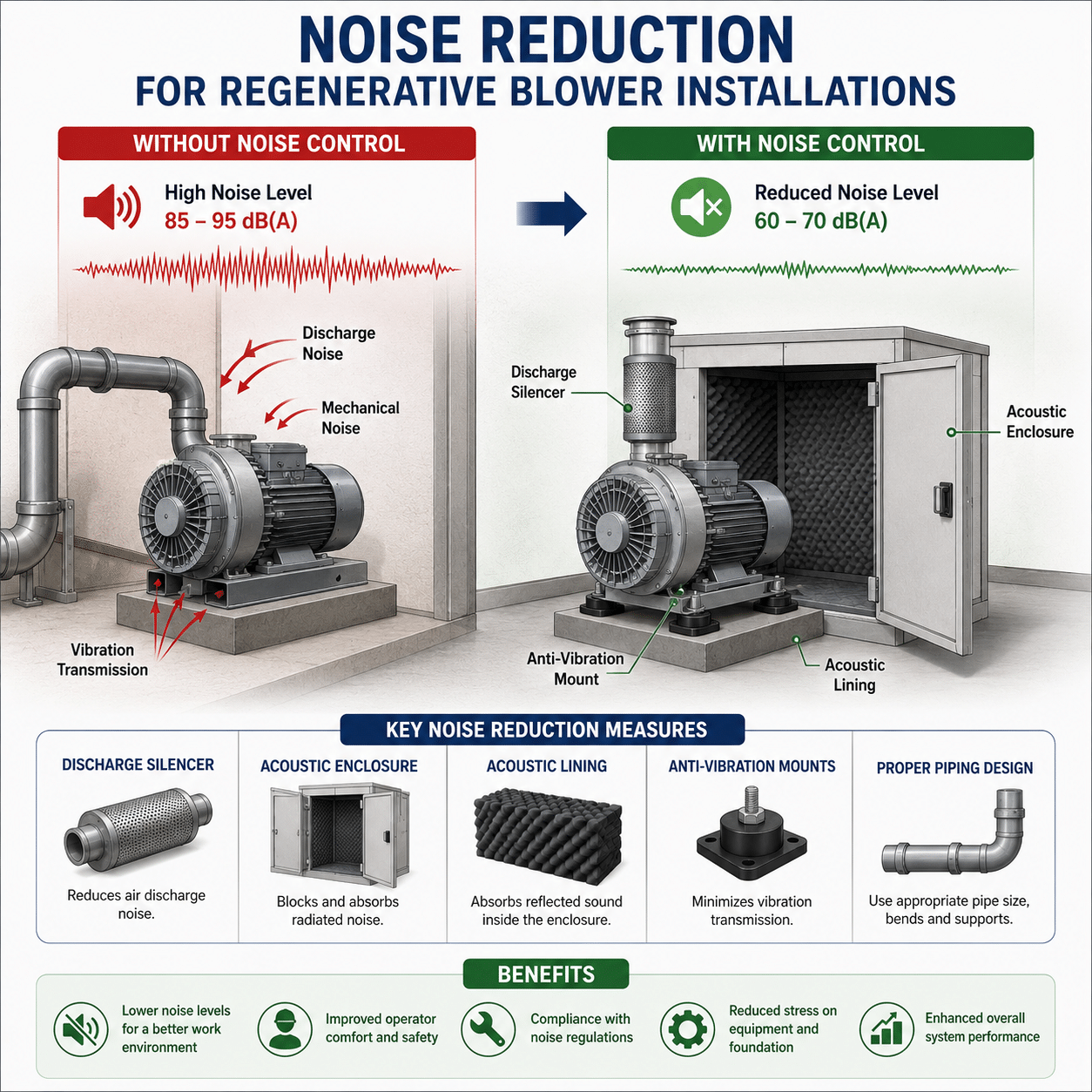
Regenerative blowers are widely used across industrial and commercial applications because of their compact design, oil-free operation, reliability, and ability to provide consistent airflow and vacuum performance. From pneumatic conveying and wastewater aeration to packaging equipment and medical systems, regenerative blowers play an essential role in many processes.
However, like all high-speed air-moving equipment, regenerative blowers can generate noise during operation. If not properly managed, excessive noise can create challenges related to worker comfort, regulatory compliance, equipment perception, and overall facility environment.
Understanding the causes of blower noise and implementing effective noise reduction strategies can significantly improve installation performance while maintaining airflow efficiency and system reliability.
Why Regenerative Blowers Generate Noise
Regenerative blowers operate by accelerating air through an impeller with multiple blades rotating at high speeds inside a specially designed housing. As air circulates through the blower stages, pressure and vacuum are generated through regenerative airflow principles.
Several factors contribute to operational noise, including:
- High-speed impeller rotation
- Air turbulence
- Motor noise
- Mechanical vibration
- Resonance within piping systems
- Intake and discharge airflow noise
The sound generated may vary depending on:
- Blower size
- Operating speed
- System pressure
- Installation environment
- Mounting method
- Piping design
Understanding the primary noise source is the first step toward effective mitigation.
Common Sources of Noise in Regenerative Blower Systems
Noise does not always originate from the blower itself. In many installations, surrounding components and system design contribute significantly to overall sound levels.
Airflow Noise
Air movement through the intake and discharge ports is one of the most common noise sources.
High-velocity airflow can create:
- Turbulence
- Whistling
- Pulsation noise
- Broadband airflow sound
Restrictions or poorly designed piping may increase airflow turbulence and amplify noise levels.
Mechanical Vibration
Mechanical vibration from the blower and motor can transfer into:
- Equipment frames
- Floors
- Pipe supports
- Building structures
This structure-borne vibration can create additional noise through resonance and amplification.
Motor Noise
The electric motor itself contributes operational sound through:
- Bearing movement
- Cooling fans
- Electromagnetic hum
- Rotational dynamics
Variable frequency drive (VFD) operation may also introduce tonal noise depending on switching frequencies and motor design.
Piping Resonance
Long piping runs or unsupported ducts can resonate at certain frequencies, increasing perceived noise throughout the system.
In some cases, piping systems act like acoustic amplifiers.
Installation Environment
Hard surfaces such as concrete walls, metal panels, and enclosed rooms can reflect and amplify sound waves, increasing overall noise exposure.
Why Noise Reduction Matters
Reducing blower noise offers several important benefits.
Improved Workplace Comfort
Lower noise levels create a more comfortable environment for operators and maintenance personnel.
Regulatory Compliance
Facilities may need to comply with:
- OSHA workplace noise regulations
- Local noise ordinances
- Environmental standards
Reduced Operator Fatigue
Continuous exposure to high noise levels can contribute to fatigue and communication difficulties.
Improved Equipment Perception
Quiet operation often creates the perception of higher equipment quality and improved system performance.
Better Facility Integration
Noise reduction is particularly important in:
- Medical facilities
- Laboratories
- Commercial buildings
- Food processing facilities
- Indoor manufacturing environments
Effective Noise Reduction Strategies
Several proven strategies can help reduce noise in regenerative blower installations.
Install Intake Silencers
One of the most effective methods for reducing blower noise is using intake silencers.
Intake silencers help:
- Reduce airflow turbulence noise
- Lower intake sound pressure levels
- Minimize high-frequency noise
Properly sized silencers can significantly reduce airborne sound without substantially restricting airflow.
Use Discharge Silencers
Discharge silencers reduce noise generated as pressurized air exits the blower system.
These silencers are especially beneficial in:
- High-pressure applications
- Pneumatic conveying systems
- Aeration systems
- Vacuum transport applications
Selecting the correct silencer design is important to avoid excessive pressure drop.
Isolate Vibration
Mechanical vibration often contributes heavily to perceived noise levels.
Vibration isolation techniques include:
- Rubber isolation mounts
- Spring isolators
- Flexible connectors
- Anti-vibration pads
Proper isolation prevents vibration transfer into building structures and connected piping.
Use Flexible Piping Connections
Rigid piping can transfer vibration directly through the system.
Flexible connectors help:
- Reduce vibration transmission
- Minimize resonance
- Lower structure-borne noise
Flexible connections are particularly important near the blower inlet and discharge ports.
Optimize Piping Design
Poor piping layouts can increase turbulence and resonance.
Best practices include:
- Avoiding abrupt transitions
- Minimizing sharp bends
- Using properly sized piping
- Reducing airflow restrictions
- Supporting piping adequately
Smooth airflow reduces turbulence-related sound generation.
Install Acoustic Enclosures
In applications requiring substantial noise reduction, acoustic enclosures can provide significant sound attenuation.
Well-designed enclosures may include:
- Sound-absorbing insulation
- Ventilation systems
- Service access panels
- Cooling airflow management
However, thermal management is critical because regenerative blowers generate heat during operation.
Apply Sound-Absorbing Materials
Acoustic treatments within the installation area can help reduce reflected noise.
Examples include:
- Acoustic wall panels
- Sound-absorbing ceiling materials
- Insulated equipment rooms
- Acoustic curtains
Reducing sound reflection improves the overall acoustic environment.
Proper Equipment Placement
Blower location can significantly affect perceived noise levels.
Whenever possible:
- Place blowers away from occupied areas
- Avoid corner installations that amplify sound
- Use isolated equipment rooms
- Separate blowers from reflective surfaces
Strategic placement can reduce operator exposure without modifying the equipment itself.
Optimize Blower Sizing
Oversized blowers may operate inefficiently and generate unnecessary noise.
Proper sizing helps:
- Improve efficiency
- Reduce excessive airflow velocity
- Lower operating speeds
- Minimize turbulence
Selecting the correct blower for the application improves both acoustic and energy performance.
Use Variable Frequency Drives (VFDs)
Variable frequency drives allow blower speed control based on system demand.
Benefits may include:
- Lower operating speeds during reduced demand
- Reduced airflow noise
- Improved energy efficiency
- Smoother system operation
Careful VFD parameter setup can also help minimize motor-related tonal noise.
Maintain the Blower System Properly
Worn or damaged components can increase operational noise.
Preventive maintenance should include:
- Bearing inspections
- Impeller inspection
- Filter cleaning
- Fastener checks
- Alignment verification
- Vibration monitoring
Maintained equipment generally operates more quietly and efficiently.
Understanding Noise Frequency Characteristics
Different noise reduction methods target different frequency ranges.
For example:
- Silencers primarily address airborne airflow noise
- Isolation mounts reduce low-frequency vibration
- Acoustic foam absorbs mid- and high-frequency reflections
A comprehensive noise reduction strategy often combines multiple approaches for the best results.
Measuring and Evaluating Noise Levels
Noise assessments help determine:
- Primary noise sources
- Frequency characteristics
- Operator exposure levels
- Effectiveness of mitigation efforts
Sound measurements are commonly expressed in decibels (dBA).
Evaluating both overall sound level and frequency spectrum provides better insight into appropriate mitigation strategies.
Balancing Noise Reduction and Performance
Noise reduction efforts should not compromise blower performance.
Improper modifications may cause:
- Excessive pressure drop
- Reduced airflow
- Increased motor loading
- Thermal issues
The goal is to achieve quieter operation while maintaining reliable system performance and efficiency.
Fuji Electric Regenerative Blower Solutions
Fuji Electric regenerative blowers are engineered for high performance, reliability, and efficient operation across demanding industrial applications.
Our blower solutions are designed to support:
- Stable airflow performance
- Compact installation
- Reliable continuous-duty operation
- Industrial durability
- Reduced maintenance requirements
Fuji Electric also supports system optimization strategies that help improve installation efficiency, operational reliability, and overall acoustic performance.
Noise generation is a common consideration in regenerative blower installations, particularly in facilities where operator comfort, environmental conditions, and regulatory compliance are important.
Fortunately, effective noise reduction can often be achieved through a combination of:
- Intake and discharge silencers
- Vibration isolation
- Proper piping design
- Acoustic treatment
- Equipment placement
- Preventive maintenance
By understanding the sources of blower noise and implementing appropriate mitigation strategies, facilities can create quieter, more efficient, and more reliable blower systems while maintaining the performance benefits regenerative blowers are known for.