
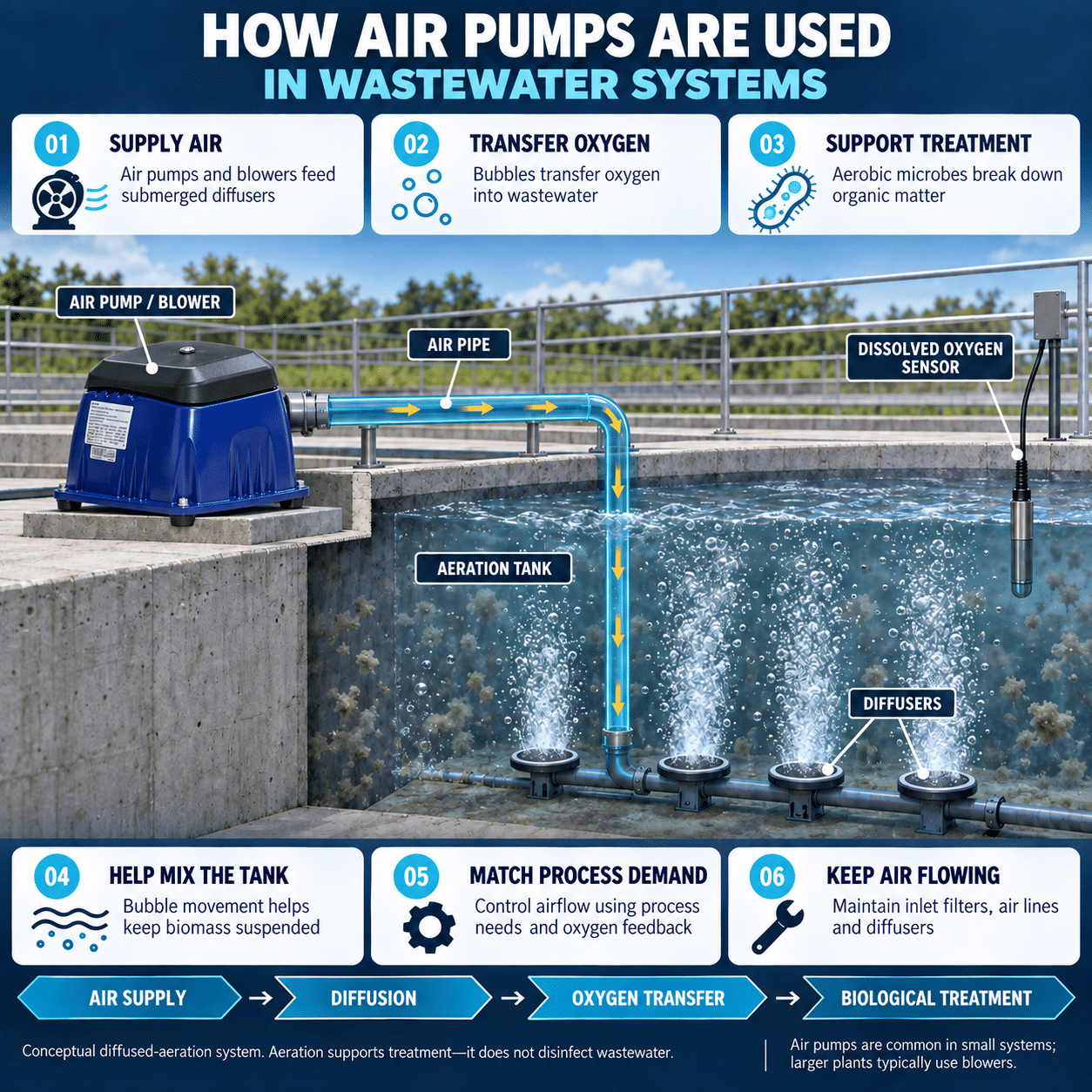
Air is essential to many wastewater treatment processes. It supplies oxygen for biological treatment, keeps solids suspended, supports mixing and helps clean filtration equipment. The equipment that provides this air may be called an air pump, blower, compressor, ring compressor or regenerative blower.
These terms are sometimes used interchangeably, but they can describe equipment with very different pressure, airflow and operating characteristics. Understanding the role of air in the treatment process makes it easier to select, operate and maintain the right system.
Why wastewater treatment needs air
Wastewater contains organic material, nutrients, suspended solids and other contaminants that must be removed before the water can be discharged or reused.
Many treatment systems rely on aerobic microorganisms. These microorganisms consume organic pollutants and convert them into more stable substances. Like other living organisms, they need oxygen.
An air pump or blower introduces air into the wastewater, usually through diffusers installed near the bottom of a tank. The bubbles provide oxygen while also helping circulate the water and keep biological solids in suspension.
Air can also serve mechanical and utility functions that do not depend directly on oxygen transfer.
Common uses include:
- Biological aeration
- Tank mixing
- Aerobic sludge digestion
- Filter backwashing
- Airlift pumping
- Grit removal
- Membrane cleaning
- Sludge drying
- Odor-control systems
- Pneumatic conveying
- Instrument air for selected equipment
The required airflow and pressure depend on the process, water depth, diffuser type, piping system and operating conditions.
What is an air pump?
In wastewater applications, the term air pump is often used broadly for equipment that moves air into a process.
Small systems may use:
- Diaphragm air pumps
- Linear air pumps
- Rotary vane pumps
- Small regenerative blowers
Larger systems may use:
- Regenerative blowers
- Positive-displacement blowers
- Screw blowers
- Multistage centrifugal blowers
- High-speed turbo blowers
A fan is designed primarily for high airflow at low pressure. A compressor generally produces higher pressure. A blower operates between these ranges.
A regenerative blower, also known as a side-channel blower or ring compressor, uses a rotating impeller to accelerate air repeatedly through a circular channel. It can provide clean, oil-free air at moderate pressure and is often well suited to small and medium wastewater aeration systems.
How an aeration system works
A typical wastewater aeration system includes:
- An air inlet
- An inlet filter
- An air pump or blower
- A check valve
- A pressure-relief valve
- A pressure gauge or transmitter
- Distribution piping
- Air-control valves
- Diffusers or spargers
- Process sensors and controls
The blower draws atmospheric air through the inlet filter and raises its pressure. The compressed air moves through a header and branch piping to diffusers at the bottom of the tank.
The diffusers divide the air into bubbles. As the bubbles rise, oxygen transfers from the air into the water. Bubble movement also creates circulation within the tank.
The blower must provide enough pressure to overcome:
- Water depth above the diffuser
- Diffuser resistance
- Piping friction
- Valve and fitting losses
- Filter restriction
- Fouling allowance
- Any required pressure at the point of use
Airflow and pressure must be considered together. A blower’s maximum airflow and maximum pressure occur at different points on its performance curve.
Biological aeration
Biological aeration is one of the most common uses of air pumps in wastewater treatment.
In an activated sludge system, microorganisms are mixed with wastewater in an aeration basin. They consume biodegradable organic material and form biological floc that can later be separated in a clarifier.
The air system performs two related functions:
- It supplies oxygen for biological activity.
- It provides mixing that keeps solids in contact with the wastewater.
If airflow is too low, dissolved oxygen can fall below the level required by the microorganisms. Treatment performance may decline, odors may develop and solids may settle.
If airflow is unnecessarily high, the plant wastes energy and may create excessive turbulence. Overaeration can also interfere with certain biological processes.
The objective is to provide enough air to meet process demand while avoiding excess.
Nitrification and nitrogen removal
Air pumps also support nitrification, the aerobic biological conversion of ammonia into nitrite and nitrate.
Nitrifying organisms generally grow more slowly and can be sensitive to:
- Low dissolved oxygen
- Low temperature
- Unfavorable pH
- Toxic compounds
- Short solids-retention time
The aeration system must provide enough oxygen for both carbon removal and nitrification when these processes occur in the same basin.
Denitrification is different. It occurs under anoxic conditions, where microorganisms use nitrate rather than dissolved oxygen. Treatment systems may therefore alternate between aerated and non-aerated zones or periods.
Accurate airflow control helps maintain the conditions required for each biological stage.
Equalization tank mixing
Equalization tanks reduce variations in flow and pollutant loading before wastewater enters downstream treatment.
Air can be introduced to:
- Keep solids suspended
- Blend incoming wastewater
- Reduce settling
- Limit septic conditions
- Control odors
- Maintain a more uniform process feed
In this application, the minimum airflow may be determined by mixing rather than oxygen demand.
The air pump must provide enough energy to circulate the tank, but excessive aeration can waste power and increase aerosol generation. Tank geometry, diffuser location and solids concentration all affect performance.
Aerobic digestion
Aerobic digesters use oxygen to stabilize biological sludge. Air pumps support both microbial activity and mixing.
Digesters may require substantial airflow because the sludge concentration is higher than in a typical aeration basin. Air demand can vary as solids are added, stabilized and withdrawn.
The system should be designed to prevent solids deposition and maintain the required dissolved oxygen without excessive energy use.
Filter backwashing
Some wastewater filters use air during backwashing.
Air can help:
- Break up compacted filter media
- Release trapped solids
- Improve cleaning
- Reduce the amount of wash water required
- Restore filter performance
Backwash duty is usually intermittent and may require high airflow for a short period. The equipment must be selected for the required cycle length, starts per hour and pressure.
A blower designed for continuous aeration may not automatically be suitable for frequent short cycles. Duty cycle and motor temperature should be checked.
Airlift pumping
An airlift pump injects compressed air into a vertical pipe submerged in liquid. The air lowers the density of the liquid and air mixture inside the pipe, causing the mixture to rise.
Airlift systems can move:
- Wastewater
- Sludge
- Scum
- Grit
- Recycle flow
They have no submerged mechanical impeller, which can be useful when handling solids or abrasive material. Their efficiency depends on submergence, lift height, pipe geometry and airflow.
The air pump must supply the required flow at the pressure created by the water depth and piping system.
Membrane systems
Air is used in many membrane bioreactor systems.
It can provide:
- Oxygen for biological treatment
- Mixing
- Scouring of membrane surfaces
- Reduction of solids accumulation
Membrane scouring can require a different airflow pattern from biological aeration. Some systems use continuous air, while others use pulsed or cyclic operation.
The blower system should be designed around the membrane supplier’s requirements. Insufficient air can accelerate fouling, while excessive air increases energy consumption and may stress the membranes.
Grit removal
Aerated grit chambers use controlled airflow to create a rolling motion in the water.
This motion helps separate heavier grit particles while allowing lighter organic material to remain suspended and continue through the treatment process.
Airflow must be balanced carefully. Too little air can reduce separation. Too much can carry grit forward or disturb the desired flow pattern.
Sludge drying and dewatering support
Airflow may also support sludge drying by increasing evaporation and removing moisture-laden air.
Applications can include:
- Drying beds
- Enclosed sludge dryers
- Biosolids ventilation
- Filter-cake drying
- Odor extraction around dewatering equipment
The blower selection depends on whether the system needs pressure, vacuum or general ventilation.
A regenerative blower can provide pressure or vacuum, but its suitability depends on the required airflow, temperature and system resistance.
Odor control
Wastewater processes can release hydrogen sulfide, ammonia and other odorous compounds.
Air-moving equipment can collect contaminated air from:
- Wet wells
- Headworks
- Sludge-processing areas
- Tanks
- Channels
- Dewatering rooms
The air is then directed to a scrubber, biofilter, activated-carbon vessel or another treatment system.
Odor-control airflow is different from process aeration. The blower must overcome duct and treatment-vessel resistance while maintaining the required capture velocity.
Materials should be selected for compatibility with corrosive gases.
Why oil-free air matters
Air introduced directly into wastewater should not add oil or other contaminants.
Regenerative blowers produce airflow without oil in the compression chamber. This makes them attractive for:
- Biological aeration
- Small treatment plants
- Package systems
- Airlift applications
- Filter backwashing
- Clean process-air requirements
Oil-free does not mean maintenance-free. Inlet filters, motor cooling, bearings and system accessories still require inspection.
How regenerative blowers move air
A regenerative blower contains an impeller with multiple blades. As the impeller rotates, air enters through the inlet and is accelerated outward into a side channel.
The airflow repeatedly returns to the impeller blades and gains additional pressure before reaching the outlet. This regenerative action produces moderate pressure without internal contact between the impeller and housing.
Key characteristics include:
- Oil-free airflow
- Direct-drive construction
- Few wear components
- Continuous airflow
- Moderate pressure capability
- Compact size
- Pressure and vacuum capability
Fuji Electric ring compressors and regenerative blowers are used to provide air for wastewater aeration. Available product families include single-stage and two-stage configurations for different combinations of airflow and pressure.
Single-stage and two-stage blowers
Single-stage blowers
A single-stage regenerative blower passes air through one compression stage.
It can be appropriate for:
- Shallow aeration tanks
- Small package plants
- Equalization tanks
- Light-duty mixing
- Filter backwashing
- Low-pressure process air
Single-stage units are generally compact and mechanically simple.
Two-stage blowers
A two-stage blower passes air through two regenerative stages to create a higher pressure differential.
It can be useful for:
- Deeper tanks
- More restrictive diffusers
- Long piping systems
- Higher-pressure airlift systems
- Processes with greater combined resistance
A two-stage blower should not be selected solely because it can produce more pressure. The operating point should fall within the recommended region of the performance curve.
Regenerative, positive-displacement or turbo blower?
The right blower technology depends on the application.
Regenerative blowers
Regenerative blowers can be a strong fit for small and medium systems requiring clean air, moderate pressure and low maintenance.
Positive-displacement blowers
Positive-displacement blowers move a relatively fixed volume of air per revolution. They are often used where pressure varies but relatively consistent airflow is required.
They can provide higher pressure, but may require more maintenance, noise control and pulsation management.
Turbo and centrifugal blowers
Turbo and centrifugal blowers are often used for larger airflow requirements. They can offer high efficiency in large treatment plants when operated within their intended range.
They may require more sophisticated controls and careful surge management.
Technology should be selected by comparing:
- Required airflow
- Required pressure
- Turndown
- Duty cycle
- Efficiency
- Noise
- Maintenance
- Installation cost
- Lifecycle cost
How blower pressure is determined
The air pump must overcome the total system pressure.
Static pressure from water depth is often the largest component. In water near standard conditions, each foot of submergence requires approximately 0.433 psi, or about 12 inches of water column.
Add:
- Diffuser pressure loss
- Piping friction
- Check-valve loss
- Control-valve loss
- Filter restriction
- Fouling allowance
Use the maximum operating water level and maximum expected airflow.
A blower should not be selected using only its maximum-pressure rating. Determine the airflow it can deliver at the required total system pressure.
How airflow is determined
For biological treatment, airflow begins with the oxygen requirement.
Factors include:
- Organic loading
- Ammonia loading
- Desired dissolved oxygen
- Wastewater temperature
- Salinity
- Tank depth
- Diffuser efficiency
- Alpha factor
- Fouling
- Mixing requirements
- Site elevation
The oxygen-transfer performance measured in clean water will usually differ from performance in actual wastewater.
For nonbiological applications, airflow may be based on:
- Required mixing intensity
- Backwash rate
- Membrane scouring rate
- Airlift capacity
- Odor-capture velocity
- Drying rate
A process engineer should establish the airflow requirement before the blower is selected.
Site conditions affect performance
Blower performance changes with inlet-air density.
Air density decreases as:
- Elevation increases
- Temperature increases
- Barometric pressure decreases
At lower density, a blower may deliver a similar actual volume but less air mass and less oxygen.
Correct the selection for:
- Site altitude
- Maximum inlet temperature
- Humidity
- Enclosure temperature
- Seasonal conditions
Do not allow hot discharge air to recirculate into the blower inlet. This reduces air density and can raise equipment temperature.
Air distribution matters
An efficient blower cannot compensate for a poorly designed distribution system.
Good design should provide:
- Properly sized headers
- Balanced branch piping
- Accessible control valves
- Low unnecessary pressure loss
- Condensate management
- Backflow prevention
- Isolation for maintenance
- Pressure measurement
- Airflow measurement where justified
Uneven piping or diffuser fouling can send too much air to one part of a tank and too little to another.
Balancing should be verified under actual operating conditions.
Diffuser selection affects performance
Diffusers determine bubble size, oxygen-transfer efficiency and pressure loss.
Common types include:
- Fine-bubble membrane diffusers
- Coarse-bubble diffusers
- Porous ceramic diffusers
- Tubular diffusers
- Disc diffusers
- Spargers
Fine bubbles provide greater surface area and can improve oxygen transfer. They can also have higher pressure loss and may be more sensitive to fouling.
Coarse bubbles provide stronger mixing and are less prone to some types of clogging, but they may transfer oxygen less efficiently.
Select the diffuser and blower as one system.
Control methods
Air demand changes with wastewater flow, pollutant loading, temperature and biological activity.
Common control methods include:
- On and off control
- Timed operation
- Multiple-blower staging
- Dissolved-oxygen control
- Airflow control
- Pressure control
- Variable-speed control
A dissolved-oxygen sensor can provide feedback to the blower system. The controller adjusts airflow to maintain the required oxygen level.
For multiple zones, airflow control valves and meters can distribute air according to local demand.
Variable-speed control may improve energy performance, but the blower must remain within its approved speed, current, pressure and temperature limits. Regenerative blowers do not necessarily behave like conventional centrifugal fans, so manufacturer data should be used when applying an AC drive.
Avoid excessive pressure
A blocked discharge, closed valve or clogged diffuser system can cause pressure and temperature to rise.
A complete installation should include appropriate protection, such as:
- Pressure-relief valve
- Pressure gauge or transmitter
- Motor overload protection
- Temperature protection
- High-pressure alarm
- Check valve
Do not use a discharge valve to force a regenerative blower to operate against excessive pressure.
A relief valve should be sized and set according to the blower manufacturer’s instructions.
Prevent water from entering the blower
Wastewater must not flow backward into the air pump.
Water ingestion can cause:
- Corrosion
- Impeller damage
- Motor damage
- Electrical faults
- Contamination
- Sudden mechanical loading
Protect the system with:
- A properly installed check valve
- Piping routed above the maximum water level where practical
- Condensate drains
- Appropriate shutdown sequencing
- High-water safeguards
The check valve should be accessible for inspection because debris and corrosion can prevent it from sealing.
Manage heat
Compressing air increases its temperature. Higher system pressure generally produces higher discharge temperature.
Allow for:
- Hot discharge piping
- Enclosure ventilation
- Clearance around the motor
- Maximum ambient temperature
- Heat recirculation
- Temperature rating of flexible connectors and plastic piping
Use metal piping for the initial discharge section when required by the blower manufacturer.
Continuous-duty applications need enough ventilation to prevent motor and blower overheating.
Control noise
Air pumps can create aerodynamic and mechanical noise.
Noise sources include:
- Inlet airflow
- Discharge pulsation
- Impeller operation
- Motor cooling
- Piping vibration
- Relief-valve operation
Noise-control measures can include:
- Inlet filter-silencers
- Discharge silencers
- Flexible connectors
- Vibration isolators
- Proper pipe supports
- Acoustic enclosures
- Correct blower sizing
An acoustic enclosure must provide adequate cooling airflow. Reducing noise should not cause overheating.
Maintenance best practices
A preventive maintenance program should include:
- Inspecting and replacing inlet filters
- Checking blower pressure
- Verifying airflow
- Monitoring motor current
- Inspecting the check valve
- Testing the relief valve
- Checking for unusual noise
- Trending vibration
- Cleaning motor cooling surfaces
- Inspecting piping and flexible connectors
- Checking for air leaks
- Verifying diffuser condition
- Confirming control-sensor calibration
A rising discharge pressure can indicate diffuser fouling, a blocked filter or a closed valve. Falling pressure and airflow may indicate leaks, worn equipment or a failed connection.
Record baseline pressure, airflow and current when the system is commissioned. These values make later changes easier to recognize.
Plan for redundancy
Aeration is often critical to biological treatment. A prolonged interruption can reduce treatment performance and damage the process population.
Possible redundancy arrangements include:
- One duty and one standby blower
- Two duty and one standby
- Multiple staged units
- A spare blower stored on site
- A common standby connected to several systems
Consider:
- Maximum acceptable outage time
- Automatic changeover
- Lead-lag rotation
- Spare-parts availability
- Maintenance access
- Alarm notification
- Emergency power
The standby blower must be capable of meeting the required operating point, not simply have the same motor horsepower.
Monitor energy performance
Aeration can account for a large portion of a wastewater plant’s electrical consumption.
Useful performance indicators include:
- Kilowatt-hours per volume treated
- Power per unit of airflow
- Airflow per unit of oxygen demand
- Dissolved-oxygen stability
- Average discharge pressure
- Time spent at full output
- Diffuser pressure increase
- Filter pressure drop
Energy can often be reduced by:
- Cleaning or replacing fouled diffusers
- Lowering unnecessary system pressure
- Repairing leaks
- Improving air distribution
- Resetting dissolved-oxygen targets appropriately
- Staging blowers efficiently
- Matching airflow to actual demand
The most efficient blower cannot overcome an unnecessarily restrictive air system.
Air-system operating checklist
For reliable wastewater air delivery, confirm:
- Is the airflow requirement based on process demand?
- Has the mixing requirement also been checked?
- What total pressure must the blower overcome?
- Is the selected operating point shown on the performance curve?
- Have altitude and inlet temperature been considered?
- Is the blower rated for the required duty cycle?
- Are the diffuser and blower compatible?
- Is the inlet filter accessible?
- Is a pressure-relief valve installed?
- Is backflow protection provided?
- Can condensate drain safely?
- Is the discharge piping temperature-rated?
- Is enclosure ventilation adequate?
- Are noise and vibration controlled?
- Is standby capacity available?
- Are pressure, airflow and motor current monitored?
- Is the control strategy matched to process demand?
- Are maintenance baselines documented?
Air pumps are part of a complete treatment system
Air pumps and blowers do more than create bubbles. They support biological treatment, mixing, filtration, sludge handling and other essential wastewater processes.
Reliable performance depends on the complete air system, including the blower, piping, valves, instrumentation, diffusers and controls. Airflow and pressure must be evaluated together, and the selected equipment must be corrected for actual site conditions.
Fuji Electric provides single-stage and two-stage ring compressors and regenerative blowers for wastewater aeration and related pressure or vacuum applications. When properly selected and integrated, these systems can provide clean, oil-free air with compact construction and low maintenance requirements.