
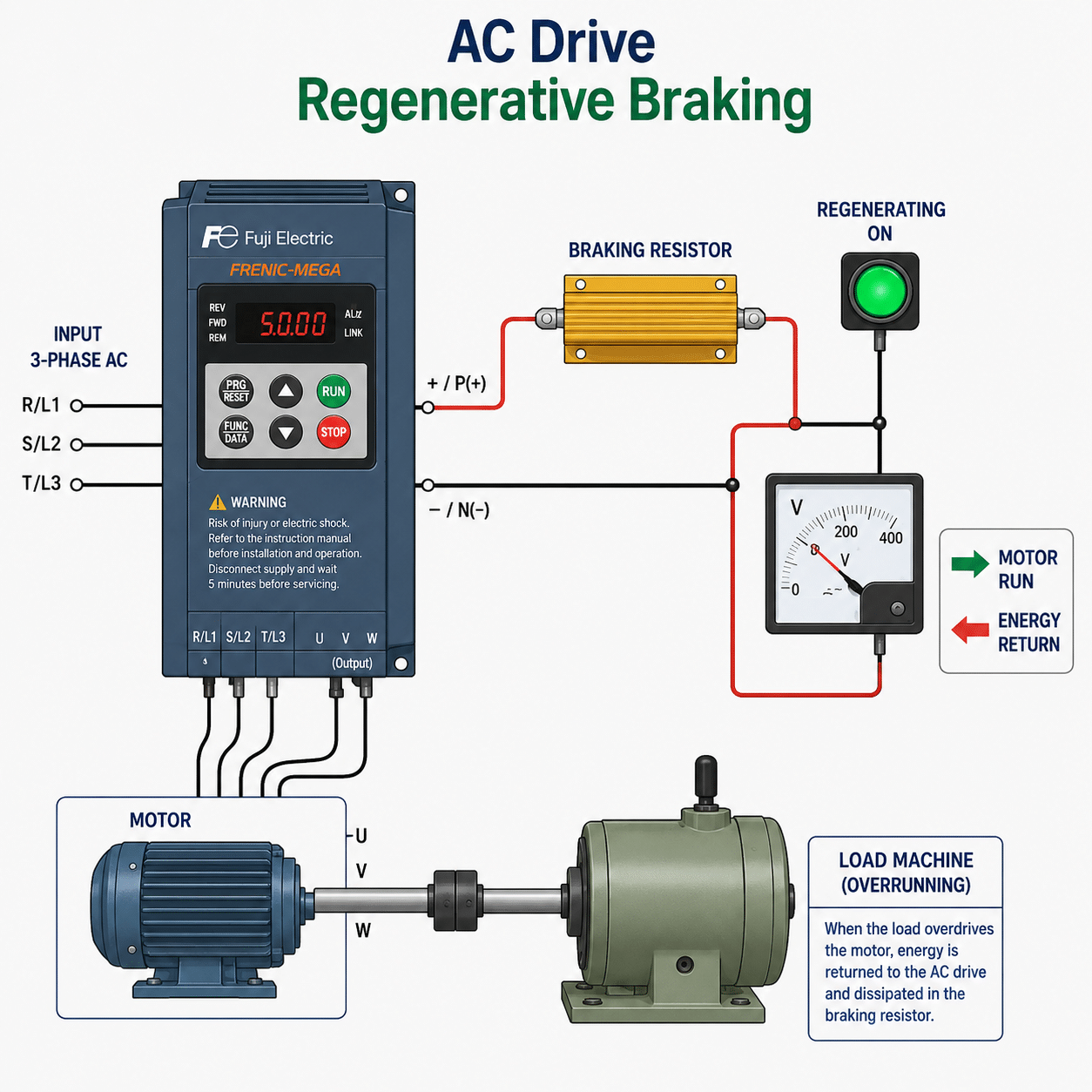
Modern AC drive systems are designed to deliver precise motor control, energy efficiency, and reliable operation across a wide range of industrial applications. However, some applications create a unique challenge for variable frequency drives (VFDs): regenerative energy.
When a motor slows down or is driven by the load itself, it can act like a generator and send energy back into the drive. If that energy is not properly managed, it can cause nuisance trips, overvoltage faults, or even equipment damage. One of the most common solutions is a dynamic braking resistor.
Understanding when regenerative energy occurs , and when a braking resistor is required , is essential for designing reliable motion control systems.
What Is a Regenerative Load?
A regenerative load occurs when the mechanical system drives the motor faster than the commanded speed or when the motor rapidly decelerates. Instead of consuming power, the motor generates power and sends it back into the DC bus of the AC drive.
As regenerative energy builds inside the drive, the DC bus voltage rises. If the voltage exceeds safe operating limits, the drive will typically trip on a DC bus overvoltage fault.
Regenerative conditions commonly occur in applications with:
- Rapid deceleration
- High inertia loads
- Overhauling loads
- Vertical motion systems
- Frequent stopping and starting
- Continuous energy feedback from the process
Common Applications That Create Regenerative Energy
Several industrial applications are naturally regenerative due to the physics of the load.
Conveyors with High Inertia
Long conveyors transporting heavy products often store large amounts of kinetic energy. During deceleration, that energy must go somewhere. Without a braking method, the drive may experience overvoltage conditions.
Centrifuges and Flywheel Loads
High-speed rotating equipment stores significant rotational energy. Fast stopping times can generate large regenerative currents as the motor attempts to slow the system.
Cranes, Hoists, and Elevators
Vertical loads are among the most common regenerative applications. Gravity can drive the motor during lowering operations, continuously feeding energy back into the drive.
Fans and Blowers
Large fans may continue spinning due to airflow or momentum after a stop command. Applications with aggressive deceleration ramps can become regenerative.
Unwind Systems
In web handling and converting operations, tension-controlled unwind systems often operate in regenerative mode because the material roll drives the motor.
What Happens Without Proper Braking?
When regenerative energy cannot be dissipated or redirected, several issues may occur:
- DC bus overvoltage trips
- Unexpected downtime
- Loss of process control
- Excessive stopping times
- Reduced system reliability
- Potential stress on drive components
In some cases, operators attempt to solve the issue by increasing deceleration times. While this can reduce regenerative energy, it may not meet process requirements where rapid stopping is necessary.
What Is a Dynamic Braking Resistor?
A dynamic braking resistor dissipates excess regenerative energy as heat.
When the DC bus voltage rises above a predefined threshold, the drive activates a braking transistor (sometimes called a chopper transistor). The transistor directs excess energy into the resistor, where it is converted into thermal energy and safely dissipated.
This allows the drive to:
- Decelerate loads faster
- Prevent overvoltage faults
- Improve stopping performance
- Maintain process control
- Protect drive electronics
Dynamic braking is one of the simplest and most cost-effective solutions for handling intermittent regenerative energy.
How Dynamic Braking Works
The process can be summarized in four basic steps:
- The motor begins decelerating.
- The motor generates regenerative energy.
- DC bus voltage inside the drive increases.
- The braking transistor switches energy into the resistor.
The resistor absorbs and dissipates the energy as heat until the DC bus voltage returns to a safe range.
Because the resistor converts energy into heat, proper sizing and ventilation are important considerations.
When Do You Need a Dynamic Braking Resistor?
Not every AC drive application requires a braking resistor. Several factors determine whether one is necessary.
Fast Deceleration Requirements
If the application requires rapid stopping times, regenerative energy increases significantly. The shorter the deceleration ramp, the greater the braking demand.
Applications that need aggressive acceleration and deceleration cycles often benefit from braking resistors.
High Inertia Loads
Loads with large rotating masses store more kinetic energy. Even moderate deceleration rates can generate substantial regenerative power.
Examples include:
- Large fans
- Crushers
- Centrifuges
- Heavy conveyors
Vertical or Overhauling Loads
Whenever gravity assists motion, the motor can easily become regenerative. Hoists, elevators, cranes, and winches frequently require braking solutions.
Frequent Cycling
Applications with constant start-stop operation can repeatedly generate regenerative energy. Over time, this can create recurring overvoltage faults without proper braking.
Overvoltage Faults During Deceleration
One of the clearest signs that braking may be required is repeated DC bus overvoltage trips during stopping.
If extending deceleration time is not practical, a braking resistor may be the best solution.
When a Braking Resistor May Not Be Necessary
Some applications naturally dissipate energy through system losses and may not require external braking.
Examples include:
- Low inertia loads
- Long deceleration times
- Constant-speed applications
- Systems with infrequent stopping
Many modern AC drives can also use techniques such as flux braking or controlled deceleration to help manage smaller regenerative conditions.
Dynamic Braking vs. Regenerative Drives
While braking resistors dissipate energy as heat, regenerative drive systems return excess energy back to the power grid.
Each approach has advantages depending on the application.
Dynamic Braking Resistors
Advantages:
- Lower initial cost
- Simpler installation
- Effective for intermittent braking
- Compact solution
Considerations:
- Energy is wasted as heat
- Additional heat management may be required
- Limited continuous braking capability
Regenerative Drives
Advantages:
- Returns energy to the electrical system
- Improved overall efficiency
- Better for continuous regeneration
- Reduced heat generation
Considerations:
- Higher initial cost
- More complex system integration
- May require harmonic mitigation considerations
For many industrial applications with occasional deceleration events, dynamic braking remains the preferred solution due to its simplicity and cost effectiveness.
Proper Braking Resistor Sizing Matters
Selecting the correct resistor is critical for reliable operation.
Important sizing factors include:
- Motor horsepower
- DC bus voltage
- Braking torque requirements
- Duty cycle
- Deceleration time
- Load inertia
- Ambient temperature
Undersized resistors can overheat or fail prematurely, while oversized systems may increase unnecessary cost.
Thermal management is also important because braking resistors can generate substantial heat during operation.
Improving Reliability in Regenerative Applications
Proper system design can help minimize braking-related issues and improve long-term reliability.
Best practices include:
- Verify load inertia during system design
- Avoid unnecessarily aggressive deceleration ramps
- Ensure proper resistor ventilation
- Follow manufacturer sizing guidelines
- Monitor braking duty cycle
- Consider regenerative drives for continuous energy feedback applications
Understanding the behavior of regenerative loads early in the design process helps prevent nuisance trips and improves overall system performance.
Fuji Electric AC Drive Solutions
Fuji Electric offers advanced AC drive solutions designed to handle demanding industrial applications, including regenerative load conditions. Our drive technologies provide reliable motor control, flexible braking integration, and high-performance operation across a wide range of industries.
Fuji Electric drives support:
- Dynamic braking configurations
- High-performance motor control
- Fast response applications
- High-inertia load management
- Industrial automation systems
- Energy-efficient operation
Whether your application involves conveyors, cranes, fans, hoists, or heavy industrial machinery, Fuji Electric can help identify the right drive and braking solution to improve performance and reliability.
Regenerative energy is a common challenge in many AC drive applications, particularly those involving rapid deceleration, high inertia, or overhauling loads. Without proper energy management, regenerative conditions can lead to overvoltage faults, downtime, and reduced system reliability.
Dynamic braking resistors provide a practical and effective method for dissipating excess energy and maintaining stable drive operation. By understanding when regenerative braking occurs and selecting the appropriate braking solution, facilities can improve uptime, protect equipment, and optimize motion control performance.
As industrial systems continue demanding faster speeds, greater precision, and higher efficiency, effective regenerative energy management will remain an essential part of modern AC drive system design.