
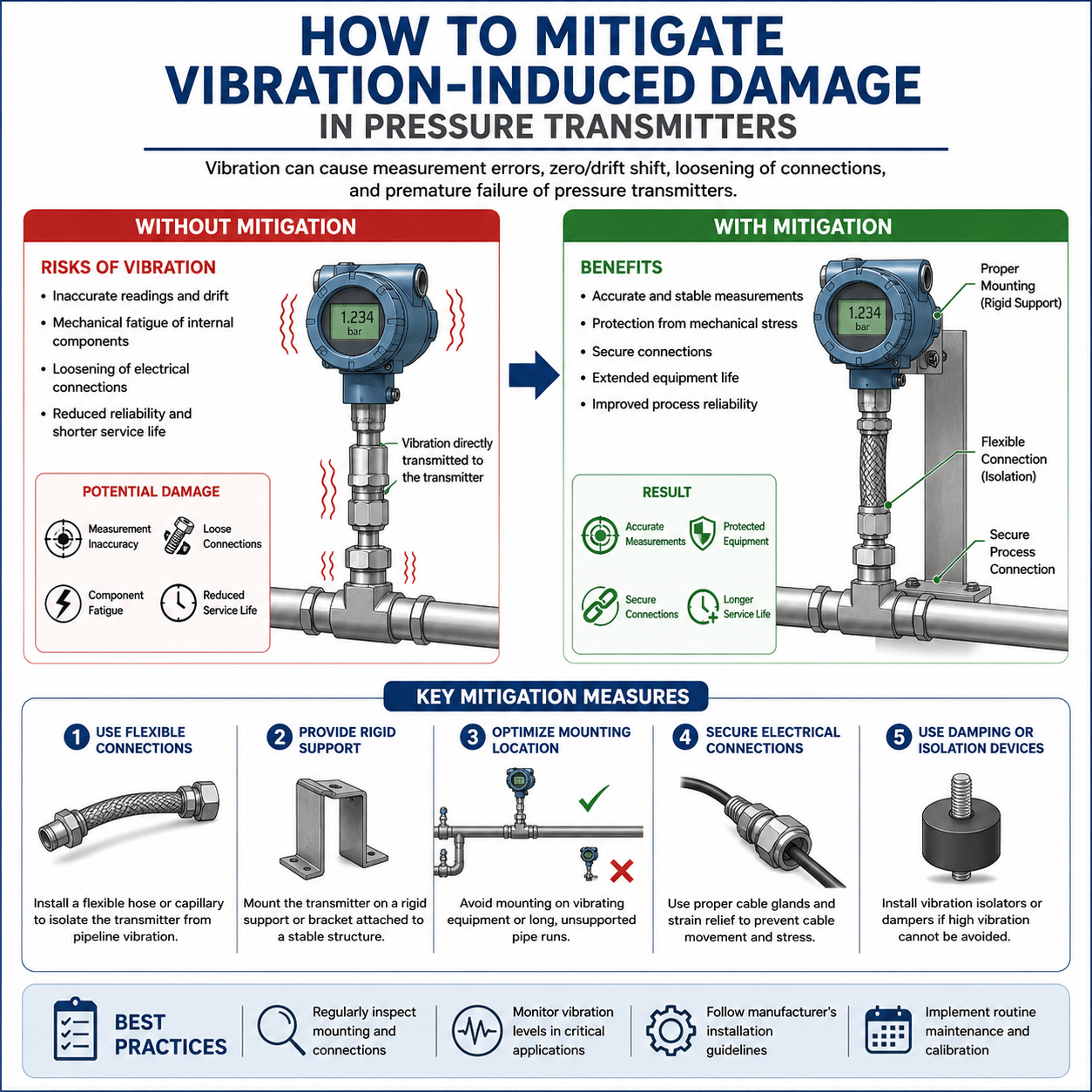
Pressure transmitters play a critical role in industrial automation systems, providing accurate pressure measurements for process control, equipment protection, and operational efficiency. From manufacturing plants and chemical processing facilities to water treatment systems and HVAC applications, reliable pressure monitoring is essential for maintaining stable operations.
However, one common challenge that can significantly impact transmitter performance and longevity is vibration.
Excessive vibration can introduce measurement inaccuracies, damage internal components, loosen electrical connections, and ultimately lead to premature transmitter failure. Understanding the causes of vibration-induced damage , and how to mitigate it , can help improve system reliability, reduce downtime, and extend equipment life.
Why Vibration Is a Problem for Pressure Transmitters
Industrial environments often expose instrumentation to continuous mechanical vibration generated by:
- Pumps
- Compressors
- Motors
- AC drives
- Fans and blowers
- Turbines
- Piping systems
- Reciprocating equipment
Pressure transmitters mounted directly on vibrating equipment or piping can experience repeated mechanical stress over time.
Even moderate vibration levels can create problems such as:
- Signal instability
- Measurement drift
- Fatigue cracking
- Sensor damage
- Electronics failure
- Loose wiring or fittings
- Calibration issues
The severity of damage often depends on:
- Vibration frequency
- Amplitude
- Exposure duration
- Mounting method
- Transmitter design
- Process conditions
Common Symptoms of Vibration-Induced Damage
Recognizing the warning signs early can help prevent unexpected failures.
Common symptoms include:
Unstable Pressure Readings
One of the earliest indicators is fluctuating or noisy pressure signals. Vibration can interfere with sensing elements and electrical components, causing unstable outputs.
Frequent Calibration Drift
Transmitters exposed to prolonged vibration may require more frequent recalibration due to internal mechanical stress.
Electrical Connection Problems
Repeated vibration can loosen terminal screws, connectors, or wiring, leading to intermittent communication issues or signal loss.
Mechanical Fatigue Cracks
Over time, vibration may cause fatigue damage to:
- Mounting brackets
- Process connections
- Welds
- Internal components
Premature Device Failure
Severe vibration can shorten the operational lifespan of both the sensing element and transmitter electronics.
Applications Most Susceptible to Vibration Issues
Certain applications naturally expose instrumentation to higher vibration levels.
These include:
- Pump skid systems
- Compressor stations
- Hydraulic systems
- Power generation equipment
- Industrial refrigeration systems
- Oil and gas processing
- Chemical plants
- Rotating machinery systems
Transmitters installed directly on process piping near rotating equipment are particularly vulnerable.
Understanding the Source of Vibration
Effective mitigation begins with identifying the root cause of vibration.
Mechanical Equipment Vibration
Rotating machinery often creates continuous vibration caused by:
- Imbalance
- Misalignment
- Bearing wear
- Mechanical looseness
Pipe Resonance
Long piping systems may amplify vibration through resonance effects, especially near pumps and compressors.
Fluid Pulsation
Positive displacement pumps and reciprocating compressors can create pressure pulsations that mechanically stress transmitters.
Structural Vibration
Building structures, skid assemblies, and support frames may transfer vibration into instrumentation systems.
Identifying the primary vibration source helps determine the best mitigation strategy.
Best Practices for Mitigating Vibration-Induced Damage
Several proven techniques can significantly reduce the impact of vibration on pressure transmitters.
Relocate the Transmitter Away from the Vibration Source
One of the most effective solutions is relocating the transmitter away from the most severe vibration zone.
Instead of mounting directly on vibrating equipment or piping, use:
- Remote mounting brackets
- Capillary systems
- Impulse lines
- Flexible tubing connections
Increasing physical separation often reduces transmitted vibration significantly.
Use Remote Seals or Capillary Systems
Remote seal systems allow the sensing element to be isolated from harsh mechanical conditions while maintaining accurate pressure measurement.
Benefits include:
- Reduced vibration exposure
- Improved thermal isolation
- Better protection from pulsation
- Extended transmitter life
These systems are especially valuable in demanding industrial environments.
Install Flexible Impulse Lines
Rigid piping transfers vibration directly into the transmitter body.
Flexible impulse tubing can help absorb mechanical movement and reduce stress on the instrument.
Properly installed flexible tubing:
- Dampens vibration transmission
- Reduces fatigue stress
- Helps stabilize measurements
Care should be taken to avoid unsupported tubing lengths that may introduce additional resonance.
Add Vibration Dampening Mounts
Specialized mounting hardware can isolate transmitters from mechanical vibration.
Common solutions include:
- Rubber isolation mounts
- Spring dampeners
- Shock absorbers
- Anti-vibration brackets
These components reduce the amount of vibration transferred into the transmitter housing.
Use Snubbers or Pulsation Dampeners
In systems with pressure pulsation, mechanical snubbers or pulsation dampeners can help stabilize both pressure and vibration effects.
These devices:
- Reduce pressure spikes
- Smooth pulsating flow
- Minimize sensor stress
- Improve signal stability
This is especially important in reciprocating pump applications.
Properly Support Process Piping
Poorly supported piping can amplify vibration and resonance.
Proper pipe support design helps reduce:
- Pipe movement
- Mechanical stress
- Resonance frequencies
- Instrument loading
Good piping practices improve both instrumentation reliability and overall system stability.
Select Transmitters Designed for Industrial Environments
Not all pressure transmitters offer the same vibration resistance.
Industrial-grade transmitters often feature:
- Reinforced internal construction
- Rugged housings
- Shock-resistant electronics
- Advanced sensor designs
- Improved vibration immunity
Selecting a transmitter specifically designed for harsh industrial applications can significantly improve long-term reliability.
Avoid Resonance Conditions
Every mechanical system has natural resonant frequencies.
If operating vibration matches the natural frequency of the transmitter assembly or mounting structure, vibration amplitude can increase dramatically.
Mitigation strategies include:
- Changing mounting configurations
- Increasing structural rigidity
- Adjusting support spacing
- Using damping materials
Avoiding resonance is critical for long-term equipment durability.
Verify Electrical Connections
Vibration can gradually loosen electrical terminations.
Regular inspection and maintenance should include:
- Checking terminal tightness
- Inspecting connectors
- Verifying grounding integrity
- Looking for cable wear
Secure wiring practices help maintain signal reliability.
Implement Preventive Maintenance
Routine inspection programs help detect vibration-related issues before failures occur.
Preventive maintenance may include:
- Visual inspections
- Calibration verification
- Signal trend analysis
- Mounting inspections
- Vibration monitoring
Monitoring equipment condition over time helps identify developing problems early.
The Role of Digital Signal Filtering
Some modern pressure transmitters include digital filtering features that help stabilize readings in vibrating environments.
Digital filtering can:
- Reduce signal noise
- Smooth output fluctuations
- Improve process control stability
However, filtering addresses signal instability , not the root mechanical cause of vibration damage. Mechanical mitigation strategies are still necessary.
Environmental Considerations
Industrial vibration issues are often compounded by other environmental factors such as:
- Temperature cycling
- Moisture
- Corrosive chemicals
- Electrical noise
A comprehensive instrumentation strategy should evaluate all environmental conditions together when selecting and installing transmitters.
Benefits of Proper Vibration Mitigation
Reducing vibration-induced stress can deliver several operational benefits:
Improved Measurement Accuracy
Stable sensors provide more consistent and reliable process data.
Longer Equipment Life
Reducing mechanical fatigue extends transmitter lifespan.
Reduced Maintenance Costs
Fewer failures and recalibrations reduce maintenance requirements.
Improved Process Reliability
Reliable instrumentation improves process control and operational stability.
Reduced Downtime
Preventing premature failures helps minimize unplanned outages.
Fuji Electric Pressure Measurement Solutions
Fuji Electric offers industrial pressure measurement solutions engineered for demanding applications and harsh operating environments.
Our pressure transmitters are designed to support:
- Stable process measurement
- Industrial durability
- Long-term reliability
- Harsh environmental operation
- High-performance automation systems
Fuji Electric instrumentation solutions help facilities improve process visibility, maintain measurement accuracy, and support reliable industrial operations even in challenging conditions.
Vibration is one of the most common causes of premature pressure transmitter failure in industrial environments. Left unaddressed, vibration can reduce measurement accuracy, damage instrumentation, and increase maintenance costs.
Fortunately, many vibration-related problems can be mitigated through proper installation practices, transmitter selection, mechanical isolation, and preventive maintenance strategies.
By understanding the sources of vibration and implementing effective mitigation techniques, facilities can improve instrumentation reliability, extend equipment life, and maintain more stable and efficient industrial processes.