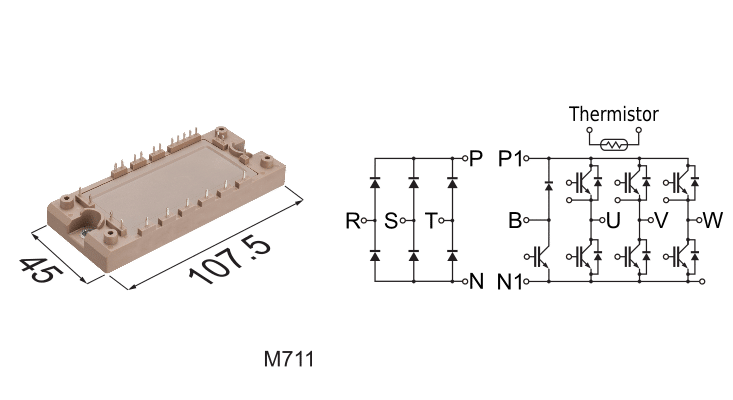
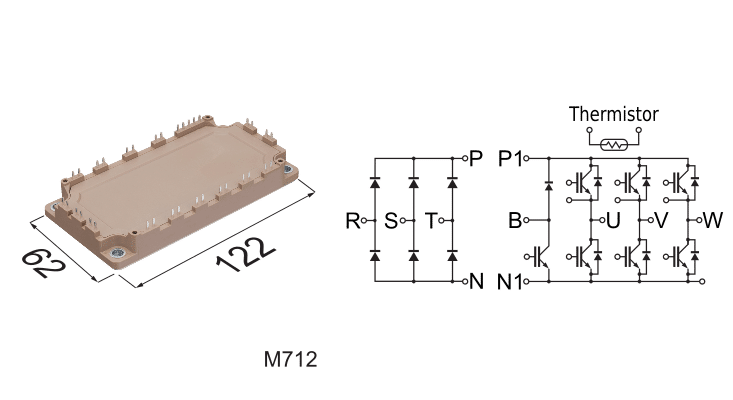
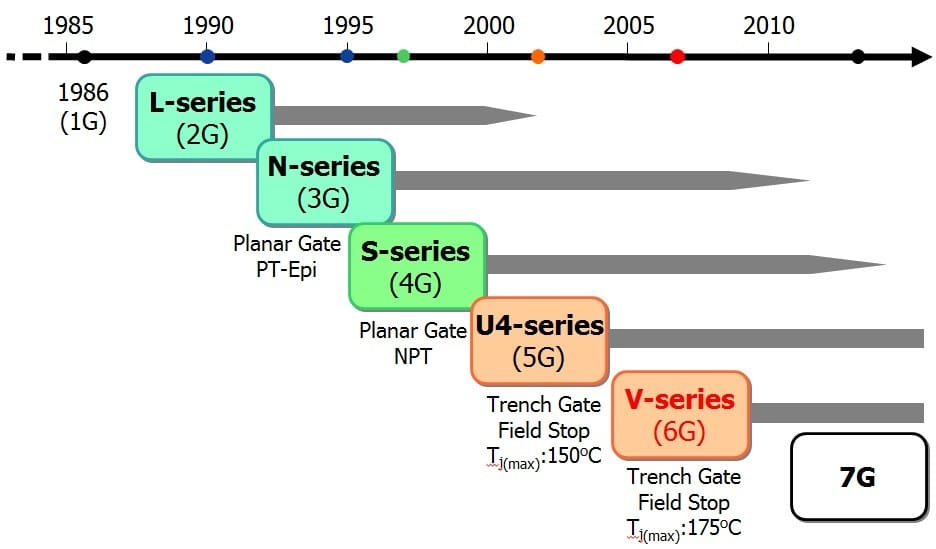
This product series uses our company’s 6th-generation IGBT chip set. This chip generation uses a trench gate structure that forms a three-dimensional gate over the silicon surface. It also contains a field stop structure (FS structure) to improve the characteristic of the element withstand voltage. These technologies made it possible to use a thinner silicon wafer which leads to a lower on-voltage, reduced switching losses, and improved switching speed control, compared to Fuji’s 5th generation IGBT (U-series IGBT).
FAQ Categories: Description of Terms
-
What is the V-series of IGBT?
-
What is the difference between PIM and IPM?
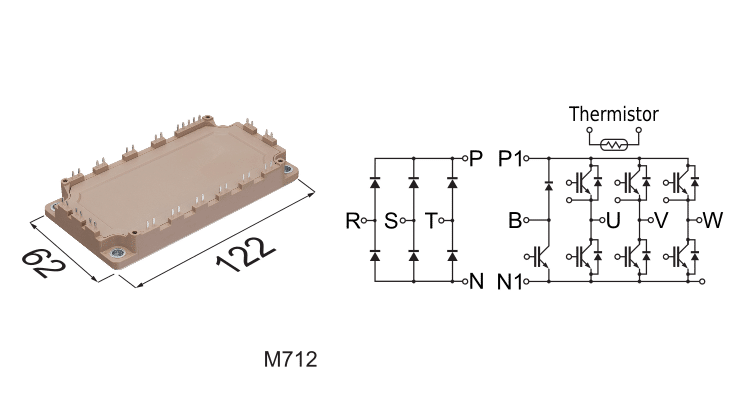
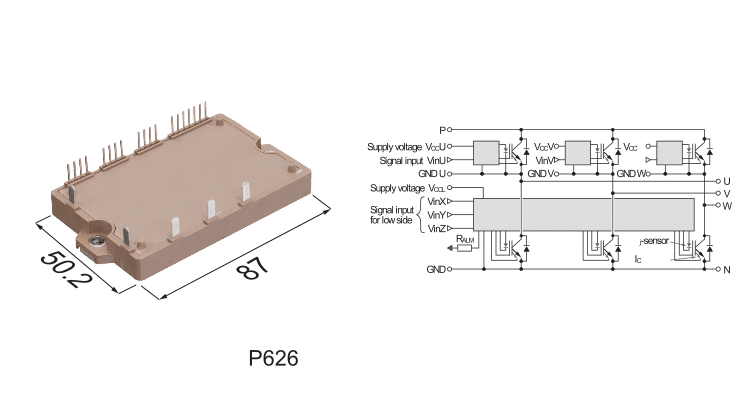
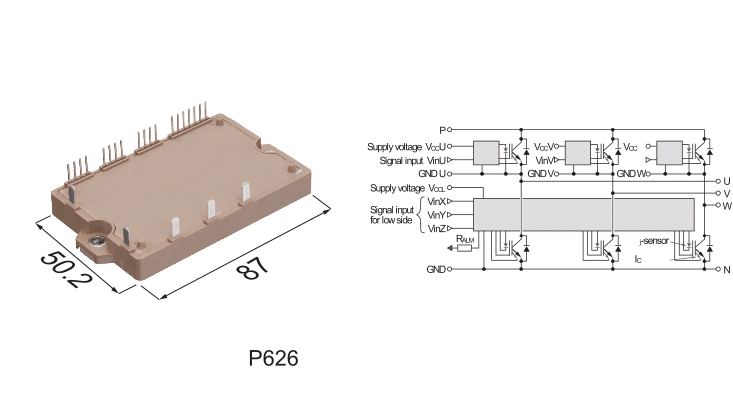
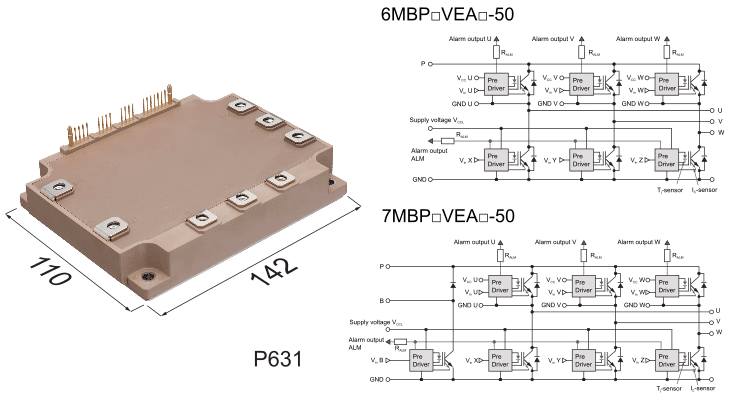
PIM is a product that integrates a 3-phase converter circuit, brake circuit, and 3-phase inverter circuit into a single module. This leads to a compact main circuit design. IPM, on the other hand, offers an advantage of simple peripheral circuit designing, by use of its built-in control IC. This IC contains gate driving and protection circuits, in addition to brake and inverter circuits.

-
What is a SiC hybrid module?
This is a product that uses a SiC-SBD (Shottky Barrier Diode) as FWD component, with a combination of Si-IGBT. This combination reduces the losses by approximately 25% in comparison with conventional all-silicon chip products. SiC devices are the focus of attention as next-generation semiconductors that offer superior characteristics in areas such as high withstand-voltage, high-temperature, and high-frequency operations.
-
What does IPM mean?
It stands for Intelligent Power Module. An IPM is a module product, based on a 3-phase inverter circuit with a control IC that contains a gate driving circuit and other protection circuits. This product makes it easier to design peripheral circuits than conventional IGBT modules with external driver circuits. The following configurations are possible: 7in1 with a brake circuit, and 6in1 without brake circuit.
-
What does PIM mean?
It stands for Power Integrated Module. A PIM is a module that is composed of a 3-phase rectifier circuit, 3-phase inverter circuit, and brake circuit. It is also called CIB (Converter Inverter Brake).
-
What is a module?
A module is a package which contains several power semiconductor devices that form a bridge circuit, etc. A modul provides thermal and electrical contact as well as the electrical insulation maintained between the heat-radiation surface and the electric part. For this reason multiple modules can be placed on the same heat sink. Compared to setups that operate with multiple discrete products, the module can handle a larger current and is superior because it is small, lightweight, and easy to assemble.
-
What does SiC mean?
It stands for Silicon Carbide. SiC has a wider bandgap width compared to silicon, and is expected to become the next-generation power device material for high-temperature operation, high-speed switching, low power-loss, and high withstand-voltage applications.
-
What is a RB-IGBT?
It stands for Reverse Blocking Insulated Gate Bipolar Transistor. Reverse-parallel connection of RB-IGBT enables both way switching. It is incorporated in AT-NPC (Advanced T-type Neutral Point Clamped) 3-level inverters, to increase the power conversion efficiency because there are less current passing elements.
-
What is the difference between an IGBT and a MOSFET?
An IGBT is a device that has a basic structure of a P-layer added to the drain side of a MOSFET. An IGBT is suited for large-current and high withstand-voltage applications. A MOSFET is suited for small-capacity and high-speed switching applications.
-
Why is FWD required?
Conventional IGBT elements are not capable of blocking a reverse-withstand voltage. When an inverter circuit is used to drive an inductive load like in a motor, the load current will continue flowing in the reverse direction (emitter to collector) at the time of switching. This may damage the IGBT. The IGBT is protected by a commutating load current in a diode (freewheeling diode: FWD) connected inversely in parallel.