
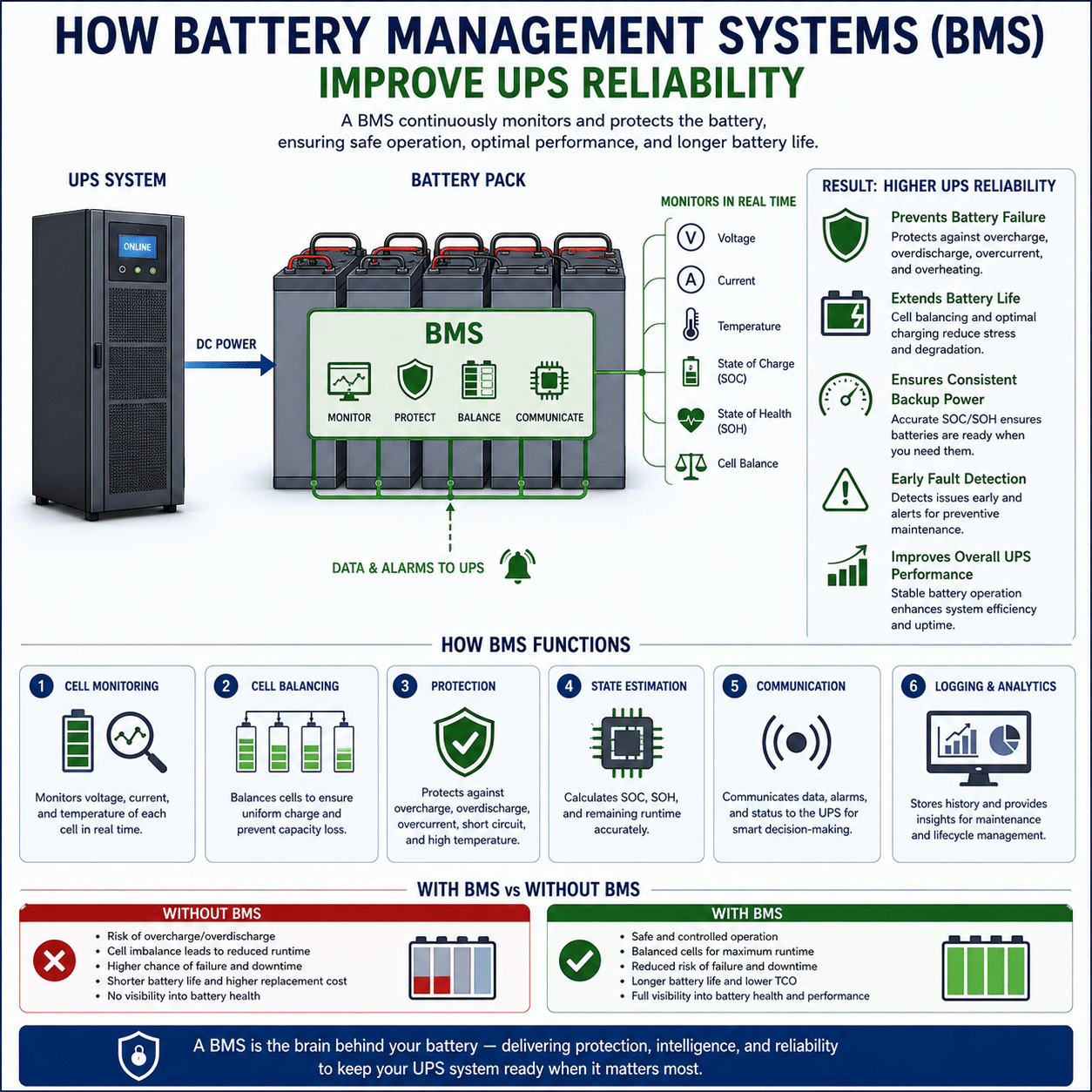
Uninterruptible Power Supply (UPS) systems play a critical role in maintaining power continuity for mission-critical operations. From data centers and healthcare facilities to industrial automation systems and telecommunications infrastructure, UPS systems protect equipment and operations from power disturbances, outages, and voltage instability.
At the heart of every UPS system is the battery system. While UPS electronics often receive significant attention, battery reliability ultimately determines whether backup power will be available when it is needed most. This is where Battery Management Systems (BMS) become essential.
Modern Battery Management Systems help improve UPS reliability by continuously monitoring, protecting, and optimizing battery performance. As battery technologies evolve and facilities demand greater uptime, BMS technologies are becoming increasingly important for maintaining dependable backup power systems.
What Is a Battery Management System (BMS)?
A Battery Management System is an electronic control and monitoring system designed to supervise battery operation and ensure safe, reliable performance.
A BMS continuously monitors key battery parameters such as:
- Voltage
- Current
- Temperature
- State of charge (SOC)
- State of health (SOH)
- Cell balancing conditions
- Charging and discharging behavior
The system uses this data to protect the batteries, optimize performance, and provide visibility into battery condition.
BMS platforms are commonly used with:
- Lithium-ion battery systems
- Advanced energy storage systems
- Modern UPS platforms
- Renewable energy storage applications
- Mission-critical backup systems
Why Battery Reliability Matters in UPS Systems
The battery system is often the most vulnerable component within a UPS installation.
Even when UPS electronics remain fully operational, battery failures can prevent backup power delivery during an outage.
Common battery-related UPS problems include:
- Reduced runtime
- Premature battery aging
- Overheating
- Cell imbalance
- Unexpected failures
- Thermal runaway risks
- Inaccurate runtime predictions
In many facilities, batteries are expected to remain on standby for long periods while still being capable of delivering immediate power during an emergency. Without proper monitoring and management, battery degradation may go unnoticed until failure occurs.
The Growing Importance of BMS Technology
As UPS systems increasingly adopt lithium-ion battery technologies, Battery Management Systems have become even more critical.
Compared to traditional valve-regulated lead-acid (VRLA) batteries, lithium-ion systems offer:
- Higher energy density
- Longer lifespan
- Faster charging
- Reduced maintenance
- Smaller footprint
However, lithium-ion batteries require more advanced monitoring and control to ensure safe operation.
BMS platforms provide the intelligence needed to safely manage these advanced battery systems while maximizing performance and reliability.
How Battery Management Systems Improve UPS Reliability
Battery Management Systems support UPS reliability in several important ways.
Continuous Battery Monitoring
One of the primary functions of a BMS is real-time monitoring of battery conditions.
The BMS continuously tracks:
- Individual cell voltages
- Battery temperatures
- Charging current
- Discharge current
- Internal resistance
- Overall pack performance
This constant visibility helps identify abnormalities before they become critical failures.
Without continuous monitoring, battery degradation may remain undetected until the UPS is called upon during a power outage.
Early Fault Detection
A major advantage of BMS technology is predictive fault detection.
The system can identify warning signs such as:
- Weak cells
- Voltage imbalance
- Excessive temperatures
- Abnormal charging behavior
- Capacity degradation
Early detection allows maintenance teams to address issues proactively, reducing the likelihood of unexpected battery failure.
Cell Balancing Improves Performance
Battery packs contain multiple cells connected together. Over time, slight differences between cells can lead to imbalance.
Cell imbalance may cause:
- Reduced runtime
- Uneven aging
- Reduced charging efficiency
- Increased thermal stress
A BMS performs cell balancing by equalizing charge levels across cells.
Proper balancing:
- Maximizes usable battery capacity
- Improves runtime consistency
- Extends battery life
- Enhances overall reliability
Temperature Management
Temperature is one of the most important factors affecting battery performance and lifespan.
Excessive heat can accelerate:
- Battery degradation
- Capacity loss
- Thermal stress
- Safety risks
Low temperatures may reduce battery performance and discharge capability.
A BMS monitors battery temperatures continuously and may:
- Trigger alarms
- Adjust charging parameters
- Activate cooling systems
- Shut down unsafe operation
Effective thermal management significantly improves long-term UPS reliability.
Protection Against Overcharging and Deep Discharge
Improper charging and discharging can permanently damage batteries.
The BMS helps protect batteries from:
- Overvoltage conditions
- Undervoltage conditions
- Excessive charging current
- Excessive discharge current
These protections help preserve battery health and prevent catastrophic failures.
Improved Runtime Accuracy
Modern BMS platforms provide more accurate runtime predictions by analyzing:
- State of charge
- Battery health
- Load conditions
- Temperature effects
This allows operators to better understand actual backup power availability during outages.
Improved runtime visibility supports better operational planning and emergency preparedness.
Enhanced Safety
Battery safety is a major concern in mission-critical facilities.
A BMS helps reduce risks associated with:
- Thermal runaway
- Short circuits
- Overheating
- Internal battery faults
- Unsafe operating conditions
If dangerous conditions are detected, the BMS can automatically disconnect the battery system or trigger protective actions.
This is especially important in high-energy lithium-ion battery systems.
Extending Battery Lifespan
Battery replacement represents a major portion of UPS lifecycle costs.
A properly managed battery system can significantly extend operational lifespan by:
- Reducing thermal stress
- Preventing overcharging
- Maintaining balanced cells
- Optimizing charge cycles
- Minimizing deep discharges
Longer battery life reduces:
- Maintenance costs
- Replacement frequency
- Operational disruptions
Supporting Predictive Maintenance
Modern BMS platforms generate valuable operational data that supports predictive maintenance strategies.
Facilities can analyze:
- Historical performance trends
- Temperature patterns
- Capacity degradation
- Charging behavior
- Alarm history
This data helps maintenance teams schedule service proactively rather than reacting to failures.
Predictive maintenance improves both reliability and operational efficiency.
Remote Monitoring and Communication
Many advanced BMS platforms support remote monitoring and industrial communication protocols.
This enables integration with:
- Building management systems (BMS)
- SCADA systems
- Data center infrastructure management (DCIM)
- Remote monitoring platforms
Operators can receive real-time alerts and monitor battery status across multiple UPS installations.
Remote visibility improves response times and system oversight.
Supporting Redundancy Strategies
In mission-critical environments, redundancy is essential.
BMS technologies help support redundant UPS architectures by providing:
- Independent battery monitoring
- Fault isolation
- System diagnostics
- Load-sharing visibility
Improved monitoring helps maintain reliability in parallel UPS configurations.
Common Applications Benefiting from BMS Integration
Battery Management Systems are increasingly important across many industries.
Data Centers
Continuous uptime and backup power reliability are critical for preventing data loss and service interruptions.
Healthcare Facilities
Hospitals and medical facilities require reliable emergency power for life-safety systems and critical equipment.
Industrial Facilities
Manufacturing operations rely on UPS systems to protect automation systems, control equipment, and sensitive processes.
Telecommunications
Network infrastructure depends on stable backup power to maintain communication services during outages.
Renewable Energy Systems
Energy storage systems require advanced battery management for reliable operation and grid support.
Challenges Without a BMS
UPS systems operating without advanced battery monitoring may experience:
- Undetected battery degradation
- Inaccurate runtime expectations
- Increased failure risk
- Reduced battery life
- Limited fault visibility
- Greater maintenance uncertainty
In critical applications, these limitations can significantly increase operational risk.
Fuji Electric UPS Solutions
Fuji Electric provides advanced UPS solutions designed to support high reliability, operational continuity, and efficient power protection across demanding applications.
Our UPS technologies support:
- Advanced battery integration
- Reliable backup power performance
- Intelligent monitoring capabilities
- Energy-efficient operation
- Mission-critical infrastructure protection
Fuji Electric solutions help facilities improve uptime, protect sensitive equipment, and maintain dependable power continuity in modern industrial and commercial environments.
Battery reliability is one of the most important factors in overall UPS system performance. As backup power systems become more advanced and battery technologies continue evolving, Battery Management Systems are playing an increasingly vital role in maintaining operational reliability and safety.
By providing continuous monitoring, fault detection, thermal management, cell balancing, and predictive diagnostics, BMS technologies help facilities reduce downtime risk, extend battery life, and improve confidence in backup power availability.
For organizations that depend on uninterrupted power, integrating advanced Battery Management Systems is no longer simply an added feature, it is a critical component of modern UPS reliability strategy.