
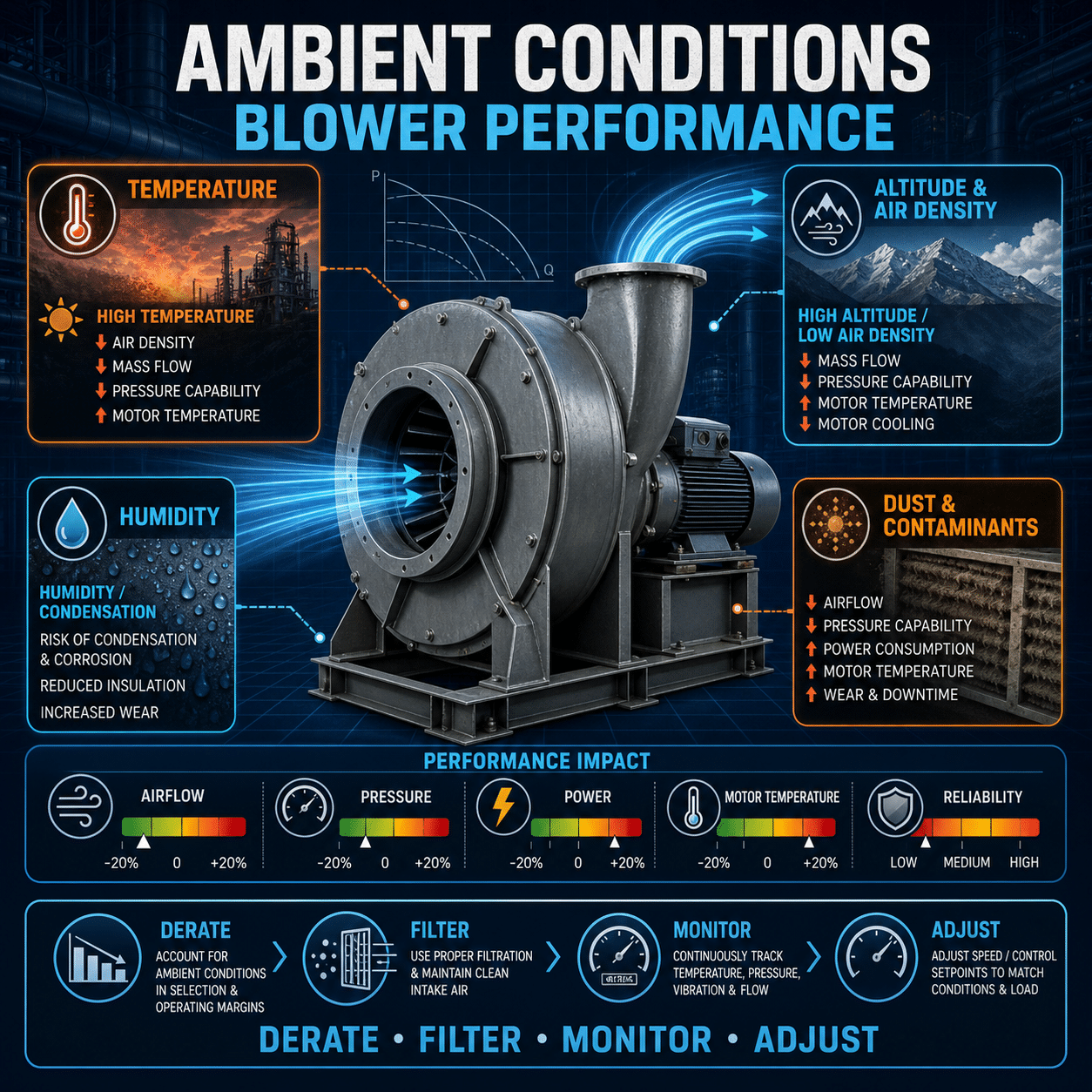
A blower does not operate independently of its environment. Altitude, temperature, and humidity change the properties of the air entering the machine, and those changes can affect mass flow, pressure capability, power demand, cooling, and process performance.
This is why a blower that performs well during a factory test may behave differently at a high-altitude installation or during a hot, humid summer. The machine may still move approximately the expected volume of air, yet deliver less oxygen, less cooling capacity, or less pneumatic-conveying capability.
Correctly evaluating blower performance requires one fundamental distinction: the difference between moving a volume of air and moving a mass of air.
Air Volume Is Not Air Mass
Blower capacity is often expressed in cubic feet per minute or cubic meters per hour. These units describe volumetric flow, the amount of space occupied by the air passing through the system.
Many processes, however, depend on mass flow rather than volume.
Examples include:
- Supplying oxygen for biological treatment
- Providing combustion air
- Cooling equipment
- Drying a product
- Aerating a tank
- Conveying material pneumatically
- Supporting a chemical reaction
The relationship is straightforward:
Mass flow = air density × actual volumetric flow
If air density decreases while the blower moves the same actual volume, the delivered mass flow decreases.
For example, if inlet-air density falls by 10 percent and actual volumetric flow remains unchanged, the blower delivers approximately 10 percent less air mass. A process requiring a fixed oxygen or cooling duty may therefore become under-supplied even though the flow display still appears normal.
Actual Flow Versus Standard Flow
Confusion often arises because airflow may be reported under either actual or standardized conditions.
Actual cubic feet per minute (ACFM) describes the volume entering or leaving the blower at the real local pressure, temperature, and humidity.
Standard cubic feet per minute (SCFM) expresses an equivalent volume at defined reference conditions.
Because different industries and organizations may use different standard temperatures, pressures, and humidity assumptions, “standard” must always be defined. An SCFM value without stated reference conditions is incomplete.
At high altitude or elevated inlet temperature, a blower may need to handle a greater actual volume to deliver the same standard flow or mass flow. The inlet piping, filters, valves, silencers, and blower inlet must all accommodate that increased actual volume.
Why Altitude Matters
Atmospheric pressure decreases as elevation increases. Lower inlet pressure means lower air density.
A blower operating at high altitude therefore takes in less air mass per revolution than the same blower operating near sea level, assuming similar inlet temperature and volumetric displacement.
The practical effects can include:
- Lower mass-flow delivery
- Reduced oxygen delivery
- Lower cooling capacity
- Increased actual volume required for the same process duty
- Changed pressure ratio
- Reduced motor and drive cooling
- Potential electrical-equipment derating
The effect is not limited to the blower. Motors, variable frequency drives, and control enclosures may also require altitude derating because thinner air removes heat less effectively and provides less dielectric strength.
Gauge Pressure Can Be Misleading at Altitude
Blower requirements are often stated as gauge pressure, for example, 8 psig. Gauge pressure is measured relative to local atmospheric pressure.
At sea level, an 8 psig discharge corresponds to a lower pressure ratio than the same 8 psig discharge at high altitude.
Pressure ratio is calculated using absolute pressure:
Pressure ratio = discharge absolute pressure ÷ inlet absolute pressure
Suppose inlet pressure is approximately 14.7 psia near sea level. Producing 8 psig gives a discharge pressure of approximately 22.7 psia and a pressure ratio near 1.54.
At an elevated location where inlet pressure is 12.0 psia, producing the same 8 psig gives a discharge pressure of approximately 20.0 psia, but the pressure ratio rises to about 1.67.
The gauge pressure is unchanged, yet the blower is being asked to achieve a higher pressure ratio. That can increase discharge temperature and move a dynamic blower closer to an operating limit.
Blower selection should therefore be based on absolute inlet and discharge conditions, not gauge pressure alone.
Altitude and Centrifugal Blowers
A centrifugal blower transfers energy to the air through a rotating impeller. At a given speed and similar inlet conditions, its actual volumetric-flow behavior is closely tied to the machine’s geometry and the connected system.
Because pressure rise and power are density-dependent, a lower inlet density generally means that a centrifugal blower at the same speed develops less pressure rise and consumes less aerodynamic power.
If the process requires the same pressure rise and mass flow at altitude, compensation may require:
- Higher blower speed
- A larger impeller or blower
- Multiple machines
- Reduced system resistance
- A different operating point
Speed increases must remain within mechanical, aerodynamic, motor, and drive limits. A blower selected too close to its maximum speed at sea-level conditions may have little remaining capacity to compensate for altitude.
Dynamic blowers also have operating boundaries such as surge, choke, and maximum speed. Changes in inlet density and pressure ratio can move the operating point relative to those limits.
Altitude and Positive-Displacement Blowers
A positive-displacement blower moves an approximately fixed volume per revolution, minus internal leakage or slip. At altitude, it may continue to move a similar actual inlet volume, but that volume contains less air mass.
To provide the same mass flow, the blower may need to run faster or be replaced with a larger unit.
Positive-displacement blowers also experience discharge-temperature and power effects associated with pressure ratio and differential pressure. At high altitude, achieving the same discharge gauge pressure results in a higher pressure ratio, which can increase thermal stress even when the inlet mass flow is lower.
Maximum speed, discharge temperature, differential pressure, torque, and motor capacity must all be checked before increasing blower speed.
The Effect of Inlet Temperature
Warm air is less dense than cool air at the same pressure. As inlet temperature rises, each cubic foot or cubic meter contains less air mass.
This can produce:
- Lower mass flow at the same actual volumetric flow
- Lower oxygen delivery
- Reduced cooling or drying capacity
- Higher inlet volume required for the same process duty
- Higher blower discharge temperature
- Reduced cooling of the motor and drive
- Less operating margin in temperature-sensitive equipment
Seasonal temperature changes can therefore create noticeable differences in process performance.
A system commissioned on a cold day may appear to have ample capacity. During summer, lower air density and higher equipment temperature may reveal that the design has insufficient margin.
Discharge Temperature
Compression raises air temperature. The amount of heating depends on factors including pressure ratio, blower efficiency, heat transfer, inlet temperature, and blower type.
A higher inlet temperature normally results in a higher discharge temperature for the same compression conditions. This may affect:
- Lubricant life
- Bearing temperature
- Seal life
- Belt life
- Downstream piping
- Flexible connectors
- Filters and silencers
- Process temperature
- Instrument limits
For positive-displacement machines, excessive discharge temperature is a common operating constraint. For centrifugal machines, elevated temperature can also affect density, pressure capability, and aerodynamic margin.
Discharge-temperature alarms and shutdown settings should reflect the manufacturer’s limits and expected site conditions.
Temperature and System Resistance
Ambient temperature can also change the system curve.
In many air systems, pressure loss depends on density, velocity, and friction. If the process requires a constant mass flow, warmer, less-dense air must move at a higher actual velocity. That greater velocity can increase pressure loss through:
- Filters
- Ducts and pipes
- Valves
- Diffusers
- Heat exchangers
- Silencers
- Process equipment
The blower may therefore need to move a larger actual volume through a system that also becomes more restrictive at that higher volume.
This combined effect is why a simple density correction may not fully describe hot-weather performance.
Humidity and Air Density
Humidity affects density because water vapor has a lower molecular weight than dry air. At the same temperature and total pressure, humid air is slightly less dense than dry air.
This sometimes seems counterintuitive because humid air can feel “heavy.” Thermodynamically, however, adding water vapor displaces some of the heavier nitrogen and oxygen molecules, reducing the density of the mixture.
The effect of humidity on density is usually smaller than the effects of altitude or temperature, but it can still matter in:
- High-accuracy mass-flow calculations
- Aeration systems
- Combustion systems
- Performance testing
- Hot and humid climates
- Applications operating close to capacity
Humidity also changes the amount of dry air and oxygen contained in a given actual volume. For processes that depend on oxygen delivery, using total wet-air flow without correcting for water-vapor content can overstate the useful oxygen supplied.
Condensation Can Be More Important Than Density
Humidity’s most serious effect is often not its modest influence on density, it is the possibility of condensation.
Air may enter the blower warm and humid, then cool in the inlet piping or during a shutdown. If its temperature falls below the dew point, water can condense.
Condensation may cause:
- Corrosion
- Contaminated lubricant
- Bearing damage
- Rotor or impeller fouling
- Filter saturation
- Instrument problems
- Reduced silencer performance
- Freezing in cold climates
- Unstable process measurements
Moisture can also condense downstream as compressed air cools. Drainage, piping slope, separators, aftercoolers, insulation, and low-point drains may therefore be necessary.
A humidity value alone does not establish condensation risk. Dew point and the temperature of exposed surfaces must be considered together.
Combined Ambient Effects
Altitude, temperature, and humidity should not be evaluated independently because they act on the same inlet-air density.
The lowest density often occurs when:
- Elevation is high
- Atmospheric pressure is low
- Inlet temperature is high
- Humidity is high
This combination produces the lowest mass flow for a given actual volume.
The most demanding thermal condition may occur at the same time because hot, thin air reduces cooling while the blower may need to run faster to satisfy the process.
Cold conditions can create a different worst case. Denser air may increase aerodynamic power demand on a centrifugal blower, potentially overloading the motor if speed or controls are not limited appropriately.
A good design therefore evaluates more than one extreme:
- Hot, humid, low-density operation
- Cold, dense-air operation
- Minimum and maximum atmospheric pressure
- Startup conditions
- Maximum required pressure
- Dirty-filter or high-resistance conditions
How Ambient Conditions Affect Different Performance Variables
Actual volumetric flow
Depending on blower type and control strategy, actual inlet volume may remain relatively stable or vary with the system operating point.
Mass flow
Mass flow falls when density falls unless the blower increases actual volumetric flow enough to compensate.
Pressure rise
For a centrifugal blower at fixed speed, pressure capability generally decreases with lower density. Positive-displacement machines respond differently but remain subject to pressure-ratio, temperature, and torque limits.
Power
Centrifugal blower aerodynamic power generally changes with gas density at a fixed operating point. Positive-displacement blower power is strongly influenced by actual inlet volume, differential pressure, efficiency, and mechanical losses.
Temperature
Higher inlet temperature and higher pressure ratio can raise discharge temperature. Reduced air density can also weaken equipment cooling.
Process capacity
Aeration, combustion, cooling, drying, and conveying performance may decline even if actual volumetric flow appears unchanged.
Common Misconceptions
“The blower is rated for the required CFM, so ambient conditions do not matter.”
A CFM value is meaningless without knowing whether it is actual or standard and under which inlet conditions it applies.
“Humidity makes air denser.”
At the same temperature and pressure, humid air is slightly less dense than dry air. Humidity may feel oppressive, but that sensation is related largely to reduced evaporative cooling from the body.
“The same discharge gauge pressure means the same blower duty.”
Not necessarily. At high altitude, the same gauge pressure corresponds to a higher pressure ratio.
“Altitude correction only affects airflow.”
Altitude can also affect blower pressure capability, discharge temperature, motor cooling, VFD capacity, electrical insulation, and process performance.
“Hot weather always reduces motor load.”
This may be true for some aerodynamic operating conditions, but it is not a safe general rule. Controls may increase speed to maintain mass flow, system resistance may change, and the motor’s cooling capability may decline.
“A VFD can correct any ambient-condition problem.”
A VFD can increase speed only within the blower, motor, and drive limits. It cannot create capacity beyond maximum speed, power, torque, pressure, temperature, or surge constraints.
Selecting a Blower for Real Site Conditions
A reliable blower specification should define:
- Installation elevation
- Minimum and maximum atmospheric pressure
- Inlet temperature range
- Relative humidity or moisture content
- Required mass or standard flow
- Actual inlet volume
- Required discharge pressure
- Inlet and discharge pressure losses
- Gas composition
- Expected filter condition
- Minimum and maximum operating rates
- Required turndown
- Maximum permitted discharge temperature
- Motor and drive ambient ratings
- Applicable operating margin
The supplier should evaluate the complete operating envelope rather than one nominal duty point.
If the process requirement is fundamentally mass-based, the specification should state mass flow or a clearly defined standard volumetric flow. The blower manufacturer can then convert that requirement to actual inlet volume at the site conditions.
Controls That Compensate for Ambient Changes
A fixed-speed blower cannot automatically replace mass-flow capacity lost as air density changes. A variable-speed system can compensate by increasing actual volume, provided sufficient capacity remains.
Possible control strategies include:
- Direct mass-flow control
- Standard-flow control with pressure and temperature compensation
- Dissolved-oxygen control in aeration systems
- Combustion oxygen or excess-air control
- Header-pressure control with coordinated flow demand
- Temperature-based cooling control
Direct measurement of the process result is often valuable. For example, dissolved-oxygen feedback can account for changes in air density as well as changes in biological demand and oxygen-transfer efficiency.
Controls should include limits for:
- Maximum blower speed
- Maximum motor current
- Maximum torque
- Maximum discharge pressure
- Maximum discharge temperature
- Minimum surge margin
- Minimum stable flow
Compensation must stop before the machine enters an unsafe operating region.
Useful Diagnostic Indicators
Changes in ambient conditions can resemble blower or process faults. Trending the following values helps separate these effects:
- Inlet temperature
- Inlet absolute pressure
- Relative humidity or dew point
- Actual volumetric flow
- Standard or mass flow
- Blower speed
- Motor current and power
- Inlet-filter differential pressure
- Discharge pressure
- Pressure ratio
- Discharge temperature
- Vibration
- Bearing temperature
- Control output
- Process response
For example, increasing speed accompanied by stable mass flow and rising inlet temperature may show that the controller is correctly compensating for lower air density. Increasing speed with falling mass flow and rising filter differential pressure instead points toward an inlet restriction.
A Practical Performance Review
When blower capacity changes with the weather or installation location, use a structured review:
- Confirm whether flow is displayed as actual, standard, or mass flow.
- Verify the reference conditions used for standard flow.
- Measure inlet absolute pressure, not just local weather-station pressure.
- Record inlet temperature at the blower, not at a distant outdoor sensor.
- Include humidity when the required accuracy justifies it.
- Calculate inlet density and required actual volume.
- Check pressure ratio using absolute pressures.
- Plot the corrected duty point on the manufacturer’s performance map.
- Verify speed, power, torque, surge, and temperature limits.
- Review motor and VFD altitude and temperature derating.
- Check filter, silencer, and piping losses at the required actual volume.
- Evaluate both hot-weather and cold-weather extremes.
The Bottom Line
Ambient conditions can change blower performance even when the machine itself has not changed.
Altitude reduces atmospheric pressure and air density. High temperature reduces density further and raises thermal stress. Humidity produces a smaller density reduction but can affect oxygen content, mass-flow calculations, corrosion, and condensation risk.
The most important practical lesson is that constant actual volume does not mean constant air mass. A blower may appear to deliver the expected CFM while the process receives less oxygen, less cooling capacity, or less conveying force.
Reliable selection and operation therefore require performance to be evaluated at actual site conditions, using absolute pressure, inlet temperature, humidity, and clearly defined flow units. When those factors are built into equipment sizing, controls, and diagnostics, seasonal and altitude-related performance changes become predictable engineering conditions rather than unexpected blower problems.