
Power semiconductors are the foundation of modern power electronics systems, enabling efficient energy conversion and motor control across applications such as industrial automation, renewable energy, electric vehicles, UPS systems, robotics, HVAC equipment, and data centers.
As power densities continue to increase and systems become more compact, thermal management has become one of the most critical aspects of semiconductor reliability. One of the most serious thermal-related failure mechanisms in power electronics is thermal runaway.
Thermal runaway can rapidly escalate from a localized temperature increase into catastrophic semiconductor failure, potentially damaging surrounding components and causing system downtime. Understanding the causes, risks, and prevention methods associated with thermal runaway is essential for improving reliability and long-term system performance.
What Is Thermal Runaway?
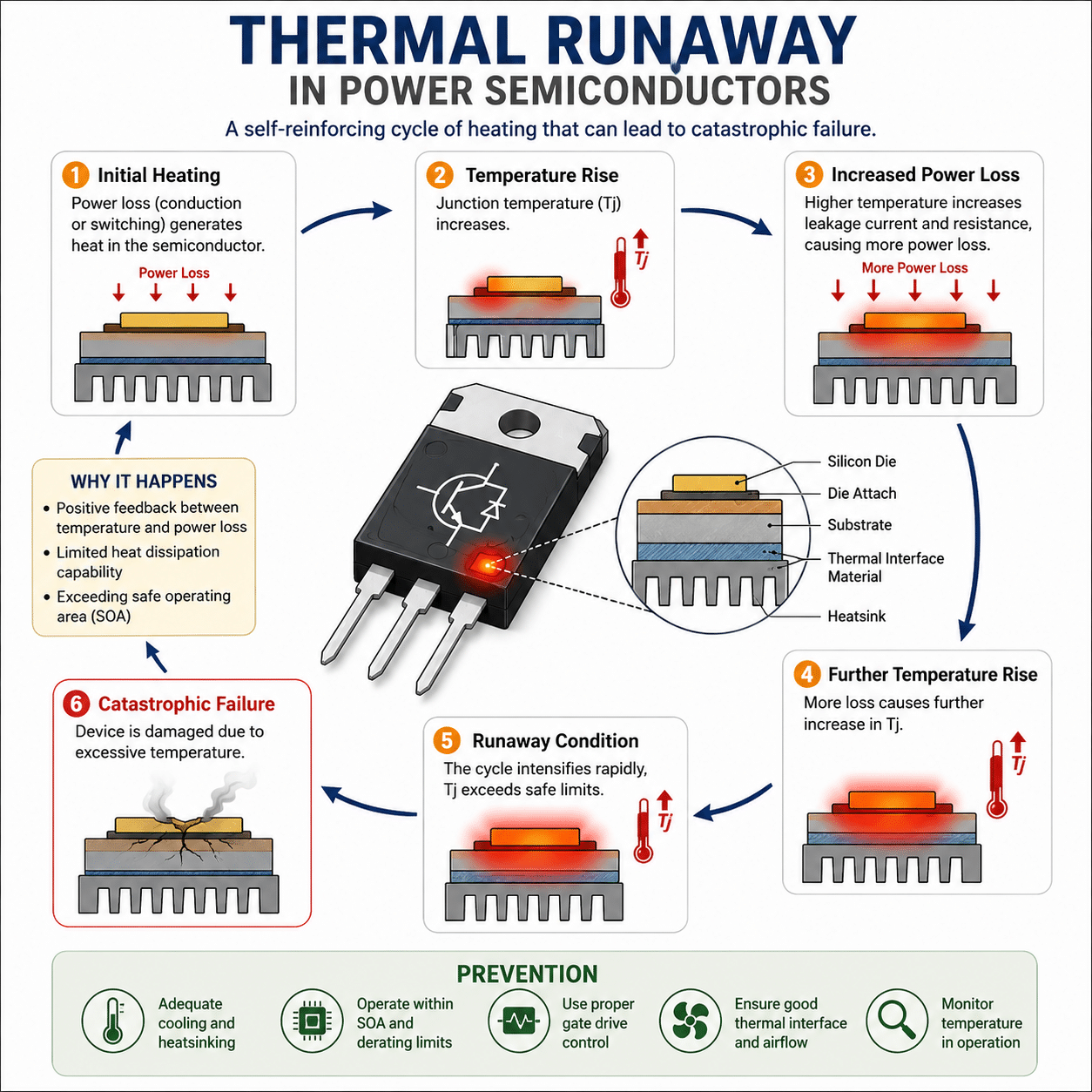
Thermal runaway occurs when increasing device temperature causes higher power dissipation, which then creates even more heat. This self-reinforcing cycle can quickly drive the semiconductor beyond safe operating limits.
In many semiconductor devices, electrical characteristics change as temperature rises. Under certain operating conditions, higher temperatures may increase current flow or conduction losses, producing additional heat faster than the system can dissipate it.
If heat generation exceeds the cooling system’s ability to remove heat, junction temperatures continue rising until permanent damage occurs.
Thermal runaway can affect various power semiconductor devices, including:
- IGBTs
- MOSFETs
- Diodes
- SiC devices
- Power modules
- Bipolar transistors
Why Thermal Runaway Matters
Power semiconductor failures can have major consequences in industrial and commercial systems.
Thermal runaway may result in:
- Catastrophic semiconductor failure
- Equipment shutdowns
- Damage to surrounding circuitry
- Reduced system reliability
- Safety hazards
- Increased maintenance costs
- Production downtime
In high-power applications such as motor drives, renewable energy inverters, and EV charging systems, preventing thermal runaway is critical for maintaining operational stability and equipment longevity.
How Thermal Runaway Develops
Thermal runaway typically occurs through a repeating feedback loop:
- Device temperature increases.
- Electrical losses increase.
- Additional heat is generated.
- Junction temperature rises further.
- The cycle accelerates.
Without intervention, device temperatures can exceed safe operating limits in a very short time.
The risk is especially high in high-current and high-switching-frequency applications where semiconductors already operate near thermal limits.
Common Causes of Thermal Runaway
Several factors can contribute to thermal runaway in power semiconductor systems.
Inadequate Heat Dissipation
One of the most common causes is insufficient cooling capacity.
Heat generated inside the semiconductor must be transferred efficiently through:
- Device packaging
- Thermal interface materials
- Heat sinks
- Cooling systems
If thermal resistance is too high, heat accumulates inside the device.
Common cooling-related issues include:
- Undersized heat sinks
- Poor airflow
- Inadequate liquid cooling
- Contaminated cooling surfaces
- Improper thermal interface application
Even minor cooling inefficiencies can significantly impact junction temperatures.
Excessive Current
Operating semiconductors beyond their rated current increases conduction losses and junction heating.
Overcurrent conditions may result from:
- Motor stalls
- Short circuits
- Overloads
- Improper sizing
- Fault conditions
As current increases, power dissipation rises rapidly, increasing thermal stress.
High Switching Frequencies
Switching losses increase with frequency.
Applications using high-frequency switching may generate significant heat due to:
- Turn-on losses
- Turn-off losses
- Gate charging losses
- Reverse recovery losses
If switching losses exceed cooling capability, thermal runaway risk increases.
Poor PCB or Busbar Design
Thermal performance is heavily influenced by system layout.
Poor designs may create:
- Uneven current distribution
- Hot spots
- Increased parasitic inductance
- Localized thermal stress
Inadequate copper area or insufficient thermal pathways can worsen heat accumulation.
Uneven Current Sharing
In parallel semiconductor configurations, current imbalance can occur between devices.
If one device carries more current than others, it heats more rapidly. Higher temperature may further alter electrical characteristics, causing even greater imbalance.
This localized overheating can trigger thermal runaway in the overloaded device.
Elevated Ambient Temperatures
High surrounding temperatures reduce the cooling system’s ability to remove heat.
Applications exposed to:
- Outdoor environments
- Enclosed cabinets
- High-temperature industrial facilities
- Poor ventilation
may experience reduced thermal margins.
Gate Drive Issues
Improper gate drive design can increase semiconductor losses.
Examples include:
- Incorrect gate voltage
- Slow switching transitions
- Insufficient dead time
- Excessive ringing
- Gate instability
Suboptimal switching behavior increases power dissipation and thermal stress.
Degraded Thermal Interface Materials
Thermal interface materials (TIMs) help transfer heat between the semiconductor and heat sink.
Over time, TIM degradation may increase thermal resistance due to:
- Drying
- Pump-out effects
- Mechanical fatigue
- Improper mounting pressure
Reduced thermal conductivity can significantly elevate junction temperatures.
Semiconductor Characteristics and Thermal Behavior
Different semiconductor technologies respond differently to temperature changes.
Bipolar Devices
Traditional bipolar transistors can exhibit negative temperature characteristics that increase thermal runaway susceptibility.
MOSFETs
MOSFETs generally have positive temperature coefficients at higher operating regions, which can help improve current sharing in parallel configurations.
However, MOSFETs may still experience thermal runaway under certain conditions involving excessive switching losses or insufficient cooling.
IGBTs
IGBT thermal behavior depends on operating current and temperature range. Modern IGBT technologies are carefully engineered to improve thermal stability and reliability.
SiC Devices
Silicon carbide (SiC) semiconductors support higher temperature operation and improved efficiency, but thermal management remains essential due to extremely high power density.
Risks Associated with Thermal Runaway
Thermal runaway can produce severe consequences beyond simple device failure.
Catastrophic Device Destruction
Extreme temperatures may destroy:
- Semiconductor junctions
- Bond wires
- Packaging materials
- Solder connections
Failure may occur explosively in severe cases.
Secondary System Damage
Failed semiconductors can damage:
- Gate drivers
- Bus capacitors
- PCBs
- Motors
- Power supplies
- Adjacent modules
The resulting repair costs may be substantial.
Reduced Reliability and Lifespan
Even repeated near-runaway thermal cycling can accelerate:
- Solder fatigue
- Wire bond degradation
- Material aging
- Mechanical stress
Over time, this reduces overall system reliability.
Downtime and Operational Losses
Unexpected semiconductor failures can create:
- Production interruptions
- Unplanned maintenance
- Lost productivity
- Service disruptions
For mission-critical systems, downtime costs can be extremely high.
Strategies for Preventing Thermal Runaway
Preventing thermal runaway requires a comprehensive thermal management approach.
Proper Thermal Design
Effective cooling design is the first line of defense.
Key considerations include:
- Correct heat sink sizing
- Adequate airflow
- Liquid cooling when necessary
- Low thermal resistance pathways
- Proper enclosure ventilation
Thermal simulations are often used during system design to verify cooling performance.
Monitor Junction Temperatures
Temperature monitoring helps detect abnormal operating conditions before failure occurs.
Modern systems may use:
- Embedded temperature sensors
- Thermal shutdown protection
- Real-time diagnostics
- Predictive monitoring systems
Active monitoring improves system protection and reliability.
Use Appropriate Semiconductor Ratings
Devices should be selected with adequate safety margins for:
- Current
- Voltage
- Temperature
- Switching frequency
Operating continuously near maximum ratings reduces thermal margin and increases failure risk.
Optimize Switching Performance
Proper gate driver design minimizes switching losses.
Optimization may include:
- Gate resistor tuning
- Controlled switching speeds
- Dead-time optimization
- Low-inductance layouts
Efficient switching reduces overall heat generation.
Improve Thermal Interface Quality
Proper thermal interface application is critical.
Best practices include:
- Uniform mounting pressure
- High-quality TIM materials
- Clean mounting surfaces
- Periodic inspection and replacement
Reducing interface resistance improves heat transfer efficiency.
Balance Parallel Devices Properly
Parallel semiconductor designs should ensure balanced current sharing through:
- Matched devices
- Symmetrical layouts
- Proper gate drive design
- Current balancing techniques
Uniform current distribution reduces localized overheating risk.
Implement Protective Circuits
Protective functions help prevent dangerous operating conditions.
Common protections include:
- Overcurrent protection
- Thermal shutdown
- Short-circuit protection
- Desaturation detection
- Soft shutdown circuits
Fast fault response helps prevent thermal escalation.
Maintain Cooling Systems
Cooling system degradation can increase thermal resistance over time.
Preventive maintenance should include:
- Fan inspection
- Filter cleaning
- Coolant verification
- Heat sink cleaning
- Airflow monitoring
Maintained cooling systems improve long-term reliability.
The Importance of Thermal Simulation
Thermal modeling and simulation are increasingly important in modern power electronics design.
Simulation tools help engineers evaluate:
- Junction temperatures
- Airflow patterns
- Heat distribution
- Cooling effectiveness
- Worst-case operating conditions
Early thermal analysis helps identify risks before hardware deployment.
Fuji Electric Semiconductor Solutions
Fuji Electric develops advanced semiconductor technologies engineered for high efficiency, thermal performance, and long-term reliability across demanding industrial applications.
Our semiconductor solutions support:
- Industrial motor drives
- Renewable energy systems
- UPS platforms
- HVAC systems
- Electric mobility
- Power conversion applications
Fuji Electric technologies are designed to help improve thermal stability, reduce losses, and support reliable high-performance power electronics systems.
Thermal runaway remains one of the most significant reliability risks in power semiconductor systems. As power densities increase and systems become more compact, effective thermal management becomes even more critical.
Understanding the causes of thermal runaway , including inadequate cooling, excessive current, switching losses, and thermal imbalance , allows engineers to design safer and more reliable systems.
Through proper thermal design, careful component selection, active monitoring, and preventive maintenance, facilities can significantly reduce the risk of thermal runaway while improving the performance and longevity of power electronic systems.