
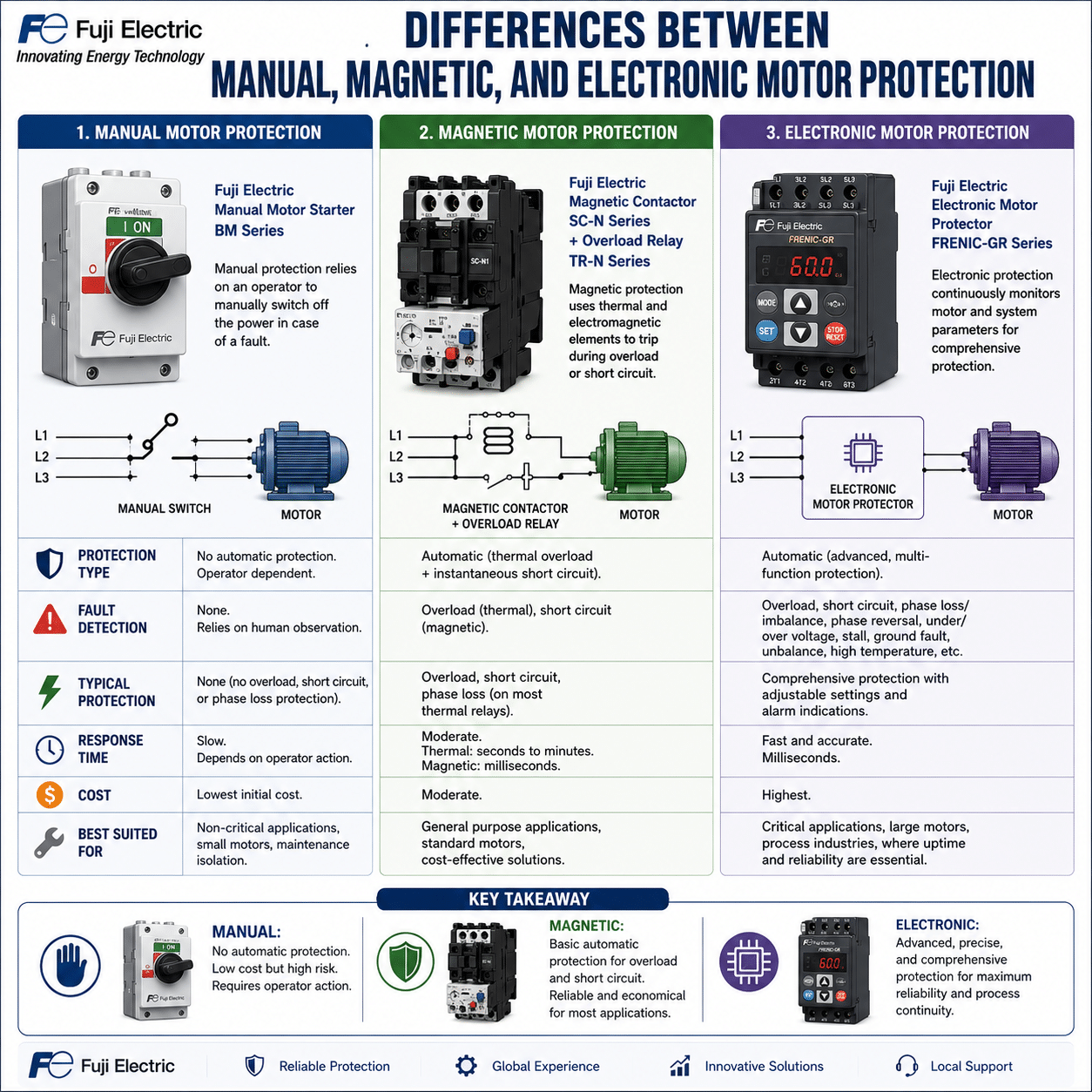
Electric motors are essential to modern industrial operations, powering everything from pumps and conveyors to compressors, fans, and production equipment. Because motors represent a significant investment and are often critical to uptime, proper motor protection is essential for maintaining reliability, safety, and operational efficiency.
Motor protection systems are designed to prevent damage caused by overloads, short circuits, phase loss, locked rotor conditions, overheating, and other electrical or mechanical faults. However, not all motor protection methods operate the same way. Three of the most common approaches are manual motor protection, magnetic motor protection, and electronic motor protection.
Understanding the differences between these technologies can help engineers, facility managers, OEMs, and maintenance teams select the best solution for their application.
Why Motor Protection Matters
Electric motors operate under varying loads and environmental conditions. Without proper protection, abnormal operating conditions can quickly lead to:
- Motor overheating
- Insulation breakdown
- Premature bearing failure
- Electrical fires
- Equipment downtime
- Production losses
- Increased maintenance costs
Motor protection devices help disconnect or control power before damage occurs, improving both safety and equipment longevity.
The level of protection required depends on factors such as:
- Motor size
- Load type
- Starting characteristics
- Duty cycle
- Environmental conditions
- Process criticality
What Is Manual Motor Protection?
Manual motor protection typically uses a manual motor starter or motor protection circuit breaker (MPCB) that combines disconnect functionality with basic overload and short-circuit protection.
These devices are manually operated using a rotary handle, switch, or pushbutton mechanism.
How Manual Motor Protection Works
Manual protectors usually incorporate:
- Thermal overload protection
- Magnetic short-circuit protection
- Manual ON/OFF motor control
Thermal protection responds to sustained overcurrent conditions by heating a bimetallic element that trips the device when excessive current persists over time.
Magnetic protection responds almost instantly to high fault currents such as short circuits.
Advantages of Manual Motor Protection
Manual motor protection offers several benefits:
- Simple operation
- Compact design
- Cost-effective solution
- Easy installation
- Built-in disconnect capability
- Suitable for small motors and simple systems
These devices are commonly used in:
- Small machinery
- HVAC systems
- Pumps
- Fans
- Light industrial equipment
Limitations of Manual Motor Protection
While manual systems are effective for many applications, they have limitations:
- Limited fault diagnostics
- Less precise overload protection
- Manual reset requirements
- Minimal communication capabilities
- Reduced customization
For basic motor control applications, manual protection may be entirely sufficient. However, more demanding systems often require additional functionality.
What Is Magnetic Motor Protection?
Magnetic motor protection typically refers to motor starters that use electromagnetic contactors combined with overload relays.
This type of system allows motors to be controlled remotely and automatically while providing protection against overload conditions.
How Magnetic Motor Protection Works
A magnetic starter contains:
- An electromagnetic contactor
- Overload relay protection
- Auxiliary contacts for control circuits
When the control circuit energizes the contactor coil, the contactor closes and supplies power to the motor. If an overload condition occurs, the overload relay trips and opens the control circuit, disconnecting the motor.
Unlike manual starters, magnetic starters allow:
- Remote operation
- Automated control
- Integration with control systems
- Frequent cycling
Thermal Overload Protection
Most traditional magnetic starters use thermal overload relays based on bimetallic elements or eutectic alloys.
These relays are designed to simulate motor heating characteristics and trip when excessive current persists long enough to threaten motor insulation.
Advantages of Magnetic Motor Protection
Magnetic protection systems provide several important advantages:
- Remote motor control capability
- Integration with automation systems
- Better support for larger motors
- Frequent start-stop operation
- Reduced operator involvement
- Improved process automation
These systems are widely used in:
- Manufacturing systems
- Conveyor systems
- Pump stations
- Industrial automation
- HVAC systems
- Material handling equipment
Limitations of Traditional Magnetic Protection
Despite their widespread use, traditional magnetic starters may have limitations:
- Limited diagnostics
- Mechanical wear over time
- Fixed protection characteristics
- Less accurate protection under varying conditions
- Minimal real-time monitoring
As industrial systems become more connected and data-driven, electronic motor protection is becoming increasingly common.
What Is Electronic Motor Protection?
Electronic motor protection uses digital electronics and microprocessor-based monitoring to provide advanced motor protection and diagnostics.
These systems continuously monitor motor operating conditions and can respond more accurately to abnormal events than traditional thermal devices.
Electronic motor protection may be integrated into:
- Electronic overload relays
- Intelligent motor controllers
- Soft starters
- AC drives
- Motor management systems
How Electronic Motor Protection Works
Electronic systems use sensors and digital processing to monitor parameters such as:
- Current
- Voltage
- Phase imbalance
- Ground fault conditions
- Motor temperature
- Power consumption
- Locked rotor conditions
- Underload conditions
Instead of relying solely on thermal elements, electronic protection calculates motor heating mathematically using real-time data.
Advanced Protection Features
Electronic motor protection systems often provide:
- Adjustable trip classes
- Phase loss protection
- Phase imbalance detection
- Ground fault monitoring
- Jam detection
- Underload protection
- Stall protection
- Thermal memory
- Event logging
- Communication capabilities
Many systems also support industrial communication protocols for integration into automation and monitoring platforms.
Advantages of Electronic Motor Protection
Electronic protection provides significant benefits in modern industrial environments.
Greater Accuracy
Electronic systems offer more precise protection than traditional thermal devices, reducing nuisance trips while improving motor safety.
Improved Diagnostics
Many electronic systems provide detailed fault information that helps maintenance teams quickly identify problems.
Enhanced Motor Life
More accurate protection reduces thermal stress and helps extend motor lifespan.
Communication and Monitoring
Electronic protection devices often support:
- Ethernet/IP
- Modbus
- PROFIBUS
- EtherCAT
- Remote monitoring systems
This enables predictive maintenance and real-time operational visibility.
Flexible Configuration
Protection settings can often be adjusted digitally to match specific motor requirements and application demands.
Limitations of Electronic Protection
Although electronic protection offers many advantages, there are considerations:
- Higher initial cost
- Greater system complexity
- Additional programming requirements
- Potential need for communication infrastructure
- More advanced troubleshooting skills
However, the long-term operational benefits often outweigh the higher upfront investment, particularly in critical applications.
Comparing Manual, Magnetic, and Electronic Protection
Manual Motor Protection
Best suited for:
- Small motors
- Simple standalone applications
- Basic motor control
- Cost-sensitive systems
Key characteristics:
- Manual operation
- Basic overload and short-circuit protection
- Simple installation
- Limited diagnostics
Magnetic Motor Protection
Best suited for:
- Automated motor control
- Frequent motor cycling
- Industrial control systems
- Medium-sized motor applications
Key characteristics:
- Electromagnetic contactor operation
- Remote control capability
- Thermal overload protection
- Automation compatibility
Electronic Motor Protection
Best suited for:
- Critical industrial systems
- Advanced automation
- Process optimization
- Predictive maintenance programs
- High-value motor assets
Key characteristics:
- Advanced diagnostics
- Real-time monitoring
- Precise protection
- Communication integration
- Intelligent control features
Selecting the Right Motor Protection Solution
Choosing the proper protection method depends on several application factors.
Application Complexity
Simple standalone equipment may only require manual protection, while highly automated production lines benefit from electronic systems.
Motor Criticality
Critical motors with high downtime costs often justify advanced electronic protection.
Environmental Conditions
Harsh industrial environments may require robust protection features and monitoring capabilities.
Maintenance Strategy
Facilities implementing predictive maintenance programs often prefer electronic protection with communication and diagnostic features.
Budget Considerations
Initial equipment cost is important, but total lifecycle cost should also be considered, including:
- Downtime reduction
- Maintenance savings
- Energy efficiency
- Equipment longevity
Fuji Electric Motor Protection Solutions
Fuji Electric offers a broad range of motor control and protection technologies designed to support industrial reliability, efficiency, and safety.
Our solutions include:
- Manual motor starters
- Magnetic contactors
- Thermal overload relays
- Intelligent motor protection systems
- AC drives with integrated protection features
- Advanced automation technologies
Fuji Electric products are engineered to help facilities improve motor performance, reduce downtime, and support modern industrial automation requirements.
Motor protection is a critical part of maintaining reliable and efficient industrial operations. Manual, magnetic, and electronic motor protection systems each offer unique advantages depending on the application requirements, operational complexity, and protection goals.
Manual protection provides a simple and economical solution for basic applications. Magnetic protection enables automated motor control and supports larger industrial systems. Electronic protection delivers advanced diagnostics, monitoring, and intelligent protection for modern connected facilities.
As industrial operations continue evolving toward smarter, more automated systems, advanced motor protection technologies will play an increasingly important role in improving uptime, extending equipment life, and optimizing overall system performance.