
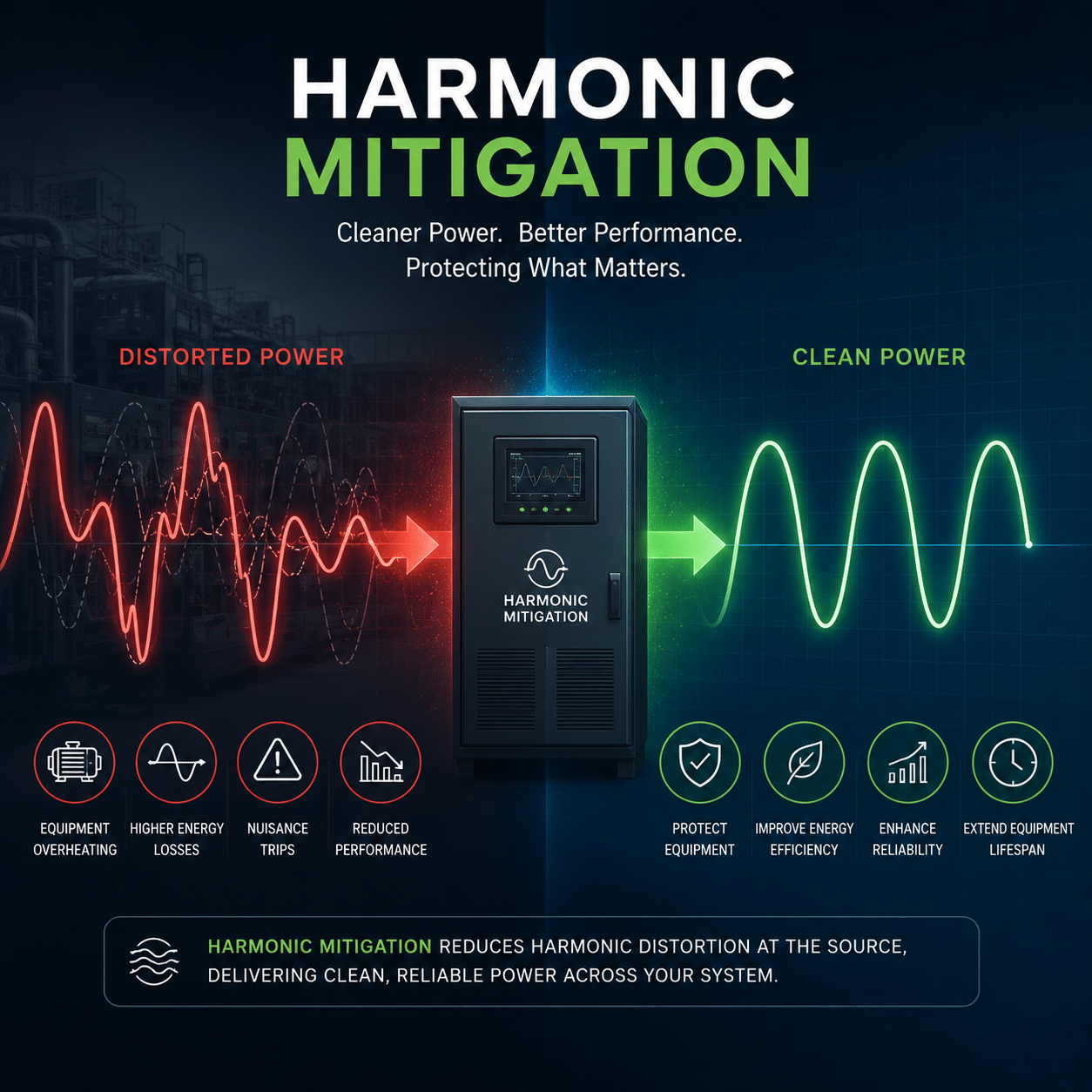
Modern industrial and commercial facilities rely heavily on variable frequency drives (VFDs), uninterruptible power supplies (UPS), power supplies, and other electronic equipment to improve efficiency and performance. While these technologies offer significant benefits, they can also introduce electrical harmonics into a facility’s power system.
If left unmanaged, harmonics can reduce efficiency, cause equipment overheating, create nuisance trips, and shorten the lifespan of electrical components. Fortunately, several harmonic mitigation solutions are available to help maintain power quality and protect critical equipment.
This guide explains the basics of harmonics and the most common mitigation methods, including Active Front End (AFE) drives, DC chokes, line reactors, and harmonic filters.
What Are Harmonics?
In an ideal electrical system, voltage and current waveforms are smooth sinusoidal waves operating at a fundamental frequency of 50 Hz or 60 Hz. However, many modern electronic devices draw current in short pulses rather than smooth waves.
These pulsed currents create harmonic frequencies that are multiples of the fundamental frequency:
- 3rd harmonic = 180 Hz (on a 60 Hz system)
- 5th harmonic = 300 Hz
- 7th harmonic = 420 Hz
- And so on
The more non-linear loads connected to a system, the greater the harmonic distortion.
Common sources of harmonics include:
- Variable Frequency Drives (VFDs)
- UPS systems
- Switched-mode power supplies
- Data centers
- LED lighting systems
- Industrial automation equipment
- Battery charging systems
Why Harmonics Matter
Excessive harmonic distortion can create several operational issues:
Overheating
Transformers, motors, generators, and conductors may experience additional heating due to harmonic currents.
Reduced Equipment Life
Higher operating temperatures accelerate insulation breakdown and component aging.
Nuisance Tripping
Circuit breakers and protective devices may trip unexpectedly due to distorted current waveforms.
Reduced System Efficiency
Harmonics increase power losses throughout the electrical distribution system.
Generator Compatibility Issues
Facilities using standby generators may experience instability when harmonics are present.
Utility Compliance Concerns
Many facilities must comply with power quality standards such as IEEE 519, which establishes recommended limits for harmonic distortion.
Understanding Total Harmonic Distortion (THD)
One of the most common measurements of power quality is Total Harmonic Distortion (THD).
THD represents the amount of harmonic content relative to the fundamental frequency.
Two common measurements include:
- THDv – Total Harmonic Distortion of Voltage
- THDi – Total Harmonic Distortion of Current
As a general reference:
|
THDi Level |
Typical Condition |
|
< 5% |
Excellent |
|
5% – 10% |
Good |
|
10% – 20% |
Moderate |
|
> 20% |
Significant harmonic content |
A standard six-pulse VFD can produce current distortion levels exceeding 30% to 40% without mitigation.
Harmonic Mitigation Solutions
Different applications require different levels of harmonic reduction. The following solutions range from basic protection to advanced harmonic control.
DC Chokes
A DC choke is an inductor installed in the DC bus section of a VFD.
Its primary purpose is to smooth current flow within the drive and reduce harmonic current generation.
Benefits
- Reduces harmonic distortion
- Improves power factor
- Helps protect drive components
- Relatively low cost
- Compact installation
Typical Harmonic Reduction
A standard six-pulse drive may produce:
- 35–45% THDi without a choke
- 25–35% THDi with a DC choke
Best Applications
- General industrial machinery
- HVAC systems
- Pumps and fans
- Applications with moderate power quality requirements
Because of their low cost and ease of implementation, DC chokes are often considered the first step in harmonic mitigation.
Line Reactors
Line reactors are inductors installed on the input side of a drive.
They add impedance between the power source and the VFD, reducing current distortion and protecting against power disturbances.
Benefits
- Reduces harmonic current
- Protects against voltage spikes
- Limits inrush current
- Extends drive life
- Improves overall system reliability
Typical Harmonic Reduction
A 3% to 5% line reactor can reduce harmonic distortion by approximately 30% compared to an unprotected drive.
Best Applications
- Facilities with unstable utility power
- Long feeder cable installations
- Industrial production equipment
- General-purpose VFD applications
Line reactors are among the most widely used and economical harmonic mitigation solutions.
Passive Harmonic Filters
Passive filters use combinations of inductors, capacitors, and resistors to target specific harmonic frequencies.
These filters are installed between the power source and the load.
Benefits
- Significant harmonic reduction
- Helps facilities meet IEEE 519 requirements
- Improves power factor
- Proven technology
Typical Harmonic Reduction
Many passive filter designs can reduce THDi to below 5%.
Best Applications
- Large VFD installations
- Commercial buildings
- Water and wastewater facilities
- Manufacturing plants
Considerations
Passive filters must be properly sized and designed for the application. Changes in system loading can affect performance.
Active Harmonic Filters
Unlike passive filters, active harmonic filters continuously monitor harmonic content and inject corrective currents to cancel distortion in real time.
Benefits
- Dynamic harmonic compensation
- Effective across multiple harmonic frequencies
- Adapts to changing loads
- Can serve multiple pieces of equipment
Typical Harmonic Reduction
Active harmonic filters can often reduce THDi to below 5%, even in systems with varying load conditions.
Best Applications
- Data centers
- Healthcare facilities
- Large manufacturing operations
- Facilities with multiple harmonic sources
Considerations
Active filters typically involve a higher initial investment but offer exceptional flexibility and performance.
Active Front End (AFE) Drives
Active Front End technology represents one of the most advanced approaches to harmonic mitigation.
Instead of using a traditional diode rectifier, an AFE drive uses IGBTs and sophisticated control algorithms to actively shape incoming current.
The result is a near-sinusoidal input current waveform with dramatically reduced harmonic distortion.
Benefits
- Extremely low harmonic distortion
- Excellent power factor
- Regenerative braking capability
- Reduced generator sizing concerns
- Supports IEEE 519 compliance
Typical Harmonic Performance
Many AFE drives achieve:
- THDi below 5%
- Near-unity power factor across operating ranges
Regenerative Operation
One major advantage of AFE technology is the ability to return energy back to the electrical system during braking or overhauling loads.
Common regenerative applications include:
- Elevators
- Cranes
- Hoists
- Centrifuges
- Test stands
- Downhill conveyors
Best Applications
- Mission-critical systems
- Large horsepower drives
- Facilities with strict power quality requirements
- Regenerative applications
Choosing the Right Harmonic Mitigation Solution
The best solution depends on several factors:
|
Solution |
Harmonic Reduction |
Cost |
Complexity |
|
DC Choke |
Moderate |
Low |
Low |
|
Line Reactor |
Moderate |
Low |
Low |
|
Passive Filter |
High |
Medium |
Medium |
|
Active Harmonic Filter |
Very High |
Medium-High |
Medium |
|
AFE Drive |
Excellent |
High |
High |
Questions to consider include:
- What are your harmonic distortion goals?
- Are you required to comply with IEEE 519?
- Are standby generators involved?
- Is regenerative braking needed?
- How many drives are connected to the system?
- What is the available budget?
A facility-wide harmonic study can help identify the most cost-effective approach.
Final Thoughts
As industrial facilities become increasingly dependent on power electronics, harmonic mitigation is no longer just a power quality issue—it is a reliability issue. Excessive harmonics can lead to overheating, reduced equipment life, downtime, and increased energy losses.
Fortunately, a range of mitigation options exists, from economical DC chokes and line reactors to advanced active harmonic filters and Active Front End drives. Understanding how each solution works allows facility managers, engineers, and maintenance teams to make informed decisions that improve power quality, increase system reliability, and protect valuable equipment.
By evaluating system requirements and power quality goals, organizations can select the right harmonic mitigation strategy and ensure their electrical infrastructure is prepared for the demands of modern automation and energy-efficient technologies.