
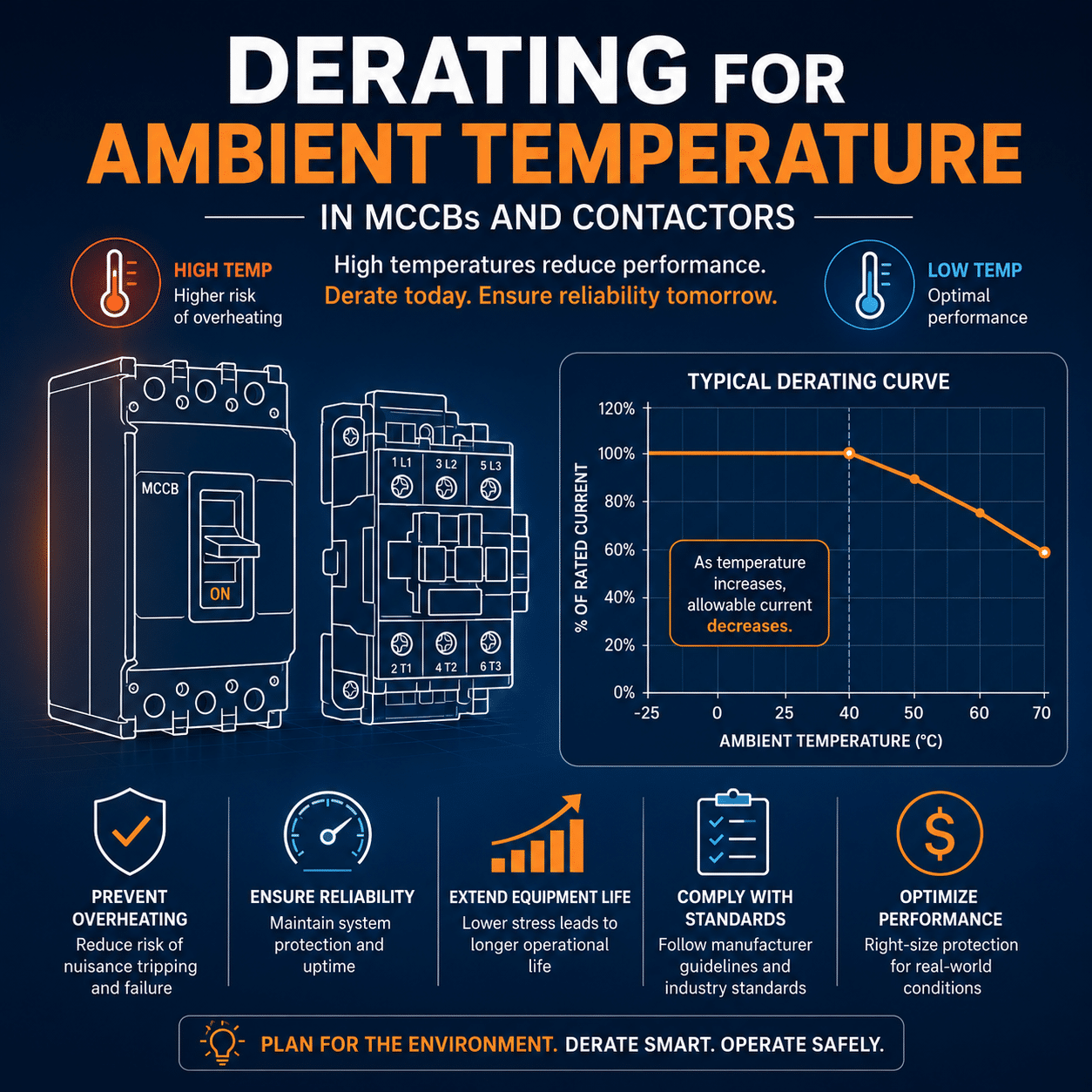
Electrical components are designed to operate within specific environmental conditions. One of the most important—and often overlooked—factors affecting performance is ambient temperature. As temperatures rise above standard operating conditions, the current-carrying capability of electrical devices can decrease, requiring engineers to apply a process known as derating.
For molded case circuit breakers (MCCBs) and contactors, understanding temperature derating is critical to maintaining system reliability, preventing nuisance trips, and ensuring long-term equipment protection.
This article explains what derating is, why it matters, and how ambient temperature affects MCCBs and contactors in real-world applications.
What Is Derating?
Derating is the practice of reducing a device’s rated current or performance capability when operating conditions differ from the manufacturer’s reference conditions.
Most electrical equipment ratings are established under standardized laboratory conditions, typically around:
- 40°C (104°F) ambient temperature for many industrial devices
- Adequate ventilation
- Standard mounting configurations
- Normal operating altitude
When actual field conditions exceed these parameters, the equipment may not be able to safely carry its full rated current.
Derating helps ensure that components continue to operate safely and reliably without excessive heat buildup.
Why Ambient Temperature Matters
Heat is the enemy of electrical equipment.
As ambient temperature increases:
- Internal component temperatures rise
- Insulation ages more rapidly
- Contact resistance increases
- Protective devices respond differently
- Equipment life expectancy decreases
Because MCCBs and contactors generate heat during normal operation, higher surrounding temperatures reduce their ability to dissipate that heat effectively.
The result is less available current-carrying capacity.
Ambient Temperature Effects on MCCBs
How MCCBs Work
A molded case circuit breaker protects electrical circuits from overloads and short circuits.
Most thermal-magnetic MCCBs use a bimetallic element that responds to heat generated by current flow. When excessive current causes the element to heat beyond its calibrated limit, the breaker trips.
Because the trip mechanism is temperature-sensitive, ambient temperature directly affects breaker performance.
High Ambient Temperatures
When the surrounding temperature exceeds the calibration temperature:
- The thermal element starts closer to its trip point
- The breaker may trip at lower currents than expected
- Nuisance tripping becomes more likely
- Available load capacity decreases
For example:
A 100A breaker calibrated at 40°C may only safely carry 90A–95A continuously in a significantly hotter environment, depending on manufacturer specifications.
Low Ambient Temperatures
Cooler environments can have the opposite effect:
- Breakers may carry higher currents before tripping
- Trip response times may increase
- Overload protection characteristics can change
While this may seem beneficial, it can alter the intended protection coordination of the electrical system.
Ambient Temperature Effects on Contactors
How Contactors Operate
Contactors are electrically controlled switches used to connect and disconnect power to motors, HVAC equipment, pumps, compressors, and other loads.
Unlike circuit breakers, contactors are primarily switching devices rather than protective devices. However, temperature still plays a major role in their performance.
Increased Heat Generation
As ambient temperatures rise:
- Coil temperatures increase
- Contact resistance rises
- Internal components experience greater thermal stress
- Mechanical life can be reduced
The contactor’s rated operational current may need to be reduced to prevent excessive temperature rise.
Coil Performance Considerations
High temperatures can also affect contactor coils.
Potential issues include:
- Reduced coil life
- Increased power consumption
- Lower insulation lifespan
- Greater risk of coil failure
In extreme environments, engineers may need to select higher-rated contactors or specialized high-temperature models.
Typical Derating Scenarios
Ambient temperature derating becomes particularly important in applications such as:
Outdoor Electrical Enclosures
Equipment installed outdoors may experience temperatures far above the surrounding air temperature due to solar loading.
An enclosure exposed to direct sunlight can easily exceed 50°C (122°F) or higher.
Industrial Facilities
Manufacturing environments often contain:
- Furnaces
- Ovens
- Boilers
- Heat-treating equipment
- Process machinery
These sources can significantly elevate local ambient temperatures.
HVAC Equipment Rooms
Mechanical rooms frequently experience elevated temperatures due to:
- Motors
- Drives
- Compressors
- Pumps
- Poor ventilation
Renewable Energy Systems
Solar installations often place electrical equipment in exposed locations where high temperatures are common.
Reading Manufacturer Derating Curves
Most manufacturers provide derating curves or tables showing how current ratings change with temperature.
A typical curve may show:
|
Ambient Temperature |
Allowable Current |
|
40°C |
100% Rating |
|
50°C |
95% Rating |
|
60°C |
90% Rating |
|
70°C |
80% Rating |
Actual values vary significantly by manufacturer and product series.
Always consult the specific product documentation rather than relying on generalized assumptions.
Additional Factors That Influence Derating
Temperature is not the only consideration.
Engineers should also evaluate:
Enclosure Density
Closely packed devices generate additional heat that can raise internal enclosure temperatures.
Ventilation
Poor airflow reduces cooling effectiveness and may require additional derating.
Altitude
Higher elevations reduce air density, decreasing heat dissipation capability.
Continuous Loading
Applications operating near full load for extended periods generate more heat than intermittent-duty applications.
Adjacent Equipment
Nearby drives, transformers, power supplies, and other heat-producing equipment can increase ambient temperatures around MCCBs and contactors.
Strategies to Minimize Derating Issues
Several design practices can help reduce temperature-related problems.
Improve Ventilation
Adding ventilation fans or heat exchangers can significantly lower enclosure temperatures.
Increase Enclosure Size
Larger enclosures provide better heat dissipation and reduce hot spots.
Separate Heat Sources
Mount heat-generating equipment away from sensitive protection and control devices whenever possible.
Select Higher-Rated Devices
Choosing an MCCB or contactor with additional current capacity provides operating margin for elevated temperatures.
Use Thermal Modeling
For large or critical systems, thermal analysis can help predict enclosure temperatures and identify potential issues before installation.
Common Mistakes to Avoid
Assuming Nameplate Ratings Always Apply
Equipment ratings are often based on specific ambient conditions that may not exist in the field.
Ignoring Enclosure Temperature Rise
The temperature inside an enclosure is often significantly higher than the surrounding room temperature.
Overcrowding Panels
Adding equipment without considering thermal effects can create unexpected derating requirements.
Failing to Review Manufacturer Documentation
Derating values vary between manufacturers and product families.
Final Thoughts
Ambient temperature has a direct impact on the performance and reliability of molded case circuit breakers and contactors. As temperatures rise, electrical devices generate and retain more heat, reducing their current-carrying capability and potentially affecting protection characteristics.
Understanding and applying proper derating practices helps prevent nuisance trips, extends equipment life, improves system reliability, and ensures safe operation under real-world conditions.
Whether designing a motor control center, industrial control panel, HVAC system, or power distribution network, engineers should carefully evaluate ambient conditions and consult manufacturer derating data to ensure MCCBs and contactors perform as intended throughout the life of the installation.