
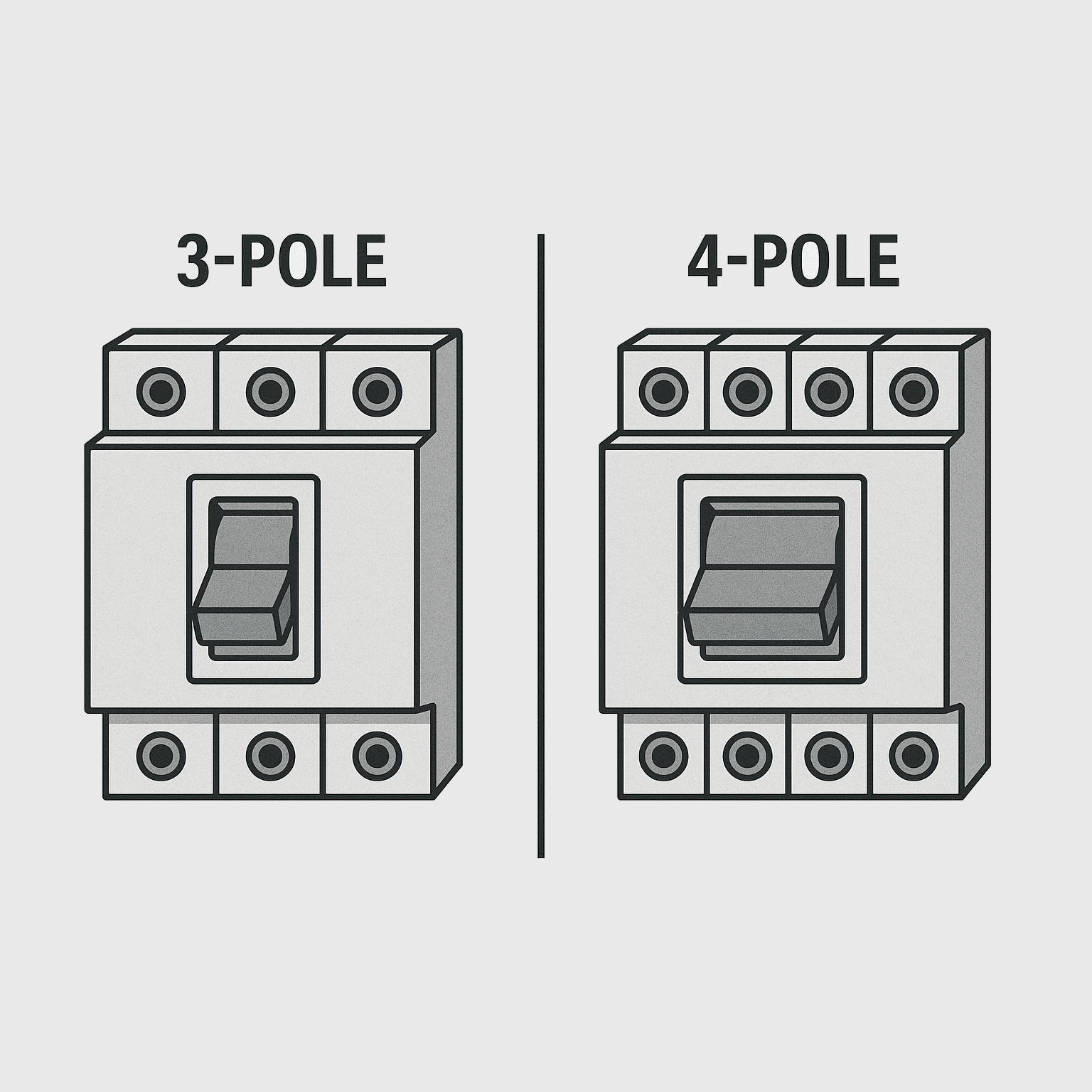
The main difference between a 3-pole and a 4-pole circuit breaker lies in the number of conductors they switch and how they handle the neutral line in addition to the phases.
3-Pole Breaker
What it does:
- Designed to interrupt three-phase power: L1, L2, and L3.
- All three phases are switched simultaneously.
Common Applications:
- Three-phase motors and equipment
- Industrial and commercial systems
- Where neutral doesn’t need switching
Notes:
- Neutral (if present) is not interrupted by the breaker.
- Typically used where the neutral is grounded or managed separately.
4-Pole Breaker
What it does:
- Switches three phases (L1, L2, L3) plus the neutral conductor.
- All four poles trip together.
Common Applications:
- Unbalanced three-phase loads with a neutral (e.g., mixed 3-phase + single-phase)
- Systems where neutral switching is required for safety or isolation
- TN-S, TT, and IT power distribution systems
- Generators, UPS systems, and sensitive equipment
Notes:
- Allows complete isolation of all conductors, including neutral.
- Reduces risk of potential differences or stray currents on neutral during maintenance.
Key Differences at a Glance
|
Feature |
3-Pole Breaker |
4-Pole Breaker |
|
Phases Switched |
3 (L1, L2, L3) |
3 (L1, L2, L3) + Neutral |
|
Neutral Handling |
Passes through or external |
Switched with the phases |
|
Application Type |
Balanced loads, motors |
Mixed loads, sensitive equipment |
|
Isolation Capability |
Phase only |
Full (phases + neutral) |
|
Cost & Size |
Smaller, less expensive |
Larger, more expensive |
Summary
- Use a 3-pole breaker for standard three-phase systems where neutral switching is not required.
- Use a 4-pole breaker when full isolation—including the neutral—is necessary, especially in systems where the neutral may carry current or needs disconnection for safety and system integrity.