
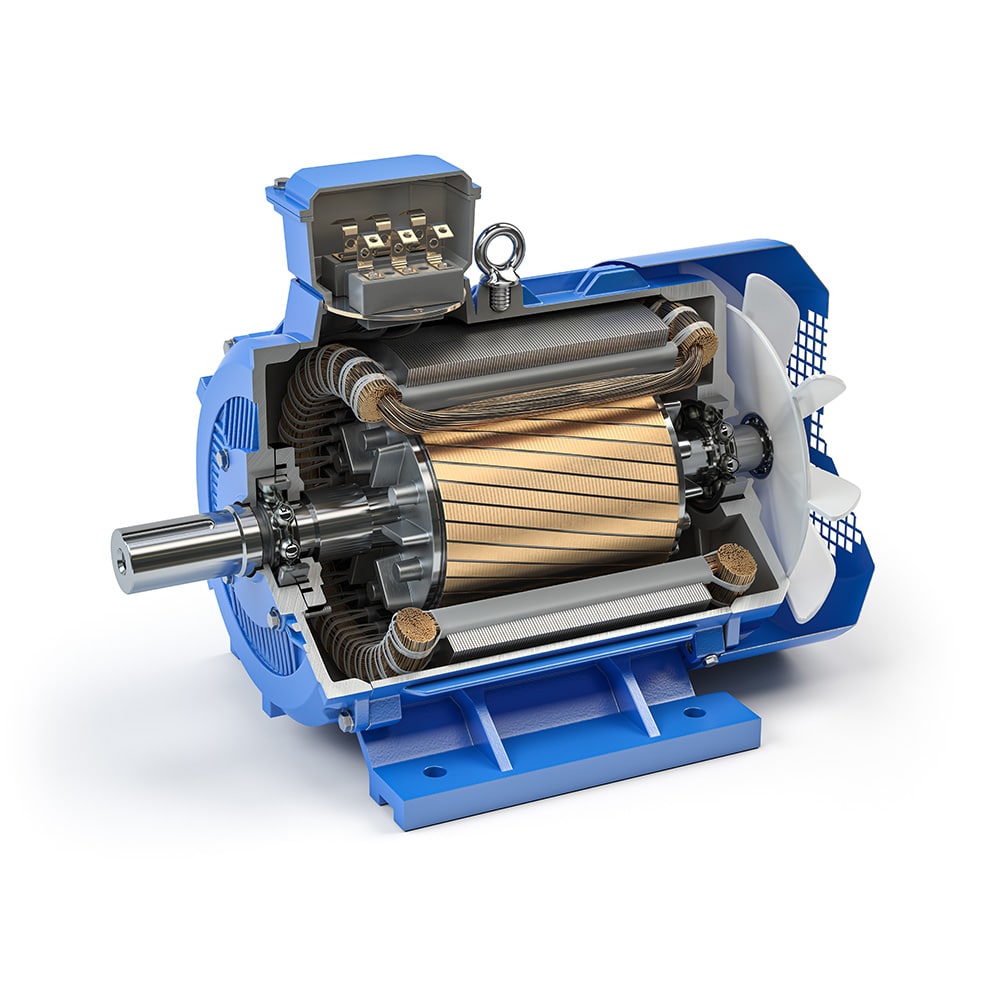
Selecting the right AC drive isn’t just about horsepower and voltage. The motor type you’re controlling—induction, permanent magnet (PM), or synchronous reluctance (SynRM)—has a major impact on drive sizing, control method, efficiency, and long-term performance. Match them correctly, and you get smooth control, high efficiency, and long motor life. Get it wrong, and you invite instability, overheating, or lost efficiency.
Below is a practical breakdown of what to consider for each motor type.
- Induction Motors (IM)
Why they’re common
Induction motors are the workhorse of industry—rugged, affordable, and widely available. Most legacy systems were built around them.
Drive considerations
Control method
- V/Hz (scalar control):
- Simple, low cost
- Best for pumps, fans, conveyors
- Limited torque control at low speeds
- Sensorless vector or closed-loop vector:
- Better torque and speed accuracy
- Recommended for demanding loads
Sizing
- Match drive current rating to motor FLA, not just HP
- Account for overload requirements (typically 150% for 60 seconds)
Key parameters
- Motor rated voltage, current, frequency, speed
- Slip compensation (important for torque accuracy)
Best-fit applications
- Fans, pumps, compressors
- General-purpose machinery
- Retrofit projects
- Permanent Magnet Motors (PM / PMSM / BLDC)
Why they’re growing fast
PM motors offer higher efficiency, higher power density, and better part-load performance—making them ideal for energy-savings programs and premium OEM designs.
Drive considerations
Drive compatibility
- The drive must explicitly support PM motors
- Requires vector control or FOC (Field-Oriented Control)
Critical differences
- No rotor losses → higher efficiency
- Magnets create back EMF → overspeed protection is essential
- Incorrect setup can cause uncontrolled voltage rise
Key parameters
- Motor back-EMF constant (Ke)
- Pole count
- Rated speed and max mechanical speed
- Encoder feedback (optional but helpful for precision)
Best-fit applications
- HVAC (chillers, compressors)
- High-efficiency pumps and fans
- EVs and high-performance machinery
- Synchronous Reluctance Motors (SynRM)
Why they’re gaining attention
SynRM motors deliver high efficiency without rare-earth magnets, making them attractive where sustainability, cost stability, and reliability matter.
Drive considerations
Control method
- Requires advanced vector control
- Many modern drives support SynRM with firmware configuration
Performance traits
- High efficiency similar to PM motors
- No magnets → simpler thermal behavior
- Torque ripple can occur if control tuning is poor
Key parameters
- d-axis and q-axis inductances
- Motor identification routine (often required at startup)
- Proper torque model selection in the drive
Best-fit applications
- Energy-efficient pump and fan systems
- Industrial processes seeking PM-like efficiency
- Sites avoiding rare-earth materials
Practical Selection Tips
- Confirm motor compatibility first – not all drives support PM or SynRM motors
- Size by current, not HP alone – especially for PM motors
- Use motor auto-tuning whenever available
- Check overspeed and braking requirements for PM motors
- Align drive features with incentives if energy efficiency matters
Bottom line
An AC drive isn’t one-size-fits-all. Induction motors favor simplicity, PM motors reward precision, and SynRM motors strike a balance between efficiency and material sustainability. Matching the drive correctly unlocks the full potential of each motor type—whether your goal is reliability, efficiency, or performance.