
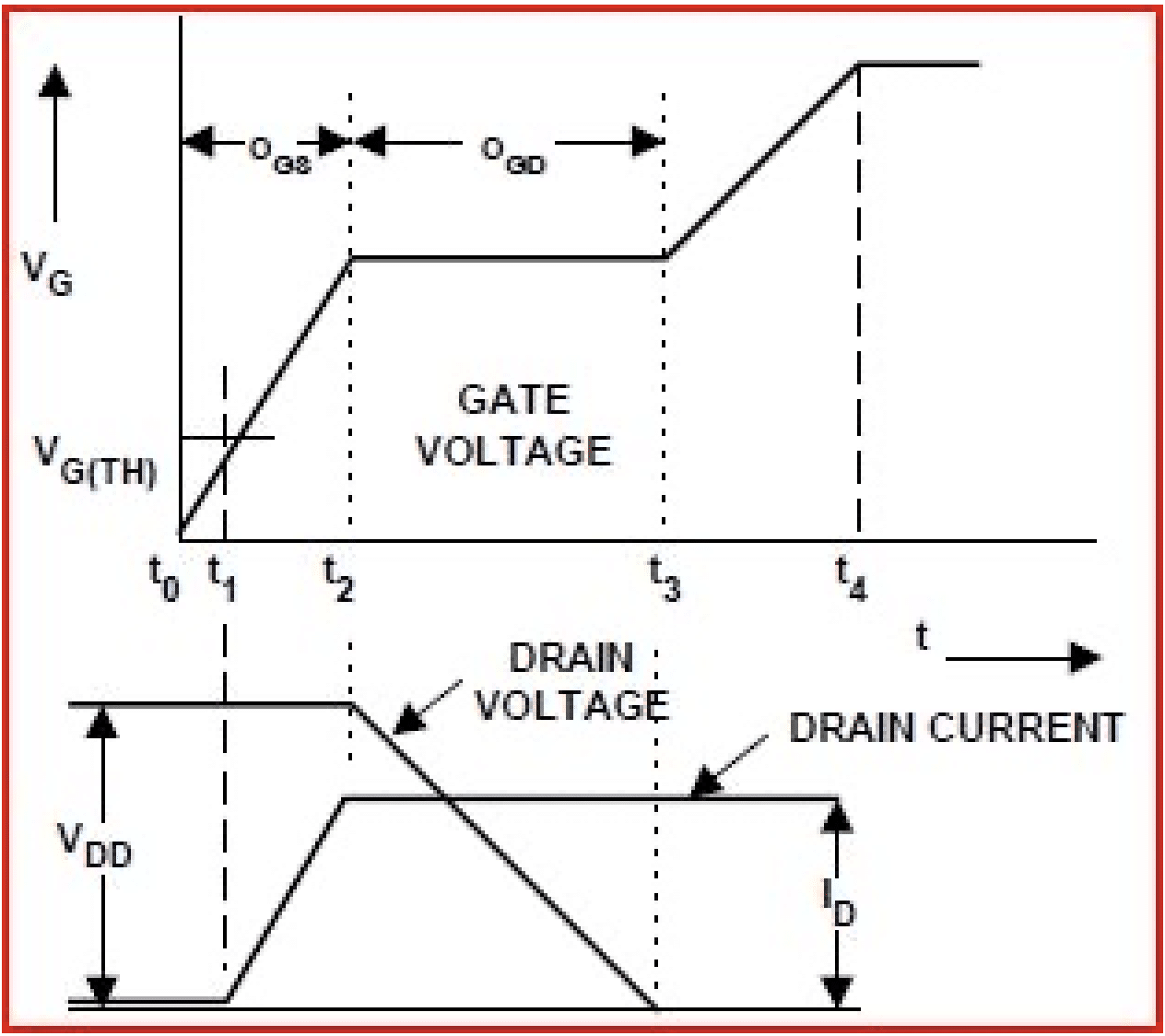
When engineers evaluate power semiconductors, they often focus on voltage rating, current rating, and conduction losses. But in real switching applications—especially at high frequency—gate charge plays a major role in determining efficiency, switching speed, EMI, and even device reliability.
Understanding how gate charge affects MOSFETs and IGBTs helps you select the right device and the right gate driver for your application.
What Is Gate Charge?
Gate charge (Qg) is the total amount of electrical charge required to drive a power device from OFF to ON at a specified gate voltage.
It is not a single number—it’s the sum of several components:
- Qgs – charge to raise the gate-to-source/emitter voltage to the threshold
- Qgd (Miller charge) – charge required during the drain/collector voltage transition
- Qg(total) – total charge needed for full enhancement
Gate charge directly determines how fast a device can switch for a given gate driver strength.
Why Gate Charge Matters
The gate is capacitive. To switch the device, the driver must move charge in and out of the gate.
This affects:
- Switching speed
- Switching losses
- Driver power requirements
- EMI and dv/dt behavior
- Maximum practical switching frequency
Key relationship
Switching speed ∝ Gate driver current / Gate charge
Gate Charge and Switching Losses
During switching transitions:
- Voltage across the device is high
- Current through the device is high
This overlap causes switching losses, which increase as switching slows down.
Higher gate charge → slower transitions → higher switching losses.
MOSFETs: Gate Charge Behavior
Characteristics
- Voltage-controlled device
- No minority carrier storage
- Very fast switching capability
Gate charge implications
- Qg scales strongly with die size
- Low-Rds(on) MOSFETs often have high Qg
- Miller plateau (Qgd) dominates high-voltage switching
Practical impact
- Low Qg → high-frequency capability (100 kHz+)
- High Qg → requires strong gate drivers
- Gate charge often limits efficiency before conduction losses do
Design tradeoff
Lower Rds(on) ≠ better overall efficiency if Qg is too high for the switching frequency
IGBTs: Gate Charge Behavior
Characteristics
- MOS gate with bipolar conduction
- Minority carrier device
- Lower conduction loss at high voltage
Gate charge implications
- Total Qg is often lower than large MOSFETs
- Switching is limited more by carrier tail current than Qg
- Turn-off losses dominate at high frequency
Practical impact
- Well suited for low–to–medium switching frequencies
- Gate charge still affects dv/dt and EMI
- Faster gate drive can reduce switching loss—but only to a point
Key limitation
Even with low gate charge, stored charge in the drift region limits IGBT switching speed
Miller Charge: The Real Bottleneck
The Miller charge (Qgd) occurs while:
- Gate voltage is “stuck” at the Miller plateau
- Drain/collector voltage is actively changing
During this time:
- Gate current controls dv/dt
- EMI and overshoot are set
- Switching loss accumulates
Devices with lower Qgd:
- Switch faster
- Produce less switching loss
- Are easier to control cleanly
Gate Charge vs. Gate Driver Design
Gate charge must always be considered together with the gate driver.
Gate driver current
tsw Qg / Igate
- High Qg → needs high peak gate current
- Weak drivers → slow switching → excess loss
- Strong drivers → faster switching but higher EMI risk
This is why gate resistors, split turn-on/turn-off resistors, and active gate control are so common.
MOSFET vs. IGBT: Gate Charge Comparison
|
Parameter |
MOSFET |
IGBT |
|
Gate type |
Capacitive |
Capacitive |
|
Total gate charge |
Often higher |
Often lower |
|
Miller dominance |
Very high |
Moderate |
|
Switching frequency |
Very high |
Moderate |
|
Limiting factor |
Qg + Qgd |
Tail current |
|
Best use case |
High-frequency |
High-voltage, lower-frequency |
Practical Design Guidelines
- Compare Qg and Qgd, not just Rds(on) or Vce(sat)
- Match gate driver peak current to total gate charge
- Don’t overspeed switching without managing EMI
- For high frequency → prioritize low Qgd MOSFETs
- For high voltage & power → accept slower switching IGBTs
- Validate with real waveforms—not just datasheets
The Bottom Line
Gate charge is one of the most important—and most misunderstood—parameters in power semiconductor selection.
- MOSFETs are often limited by gate charge at high frequency
- IGBTs are limited more by stored charge, but gate charge still shapes switching behavior
- Gate charge directly links device physics to real-world efficiency
Designing efficient, reliable power electronics means treating the device and gate driver as a system, not separate components.