
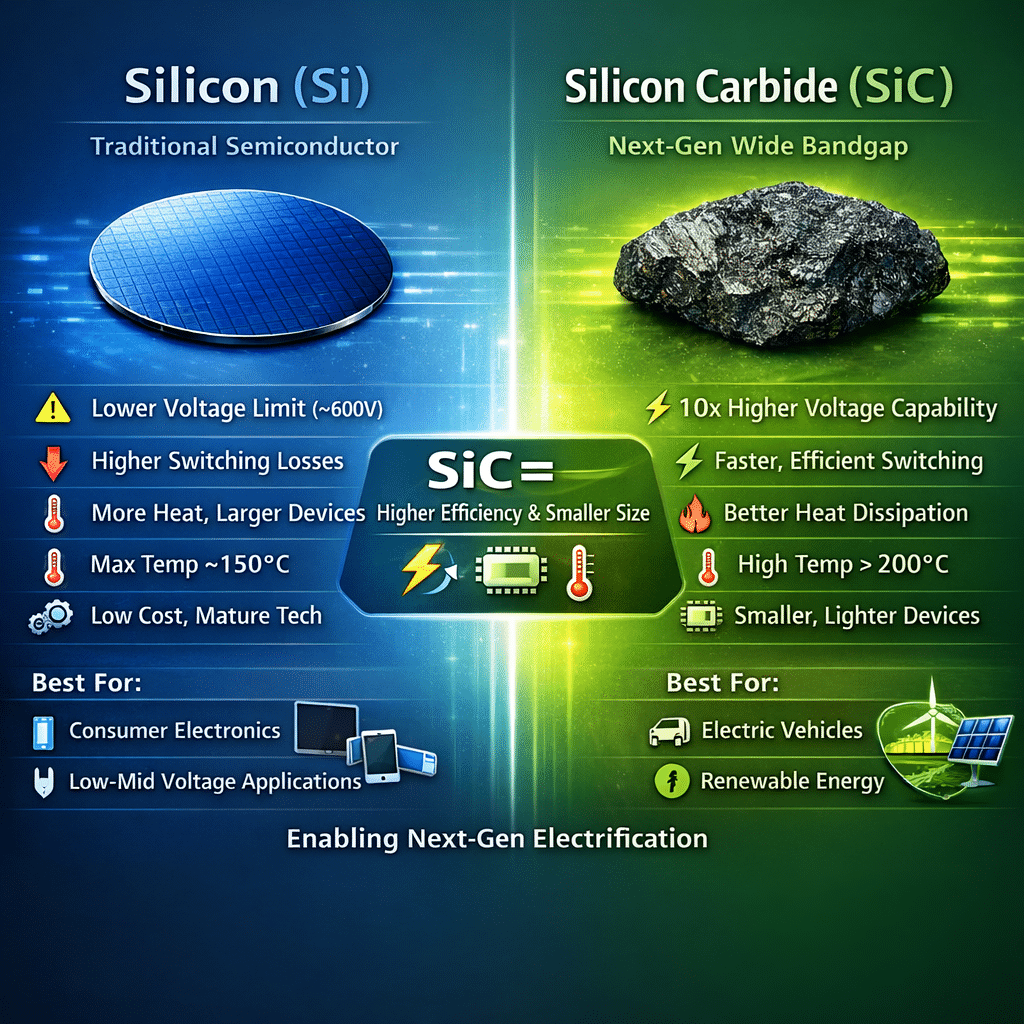
As industries push for higher efficiency, faster switching, and more compact designs, the choice of semiconductor material has become increasingly important. Two of the most widely used materials in power electronics today are silicon (Si) and silicon carbide (SiC).
While both serve similar functions in devices like inverters, drives, and power supplies, they differ significantly in one critical area: switching losses.
Understanding these differences is key to selecting the right technology for your application.
What Are Switching Losses?
Switching losses occur when a semiconductor device transitions between its on (conducting) and off (non-conducting)states.
During these transitions:
- Voltage and current overlap briefly
- Energy is dissipated as heat
This energy loss happens every switching cycle and is influenced by:
- Switching frequency
- Device characteristics
- Load conditions
The higher the switching frequency, the more important switching losses become.
Silicon (Si) Devices: Proven but Limited
Silicon-based devices—such as IGBTs and MOSFETs—have been the industry standard for decades.
Characteristics:
- Moderate switching speeds
- Higher switching losses at elevated frequencies
- Well-understood and cost-effective
Limitations:
- Slower turn-on and turn-off times
- Higher energy loss per switching event
- Increased heat generation at higher frequencies
Silicon performs well in low-to-medium switching frequency applications, but efficiency drops as frequency increases.
Silicon Carbide (SiC) Devices: High-Performance Alternative
Silicon carbide is a wide bandgap semiconductor that enables faster and more efficient switching.
Characteristics:
- Extremely fast switching speeds
- Lower switching losses
- Higher voltage and temperature capability
Advantages:
- Reduced energy loss during transitions
- Lower heat generation
- Ability to operate at higher switching frequencies
SiC excels in high-frequency, high-efficiency applications where performance is critical.
Why Switching Losses Differ
The key difference lies in the material properties:
- Bandgap Energy
- Silicon: ~1.1 eV
- SiC: ~3.2 eV
Higher bandgap allows SiC to:
- Withstand higher electric fields
- Switch faster with less leakage
- Switching Speed
SiC devices:
- Turn on/off faster
- Reduce overlap between voltage and current
Result:
Lower switching energy loss per cycle
- Reverse Recovery Losses
Silicon devices (especially IGBTs and diodes):
- Have significant reverse recovery current
SiC devices:
- Exhibit minimal reverse recovery
Result:
Reduced losses and improved efficiency, especially in fast-switching circuits
Switching Loss Comparison
|
Factor |
Silicon (Si) |
Silicon Carbide (SiC) |
|
Switching Speed |
Moderate |
Very high |
|
Switching Losses |
Higher |
Significantly lower |
|
Heat Generation |
Higher |
Lower |
|
Frequency Capability |
Limited |
High |
|
Efficiency |
Good |
Excellent |
Real-World Impact
- Higher Efficiency
Lower switching losses mean:
- Less wasted energy
- Higher system efficiency
This is critical in:
- Industrial drives
- Renewable energy systems
- EV powertrains
- Smaller System Size
Because SiC:
- Generates less heat
- Supports higher frequencies
You can use:
- Smaller heat sinks
- Smaller passive components (inductors, capacitors)
Result: more compact system design
- Reduced Cooling Requirements
Lower losses = less heat:
- Reduced cooling system size
- Lower operating costs
- Improved reliability
- Higher Switching Frequencies
SiC enables:
- Faster switching
- Improved control precision
- Better motor performance in VFD applications
When to Choose Silicon
Silicon devices are still a strong choice when:
- Cost is a primary concern
- Switching frequency is relatively low
- Thermal constraints are manageable
Typical applications:
- Standard industrial drives
- General-purpose power supplies
- Legacy systems
When to Choose Silicon Carbide
SiC is ideal when:
- Efficiency is critical
- High switching frequency is required
- Space and weight must be minimized
Typical applications:
- High-performance VFDs
- Solar inverters
- EV charging and power systems
- Data centers
Common Misconceptions
- “SiC always replaces silicon”
→ Not always—cost and application needs still matter
- “Switching losses don’t matter at low frequency”
→ True to a degree, but system efficiency still benefits from reduction
- “SiC is only for niche applications”
→ Rapidly becoming mainstream across industries
Bringing It All Together
Switching losses play a major role in determining system efficiency, thermal performance, and overall design.
- Silicon devices offer reliability and cost-effectiveness for many standard applications
- Silicon carbide devices deliver superior performance where efficiency and speed are critical
Final Thought
As power electronics continue to evolve, the shift toward higher efficiency and smarter systems is accelerating.
Understanding switching losses—and choosing the right semiconductor—can unlock better performance, lower costs, and a competitive edge in modern applications.