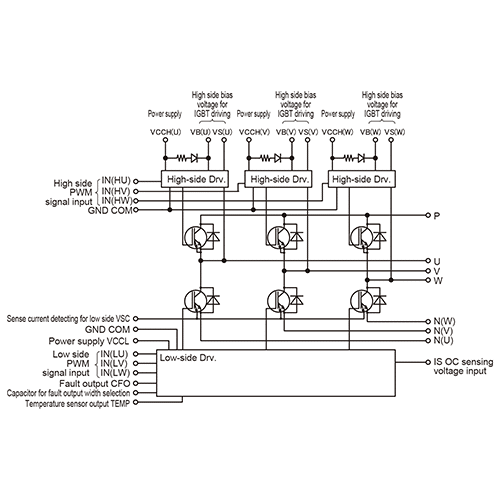

When working with high-voltage IGBT modules, creepage and clearance distances are critical for ensuring electrical safety, preventing arcing, and maintaining long-term reliability—especially in environments with dust, moisture, or corrosive gases.
Definitions
- Clearance:
The shortest air distance between two conductive parts. It determines how easily a spark (arc) could jump across an air gap.
- Creepage:
The shortest path along an insulating surface between two conductors. This is more critical in the presence of contaminants or humidity, which can lower insulation resistance.
Why It Matters in IGBT Applications
IGBTs are often used in high-voltage power converters, inverters, and motor drives, where insulation failure can cause:
- Catastrophic short circuits
- Fire hazards
- Equipment downtime
- Safety violations (per standards like UL, IEC, or EN)
Key Design Considerations
- Operating Voltage and Pollution Degree
- The higher the voltage, the greater the required creepage and clearance.
- Pollution Degree:
- PD 1: Controlled, clean environments (e.g., lab)
- PD 2: Typical industrial settings
- PD 3: Harsh, conductive environments
- Material Comparative Tracking Index (CTI)
- CTI indicates the resistance of insulating material to electrical tracking.
- Higher CTI allows shorter creepage distances.
- Group I: CTI ≥ 600 (best)
- Group II: 400 ≤ CTI < 600
- Group IIIa/b: CTI < 400
- Altitude Considerations
- At altitudes > 2000m, air density decreases, requiring increased clearance.
- Use correction factors or derating as per IEC 60664-1.
- Board and Layout Design
- Maintain adequate spacing in PCB traces and component placement.
- Use slots, grooves, or conformal coating to increase creepage in tight spaces.
- Round off sharp conductor corners to reduce electric field concentration.
- Standards Compliance
- Use IEC 60664, UL 840, and IPC-2221 for guidance on creepage/clearance values.
- Example (for 600V, PD2, CTI 175–399):
- Clearance ≈ 3.0 mm
- Creepage ≈ 5.0 mm
Practical Tips
|
Situation |
Design Tip |
|
High Humidity |
Use conformal coating or increase creepage distance |
|
Tight PCB Space |
Add slots or ridges to increase surface path |
|
High Altitude |
Apply clearance correction factor (~1.5× at 5000m) |
|
High-Frequency Switching |
Consider additional margin for EMI control |
Example: 1200V IGBT in Industrial Inverter
- Pollution Degree: 2
- CTI: 250 (Group IIIa)
- Required Creepage: ~10 mm
- Required Clearance: ~5.5 mm
(Exact values depend on specific standards and environment)
Summary
To ensure safe and reliable IGBT performance, especially at high voltages:
- Calculate minimum creepage and clearance based on voltage, environment, and material CTI.
- Follow international standards for design validation.
- Use PCB layout techniques and insulation enhancements (coatings, barriers) when needed.