
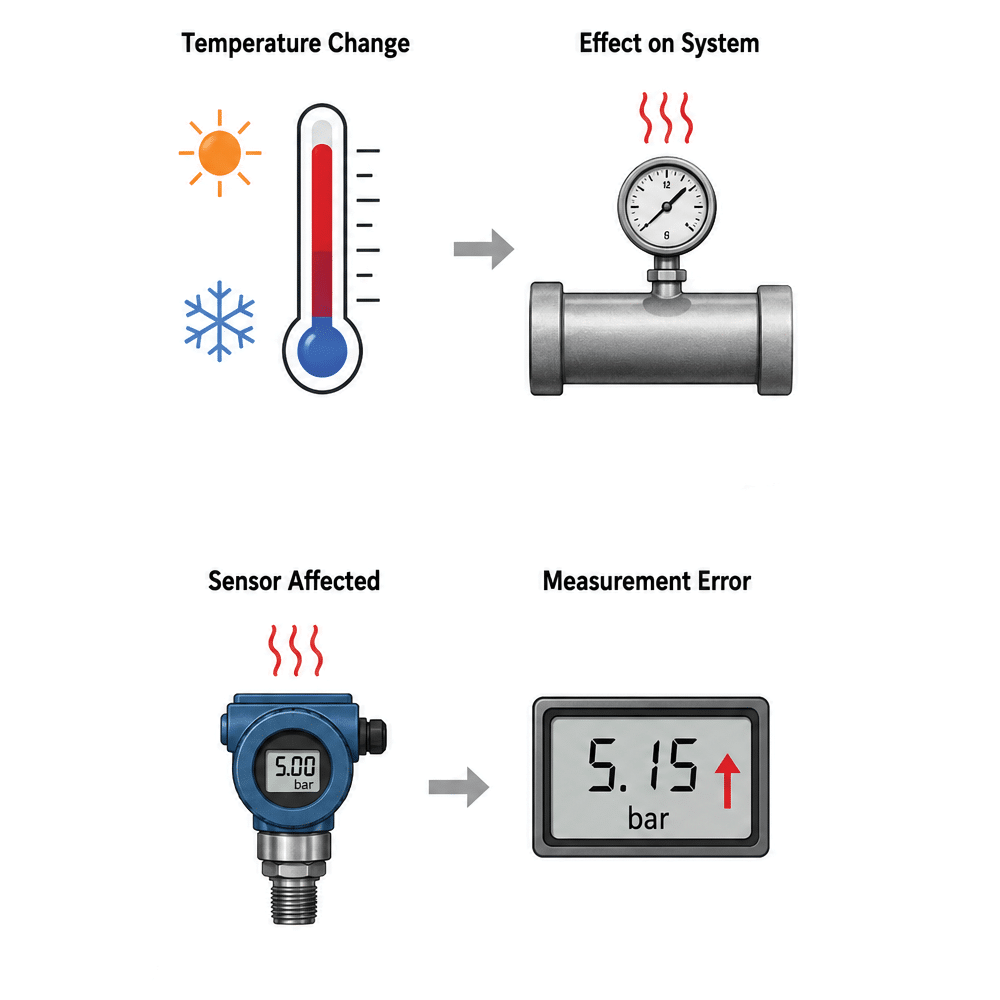
Protect measurement integrity. Improve control. Avoid costly errors.
Why Temperature Matters
Pressure instruments are calibrated under specific temperature conditions. When process or ambient temperatures shift, sensor behavior changes—introducing measurement drift, reduced accuracy, and potential control issues.
Key Temperature Effects on Pressure Measurement
- Sensor Drift
Most pressure sensors (strain gauge, piezoresistive, capacitive) are sensitive to temperature. As temperature rises or falls, internal components expand or contract, causing output signals to shift—even if actual pressure remains constant.
Impact: Inaccurate readings, especially in processes with wide temperature swings.
- Zero and Span Shift
Temperature changes can affect:
- Zero (offset): The baseline reading when no pressure is applied
- Span (sensitivity): The scaling of output across the measurement range
Impact: Misleading readings across the full range—not just at a single point.
- Fluid Property Changes
Temperature alters fluid characteristics such as density and viscosity.
- Liquids expand with heat, affecting static pressure
- Gases follow temperature-pressure relationships (e.g., ideal gas behavior)
Impact: Apparent pressure changes that reflect temperature—not actual system performance.
- Mechanical Stress on Components
Thermal expansion and contraction in piping, impulse lines, and mounting hardware can introduce mechanical strain on sensors.
Impact: False readings or long-term sensor damage.
- Electronics Performance Degradation
Extreme temperatures can affect internal electronics, including signal processing and output stability.
Impact: Increased noise, reduced reliability, or complete failure.
How to Minimize Temperature-Related Errors
Use Temperature-Compensated Transmitters
Modern instruments include built-in compensation to correct for thermal effects.
Install Proper Isolation
- Use impulse lines, siphons, or cooling elements for high-temperature processes
- Protect sensors from direct heat exposure
Calibrate at Operating Conditions
Whenever possible, calibrate instruments at or near actual process temperatures.
Select the Right Sensor Technology
Different sensor types perform better under specific temperature ranges—match the technology to the application.
Monitor Ambient Conditions
Avoid placing transmitters in areas with extreme or fluctuating temperatures.
Best Practices
- Verify operating temperature ranges during specification
- Account for both process and ambient temperature effects
- Include temperature considerations in maintenance and calibration schedules
- Review manufacturer compensation curves and accuracy specs
Temperature is one of the most common—and overlooked—sources of pressure measurement error. Addressing it upfront ensures accurate data, stable control, and long-term reliability.