
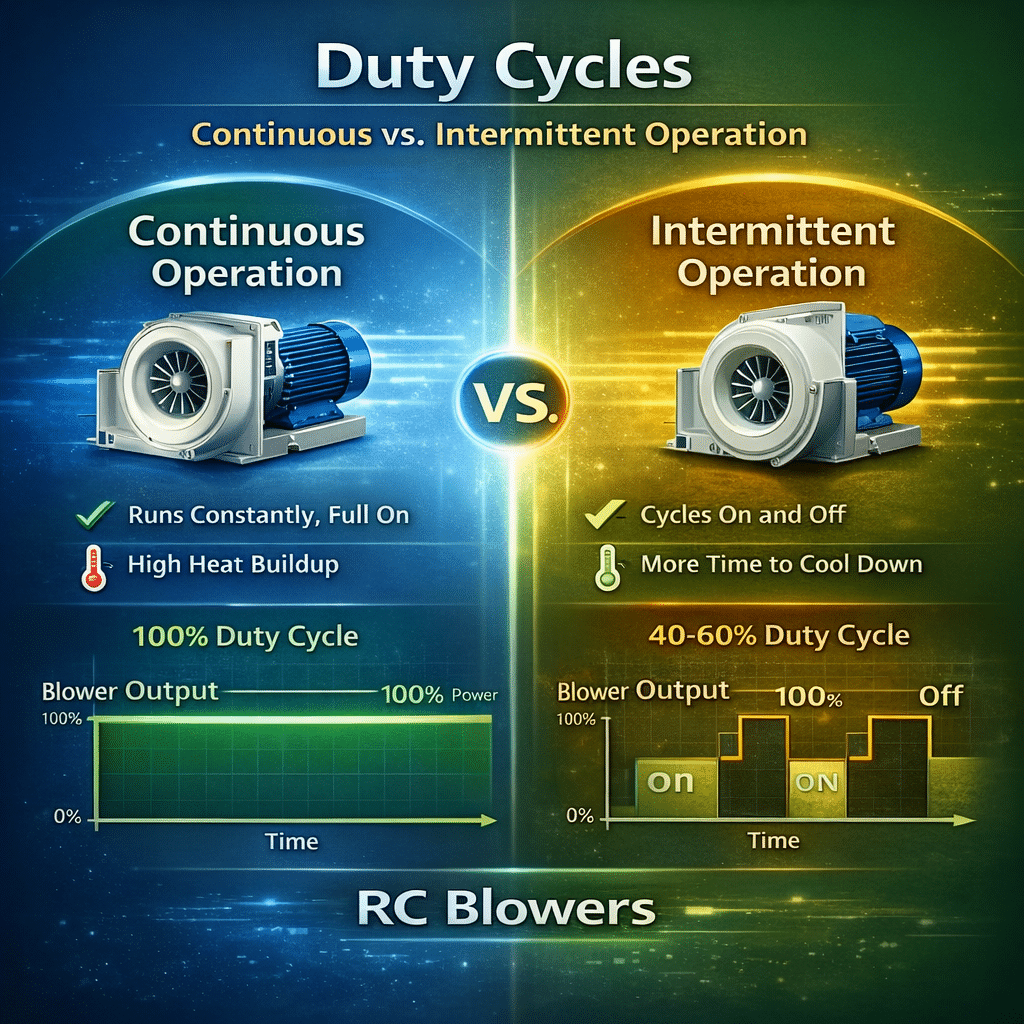
Selecting the right regenerative (side-channel) blower isn’t just about airflow and pressure—it’s also about how the blower is expected to operate over time. One of the most important (and often misunderstood) considerations is duty cycle.
Understanding whether your application requires continuous or intermittent operation can mean the difference between long-term reliability and premature equipment failure.
What Is a Duty Cycle?
A duty cycle defines how long a blower runs versus how long it rests within a given time period.
- Continuous Duty (100%) → Runs non-stop
- Intermittent Duty → Runs in cycles (on/off periods)
For RC blowers, duty cycle directly impacts:
- Heat generation
- Motor life
- Performance stability
- Maintenance requirements
Continuous Duty Operation (100%)
What It Means
The blower operates 24/7 without stopping, often under steady load conditions.
Typical Applications
- Wastewater aeration systems
- Pneumatic conveying
- Continuous drying processes
- Central vacuum systems
Key Considerations
- Heat Management
Continuous operation generates constant heat. RC blowers must be designed with:
- Efficient cooling (air-cooled designs)
- Adequate ventilation
- Proper ambient temperature conditions
- Motor Rating
Motors must be rated for continuous duty (S1) to avoid overheating and insulation breakdown.
- Reliability and Longevity
Well-matched continuous-duty blowers offer:
- Stable performance
- Longer service life
- Reduced downtime
If your process never stops, your blower must be built to run without interruption.
Intermittent Duty Operation
What It Means
The blower runs in cycles, alternating between operation and rest.
Example:
- Run for 2 minutes → Off for 3 minutes → Repeat
Typical Applications
- Packaging and pick-and-place systems
- Vacuum lifting
- Batch processing
- Medical or laboratory equipment
Key Considerations
- Start/Stop Frequency
Frequent cycling can:
- Increase electrical stress
- Cause mechanical wear
- Impact bearing life
- Inrush Current
Each startup draws higher current, which can:
- Affect electrical systems
- Require proper motor protection
- Thermal Recovery
Off periods allow the blower to cool, which can:
- Extend lifespan (if properly managed)
- Prevent overheating in high-load scenarios
Intermittent duty can be efficient—but only when the blower is designed for it.
Continuous vs. Intermittent: Key Differences
|
Factor |
Continuous Duty |
Intermittent Duty |
|
Operation |
Non-stop |
On/off cycles |
|
Heat |
Constant buildup |
Cycles of heating/cooling |
|
Wear |
Steady |
Increased from cycling |
|
Motor Rating |
Continuous (S1) |
Often S3 or similar |
|
Best For |
Stable, ongoing processes |
Variable or batch processes |
Why Duty Cycle Matters for RC Blowers
- Preventing Overheating
RC blowers are compact and efficient—but they rely heavily on airflow for cooling.
- Continuous overload → overheating
- Incorrect duty cycle → reduced lifespan
- Ensuring Proper Sizing
A blower sized only for peak demand—but used continuously—can fail prematurely.
- Continuous applications require derating safety margins
- Intermittent applications may allow higher short-term loads
- Optimizing Energy Efficiency
- Continuous systems benefit from stable, optimized operation
- Intermittent systems may benefit from:
- Controls
- Timers
- VFD integration (in some cases)
- Reducing Maintenance Costs
Mismatch between duty cycle and blower design leads to:
- Frequent repairs
- Bearing failures
- Motor burnout
Proper alignment reduces:
- Downtime
- Maintenance intervals
- Total cost of ownership
Common Mistakes to Avoid
- Assuming all blowers are continuous duty
(Not all are designed for 24/7 operation)
- Ignoring ambient temperature
(Higher temps reduce allowable duty cycle)
- Overlooking start/stop frequency
(Critical for intermittent applications)
- Running intermittent-duty blowers continuously
(A fast track to failure)
Best Practices for Selecting RC Blowers
- Define your duty cycle clearly
(Run time vs rest time)
- Match motor rating to application
(S1 for continuous, S3/S6 for intermittent)
- Consider thermal limits
(Cooling, airflow, environment)
- Evaluate control strategies
(Timers, sensors, or VFDs where appropriate)
- Build in safety margins
(Especially for continuous operation)
Bringing It All Together
Duty cycle isn’t just a specification—it’s a critical factor that determines how your RC blower performs over time.
- Continuous duty ensures stable, long-term operation for always-on processes
- Intermittent duty supports flexibility and efficiency in cyclic applications
Final Thought
The right blower isn’t just about what it does—it’s about how long and how often it does it.
Match the duty cycle to the application, and you’ll maximize performance, efficiency, and equipment life.