Uninterruptible Power Supply (UPS) systems are essential for protecting critical loads—from data centers and healthcare facilities to industrial automation and control systems. But beyond backup power, UPS systems can also play a key role in power quality, particularly when it comes to harmonics.
Understanding how UPS systems interact with harmonics—and how to evaluate THDi (Total Harmonic Distortion of Current) and THDv (Total Harmonic Distortion of Voltage)—is critical for designing reliable, efficient electrical systems.
What Are Harmonics?
Harmonics are distortions in electrical waveforms caused by non-linear loads. Instead of a smooth sine wave, the current or voltage waveform becomes distorted.
Common sources include:
- Variable Frequency Drives (VFDs)
- Switch-mode power supplies
- LED lighting
- UPS systems themselves
These distortions can lead to:
- Overheating of equipment
- Increased losses
- Nuisance tripping
- Reduced equipment lifespan
Visualizing Harmonics
A pure sine wave represents ideal power. Harmonics introduce additional frequencies (multiples of the fundamental frequency), distorting the waveform.
What Is THDi vs. THDv?
THDi (Total Harmonic Distortion – Current)
- Measures distortion in current waveform
- Expressed as a percentage of the fundamental current
Indicates how much harmonic current a device injects into the system
THDv (Total Harmonic Distortion – Voltage)
- Measures distortion in voltage waveform
- Expressed as a percentage of the fundamental voltage
Reflects the impact of harmonic currents on system voltage
Key Relationship
- Non-linear loads → create harmonic currents (THDi)
- System impedance → converts THDi into voltage distortion (THDv)
High THDi can lead to high THDv, depending on the system.
Why Harmonics Matter in UPS Systems
UPS systems can both:
- Generate harmonics (especially older or less advanced designs)
- Mitigate harmonics (with modern technologies)
Risks of Poor Harmonic Performance
- Overheating of transformers and cables
- Reduced generator compatibility
- Interference with sensitive equipment
- Lower overall system efficiency
Modern UPS Harmonic Mitigation Techniques
- Active Front End (AFE) Rectifiers
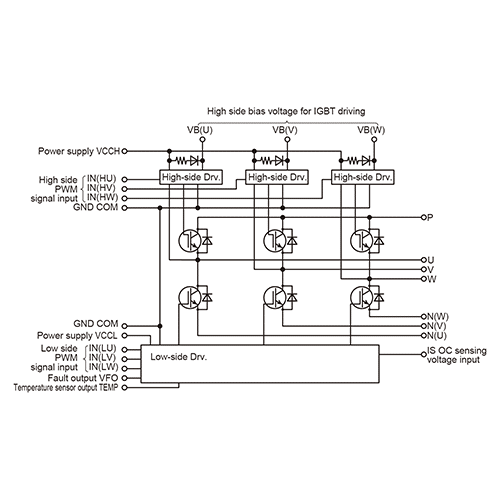
- Uses IGBT-based converters
- Draws near-sinusoidal input current
- Achieves very low THDi (often < 3%)
One of the most effective harmonic mitigation solutions
- Passive Harmonic Filters
- Uses inductors and capacitors
- Reduces harmonic distortion at specific frequencies
Pros:
- Cost-effective
- Simple design
Cons:
- Less flexible
- Larger footprint
- Multi-Pulse Rectifiers (12-pulse, 18-pulse)
- Uses phase-shifting transformers
- Cancels out certain harmonic components
Typical performance:
- 12-pulse: ~10–12% THDi
- 18-pulse: ~5–8% THDi
- Active Harmonic Filters (External)
- Dynamically injects counter-harmonics
- Can be used system-wide (not just UPS)
Typical THDi and THDv Targets
|
Parameter |
Recommended Range |
|
THDi (UPS input) |
< 5% (modern systems) |
|
THDv (system voltage) |
< 5% (per IEEE 519 guidelines) |
Staying within these limits ensures:
- Compliance with standards
- Reliable system operation
- Protection of connected equipment
Real-World Impact
- Generator Compatibility
High THDi can cause:
- Generator overheating
- Voltage instability
- Poor performance
Low-THDi UPS systems improve generator sizing and stability.
- Energy Efficiency
Harmonics increase:
- Resistive losses
- Heat generation
Reducing harmonics improves:
- Overall system efficiency
- Operating costs
- Equipment Lifespan
Lower harmonic distortion:
- Reduces thermal stress
- Minimizes insulation damage
- Extends equipment life
- System Reliability
Clean power ensures:
- Stable operation of sensitive electronics
- Fewer unexpected failures
- Reduced downtime
Common Mistakes to Avoid
- Focusing only on THDv and ignoring THDi
(Both are important and interconnected)
- Assuming all UPS systems have low harmonics
(Older designs can have high THDi)
- Ignoring upstream/downstream impacts
(Harmonics affect the entire system)
- Not considering generator interaction
(Critical for backup systems)
How to Choose the Right UPS for Harmonic Performance
Ask these key questions:
- What is the UPS input THDi rating?
- Does it use an AFE rectifier or multi-pulse design?
- Will it operate with a generator?
- What are the system THDv requirements?
- Is additional filtering needed?
Bringing It All Together
Harmonics are a critical—but often underestimated—aspect of UPS system design.
- THDi tells you how much distortion your UPS introduces
- THDv tells you how that distortion affects your system
Modern UPS technologies, especially those with active front ends, can significantly reduce harmonic impact—improving efficiency, reliability, and compliance.
Final Thought
In today’s power-sensitive environments, it’s not just about keeping the lights on—it’s about keeping the power clean.
Understanding and managing harmonics ensures your UPS system not only protects your load—but enhances the entire electrical system.